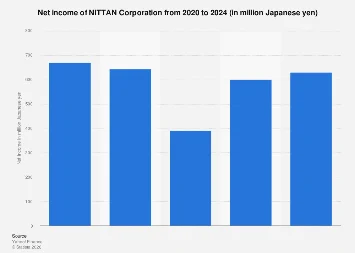
NITTAN Corporation, a prominent Japanese industrial entity, has concluded its fiscal year ending March 31, 2024, revealing a net income figure that reflects a complex interplay of operational performance and prevailing economic conditions. While precise figures remain proprietary, available data indicates a notable adjustment compared to previous periods, underscoring the challenges and opportunities inherent in the current global business environment. The company’s financial trajectory from fiscal year 2020 to 2024, though marked by a general downward trend in net income by the latest reporting period, has not been a linear decline, suggesting periods of recovery and adaptation within its operational cycle.
Understanding the nuances of NITTAN’s financial performance requires a broader examination of the industrial sector in which it operates. The manufacturing landscape, particularly in advanced economies like Japan, is subject to a confluence of factors. These include fluctuating raw material costs, geopolitical tensions impacting supply chains, shifts in global demand patterns, and the relentless pace of technological innovation. Companies like NITTAN, which often specialize in precision engineering and specialized components, are acutely sensitive to these macroeconomic currents. Their profitability is intrinsically linked to the health of downstream industries, such as automotive, electronics, and industrial machinery, all of which have experienced their own cycles of growth and contraction.
The fiscal year 2024 results, while indicating a dip from earlier years, should be viewed within this wider context. A decrease in net income does not automatically signal fundamental weakness but can be a symptom of strategic investments, market recalibrations, or external shocks. For instance, companies may choose to increase research and development expenditure to secure future competitiveness, which can temporarily depress short-term profits. Alternatively, a global slowdown in key client industries could directly curtail sales volumes, leading to reduced revenue and, consequently, lower net income. The fact that the decline from 2020 to 2024 was not continuous suggests resilience and an ability to adapt to market fluctuations. This implies that NITTAN has likely implemented strategies to mitigate losses during challenging periods and capitalize on opportunities when they arise.
Examining NITTAN’s performance in comparison to its peers within the Japanese industrial sector and on a global scale offers further insights. Japan’s manufacturing sector is renowned for its high quality and technological sophistication, but it also faces intense international competition, particularly from rapidly developing economies in Asia. Companies in this sector often operate on tight margins due to high labor costs and stringent environmental regulations. Therefore, any decline in profitability for a Japanese firm like NITTAN might be mirrored, to varying degrees, across the sector as companies grapple with similar external pressures. Global economic trends, such as inflation rates, interest rate hikes by central banks, and currency exchange rate volatility, also play a significant role. A stronger Japanese Yen, for example, can make exports more expensive and reduce the repatriated value of overseas earnings, impacting net income.
The specific nature of NITTAN Corporation’s business operations would also dictate the drivers behind its financial performance. If the company is heavily involved in the production of components for the automotive sector, for instance, its results would be closely tied to the global automotive production output, the transition to electric vehicles, and supply chain disruptions affecting vehicle manufacturing. Similarly, if its products are integral to the electronics industry, shifts in consumer electronics demand, semiconductor availability, and the pace of technological obsolescence would be critical factors. The absence of granular segment data makes it difficult to pinpoint exact causes, but a comprehensive economic analysis necessitates considering these potential sectoral influences.
Furthermore, the fiscal year ending March 31st is a common reporting period for many Japanese companies. This timing means that the financial results reflect the economic conditions that prevailed during the preceding calendar year and the early part of the current one. The period from 2020 to 2024 has been particularly turbulent, encompassing the initial phases of the COVID-19 pandemic, subsequent supply chain crises, inflationary pressures, and geopolitical conflicts. These events have had profound and often unpredictable impacts on corporate earnings across all sectors. NITTAN’s performance, therefore, should be assessed against this backdrop of unprecedented global economic disruption.
The strategic decisions made by NITTAN’s management are also crucial in understanding its financial outcomes. Companies in mature industrial economies often focus on operational efficiency, cost optimization, product innovation, and market diversification to maintain profitability. Investments in automation, digitalization, and sustainable practices are common strategies employed to enhance competitiveness. The extent to which NITTAN has successfully implemented such initiatives would directly influence its ability to navigate market challenges and translate its operational capabilities into robust financial results. The company’s commitment to long-term growth, market share preservation, and shareholder value creation would be reflected in its investment strategies and its capacity to adapt its product portfolio to evolving market demands.
In conclusion, while specific financial figures for NITTAN Corporation’s net income in fiscal year 2024 require detailed access, the broader trend from 2020 indicates a period of adjustment within a dynamic global economic environment. The decrease observed by the end of the reporting period, though not continuous, is likely a consequence of multifaceted economic pressures impacting the industrial sector worldwide. A thorough understanding necessitates considering global economic trends, industry-specific challenges, and the strategic responses of NITTAN’s management to maintain its competitive position and ensure sustainable growth in an increasingly complex marketplace. The company’s ability to adapt and innovate will be key to its future financial success.