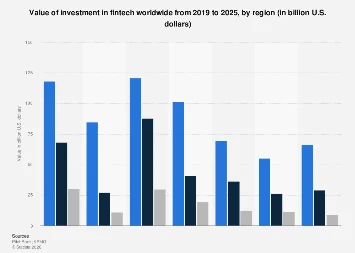
Global investment in financial technology (fintech) companies experienced a significant rebound in 2025, marking the first year of growth since 2021, following a sharp decline in the preceding two years. While the Americas firmly maintained its position as the leading destination for fintech capital, securing an impressive $66.5 billion, the European, Middle Eastern, and African (EMEA) region also witnessed a notable resurgence, attracting $29.3 billion. In contrast, the Asia-Pacific (APAC) region continued to grapple with softening investment activity, garnering $9.3 billion. This divergence in regional performance highlights a complex global economic landscape, with investors selectively re-engaging with the sector after a period of caution.
The recovery, though welcome, did not erase the impact of the downturn that began in early 2022 and persisted through 2023 and 2024. Global fintech funding in 2025, despite a noticeable uptick in the first and fourth quarters, remained substantially below the sector’s peak. For context, the third quarter of 2019 saw an astonishing nearly $145 billion invested globally, a benchmark that 2025’s total, while growing, had not yet approached. This indicates that while confidence is returning, the scale of investment is still recalibrating from the frothy heights of a few years ago. The cumulative effect of this prolonged dip meant that the overall funding levels in 2025 hovered below the $35 billion mark for much of the year, a stark reminder of the market corrections experienced.
However, the narrative of decline is not uniform across all segments of the fintech industry. A closer examination of quarterly trends reveals pockets of resilience and even growth. Certain specialized areas within fintech demonstrated increasing investor appetite, suggesting a strategic shift in capital allocation. Notably, regulatory technology (regtech) and insurance technology (insurtech) emerged as standout performers, experiencing the sharpest increases in investment activity. This suggests that as the financial services industry faces increasingly complex regulatory environments and evolving consumer demands in areas like protection and risk management, solutions that address these specific pain points are attracting significant attention and capital.
The broader venture capital landscape, which underpins a substantial portion of fintech innovation, also played a pivotal role in shaping the 2025 investment scene. Venture capital deals accounted for the largest share of fintech funding, totaling $56.7 billion. This underscores the continued reliance on venture capital for nurturing early-stage and growth-stage fintech companies. While this figure represents a significant inflow, it’s important to contextualize it within the overall investment ecosystem. Mergers and acquisitions (M&A), another crucial component of the fintech market, while still substantial at $55.3 billion, experienced a marked decrease compared to previous years. The $102 billion recorded in M&A activity in 2022 highlights a cooling-off in large-scale consolidation, potentially indicating a greater focus on organic growth and strategic partnerships rather than outright acquisitions. This shift could be attributed to a variety of factors, including more stringent regulatory scrutiny of deals, a reassessment of valuations, or a strategic decision by larger players to build in-house capabilities.
Despite the prevailing economic headwinds and market recalibrations, the fintech sector continues to demonstrate its inherent dynamism and the enduring appeal of financial innovation. Companies at the forefront of this evolution are not only surviving but thriving, serving as powerful indicators of the sector’s long-term potential. For instance, in the United States, a key fintech hub, companies like Stripe continue to command significant valuations. With a reported valuation of $70 billion, Stripe exemplifies the potential for disruptive technologies to reshape established financial paradigms. Such high-profile successes provide crucial validation for the fintech model and can inspire further investment and entrepreneurial activity across the globe. The resilience and innovative spirit of these leading firms suggest that while the path to investment may have become more discerning, the fundamental drivers of fintech growth – efficiency, accessibility, and improved customer experience – remain robust. As the global economy continues to navigate its recovery, the fintech sector is poised to play an increasingly vital role in shaping the future of finance.