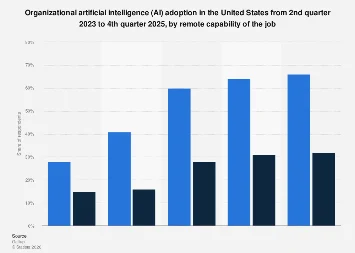
The widespread adoption of artificial intelligence (AI) within the U.S. workforce is set to accelerate significantly through 2025, with a notable trend emerging: AI’s integration is proving more potent and pervasive in roles that offer remote work capabilities. Projections indicate that by the fourth quarter of 2025, a substantial portion of the U.S. workforce engaged in remote-capable jobs will be leveraging AI tools, far outpacing their counterparts in roles that inherently require physical presence. This growing chasm underscores the transformative impact of AI on the modern workplace, particularly as it aligns with the evolving landscape of flexible work arrangements.
While precise figures for the fourth quarter of 2025 remain proprietary until full market access, data from late 2023 and interim projections for 2024 suggest a strong upward trajectory. The trend indicates that AI utilization in remote-capable roles is not just growing, but growing at an accelerated pace. This contrasts with the adoption rates in positions that are not remote-capable, which, while still showing an increase, are not exhibiting the same exponential growth. This divergence points to a strategic alignment between AI technologies and the infrastructure and operational models that support remote work.
The implications of this trend are multifaceted. For businesses, it suggests a potential for enhanced productivity and efficiency gains in their remote workforce, as AI tools can automate tasks, provide data-driven insights, and facilitate seamless collaboration across distributed teams. This can translate into reduced operational costs, improved employee engagement, and a more agile response to market dynamics. Companies that are heavily invested in remote or hybrid work models are likely to see the most immediate and significant returns from AI integration.
Conversely, the slower adoption in non-remote-capable roles might present challenges. These sectors, often including manufacturing, healthcare, and essential services, may need to explore AI applications that are specifically tailored to their on-site environments. This could involve AI-powered robotics, advanced analytics for physical operations, or AI-driven safety and compliance systems. Failing to bridge this AI adoption gap could lead to a widening productivity disparity between different segments of the economy.
Several factors contribute to the higher AI adoption in remote-capable jobs. Firstly, the nature of many remote-friendly roles often involves digital tasks, data analysis, and communication, which are prime areas for AI augmentation. Tools for natural language processing, predictive analytics, and intelligent automation are readily applicable to these functions. Secondly, the established digital infrastructure and comfort with technology among remote workers create a fertile ground for AI integration. Employees who are already accustomed to using various digital tools for collaboration and task management are more likely to embrace AI solutions.
Furthermore, the increasing sophistication of AI-powered collaboration platforms plays a crucial role. These platforms can streamline workflows, manage projects, and facilitate communication, all of which are essential for distributed teams. AI features within these tools can offer intelligent scheduling, automated task assignment, and real-time performance feedback, directly enhancing the productivity of remote employees. The shift towards a more digitally native workforce, accelerated by recent global events, has further normalized the use of advanced technologies in the workplace.
Economically, this trend could reshape the U.S. labor market. The enhanced productivity from AI in remote-capable sectors might lead to higher demand for skilled workers who can leverage these technologies effectively. This could create new job categories and necessitate upskilling initiatives for the existing workforce. Conversely, it might also raise concerns about job displacement in roles where AI can fully automate tasks, though historical patterns suggest that technological advancements often lead to job transformation rather than outright elimination.
The global context is also important. As other developed economies navigate similar shifts in work arrangements and technological adoption, the U.S. experience with AI and remote work could serve as a benchmark. Countries with robust digital infrastructure and progressive labor policies may see comparable or even accelerated adoption rates. Emerging economies, on the other hand, might face a different set of challenges and opportunities, potentially leapfrogging certain stages of AI adoption by focusing on mobile-first and cloud-based solutions tailored to their specific contexts.
Market data from technology research firms consistently show a surge in investment and development in AI solutions designed for enterprise use. This includes AI-powered customer relationship management (CRM) systems, human resources (HR) platforms, and business intelligence tools. The demand for these solutions is directly correlated with the growing recognition of AI’s potential to drive business outcomes. The ability of these tools to integrate seamlessly with existing enterprise software and cloud infrastructure further facilitates their adoption, especially within organizations that have already embraced cloud computing for their remote operations.
Expert insights suggest that the key to maximizing AI’s benefits lies in strategic implementation and a focus on augmenting human capabilities rather than simply replacing them. Companies that foster a culture of continuous learning and provide adequate training will be better positioned to harness the full potential of AI. The ethical considerations surrounding AI, including data privacy, algorithmic bias, and transparency, will also become increasingly critical as adoption grows. Proactive engagement with these issues will be essential for building trust and ensuring responsible AI deployment.
The period between Q2 2023 and Q4 2025 represents a pivotal phase in the integration of AI into the American workplace. The clear divergence in adoption rates between remote-capable and non-remote-capable roles highlights the evolving dynamics of work and technology. As AI continues to mature and become more accessible, its impact will undoubtedly extend beyond these initial trends, shaping the future of industries, economies, and the very nature of work itself. The ongoing narrative will be one of adaptation, innovation, and a continuous quest to leverage intelligent technologies for enhanced productivity and economic growth.