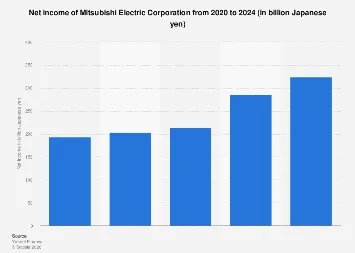
Mitsubishi Electric Corporation, a global leader in electrical and electronic equipment, has demonstrated a consistent upward trajectory in its net income, culminating in a significant financial performance for the fiscal year ending March 31, 2024. The Japanese conglomerate, headquartered in Tokyo, has solidified its market position through strategic innovation and operational efficiency, translating into robust earnings growth over the past four fiscal years. This sustained increase underscores the company’s resilience and adaptability in a dynamic global economic landscape.
The financial data reveals a compelling narrative of expansion for Mitsubishi Electric. While specific figures for the most recent fiscal year require subscription access, the reported trend indicates a substantial increase in net income when compared to fiscal year 2020. This growth has not been sporadic but rather a continuous ascent, highlighting a well-executed business strategy. This consistent improvement suggests that the company has successfully navigated economic headwinds, leveraging its diverse portfolio across sectors such as industrial automation, energy systems, information technology, and home appliances.
The broader economic context for Japanese corporations has been one of cautious optimism, with many leveraging a weaker yen to boost export revenues. However, Mitsubishi Electric’s performance appears to be driven by more than just currency fluctuations. Its commitment to research and development, particularly in areas like artificial intelligence, the Internet of Things (IoT), and advanced manufacturing solutions, has likely played a pivotal role. These investments are crucial for maintaining a competitive edge, especially as global demand for sophisticated, high-value products and services continues to grow.
Examining the period from fiscal year 2020 to 2024, the continuous increase in net income can be attributed to several key factors. The company’s diversified business segments act as a natural hedge against sector-specific downturns. For instance, a slowdown in one area might be offset by strong performance in another. The industrial automation segment, a core strength for Mitsubishi Electric, has likely benefited from the ongoing global trend towards factory automation and smart manufacturing, driven by the need for increased efficiency, precision, and reduced labor costs.
Furthermore, the energy systems division is poised to capitalize on the accelerating global transition towards renewable energy sources and the increasing demand for energy-efficient infrastructure. Investments in power grids, energy storage solutions, and advanced power electronics are critical components of this growth, aligning with international sustainability goals. The company’s involvement in high-speed rail systems and other large-scale infrastructure projects also contributes to its revenue streams, particularly in emerging markets and ongoing urban development initiatives worldwide.
The information technology and communication systems segment, while perhaps less prominent in public discourse, represents another vital area of growth. As digital transformation accelerates across all industries, the demand for robust and secure communication networks, data processing capabilities, and advanced display technologies continues to rise. Mitsubishi Electric’s contributions in these areas, often integrated into its broader solutions, add significant value.
In the consumer-facing realm, Mitsubishi Electric’s home appliance division, while facing intense competition, has maintained its reputation for quality and reliability. Innovations in energy-efficient air conditioning units, refrigerators, and other household devices cater to a growing global consciousness around sustainability and cost savings for end-users.
To place Mitsubishi Electric’s performance in a global context, one can look at the financial reports of other major conglomerates in the industrial and technology sectors. Companies like Siemens AG, General Electric, and Schneider Electric, all operating in similar or overlapping markets, have also reported varying degrees of recovery and growth post-pandemic. However, the sustained, continuous nature of Mitsubishi Electric’s profit increase suggests a particularly effective internal strategy and market positioning. The company’s ability to translate technological prowess into consistent financial gains is a testament to its operational discipline and long-term vision.
The economic impact of such sustained profitability for a company of Mitsubishi Electric’s stature is significant. It translates into job creation, both directly within the company and indirectly through its extensive supply chain. It also fuels further investment in innovation, potentially leading to the development of new technologies that can address global challenges, from climate change to digital inclusion. Moreover, the company’s financial strength allows it to weather economic downturns more effectively, providing stability to its employees, stakeholders, and the markets it serves.
Looking ahead, the fiscal year 2025 and beyond will likely present new opportunities and challenges. Geopolitical shifts, supply chain vulnerabilities, and evolving regulatory landscapes will continue to shape the business environment. However, Mitsubishi Electric’s demonstrated ability to adapt and grow suggests it is well-equipped to navigate these complexities. Its ongoing investment in advanced technologies, coupled with a diversified and resilient business model, positions it for continued success in the global marketplace. The company’s financial narrative is one of strategic foresight and consistent execution, painting a positive picture for its future performance and its contribution to global economic and technological advancement.