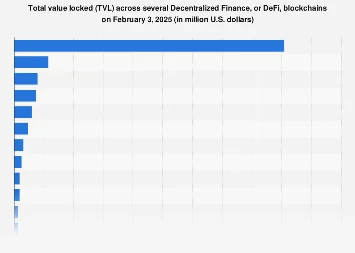
The decentralized finance (DeFi) landscape is poised for continued growth and evolution, with Ethereum expected to maintain its dominant position in terms of total value locked (TVL) across various blockchains by September 5, 2025. TVL, a crucial metric for assessing the overall market size and adoption of DeFi protocols, reflects the aggregate value of assets deposited into smart contracts for lending, borrowing, staking, and other financial activities. As of late 2025, Ethereum’s TVL is projected to dwarf that of its competitors, underscoring its foundational role in the burgeoning DeFi ecosystem.
The year 2021 marked a significant inflection point for the DeFi market, witnessing an unprecedented surge in its overall size. This expansion was intrinsically linked to the performance and capabilities of Ethereum, the primary blockchain network powering the majority of DeFi transactions. Consequently, fluctuations in the price of Ether (ETH), Ethereum’s native cryptocurrency, have a pronounced impact on the reported TVL. For instance, a sharp overnight price drop in ETH on September 10, 2021, resulted in a substantial decrease of billions of U.S. dollars in Ethereum’s TVL, illustrating the sensitivity of this metric to underlying asset valuations.
While Ethereum’s supremacy is evident, the broader DeFi ecosystem is becoming increasingly multi-chain. Several other prominent blockchains are actively developing and attracting significant liquidity, each vying for a larger share of the DeFi market. These include platforms like Binance Smart Chain (now BNB Chain), Solana, Polygon, Avalanche, and Cardano, among others. These alternative blockchains often offer distinct advantages, such as lower transaction fees, faster transaction speeds, or specialized functionalities, which appeal to different segments of users and developers.
The competition among these blockchains is not merely about attracting individual users but also about fostering vibrant ecosystems of decentralized applications (dApps). The TVL on a particular blockchain is a strong indicator of the health and activity of its dApp ecosystem. A higher TVL suggests greater user confidence, more robust protocol development, and a larger pool of capital being deployed for financial innovation. This, in turn, attracts more developers, leading to a virtuous cycle of growth.
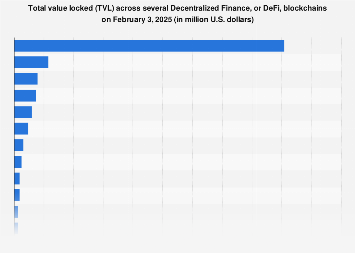
Analyzing the projected TVL by September 5, 2025, provides a forward-looking perspective on the competitive dynamics within the DeFi space. While specific, precise figures for all blockchains are proprietary and require access to premium data services, industry analysis and projections consistently point to Ethereum’s continued leadership. This dominance is attributed to several factors, including its first-mover advantage, its extensive developer community, the sheer number and maturity of its dApps, and the network effects it has cultivated over years of operation. Ethereum’s smart contract capabilities are the most sophisticated, supporting a wide array of complex financial instruments and protocols.
However, the growth of alternative Layer 1 blockchains and Layer 2 scaling solutions is undeniable. These platforms are making significant inroads by addressing some of Ethereum’s perceived limitations, particularly in terms of scalability and cost. For example, BNB Chain, leveraging its integration with the Binance exchange ecosystem, has captured a substantial portion of DeFi users seeking lower fees. Solana, with its high-throughput architecture, has attracted projects requiring rapid transaction finality. Polygon has emerged as a leading Layer 2 scaling solution for Ethereum, offering a more affordable and faster environment for dApps while remaining interconnected with the Ethereum mainnet.
The economic impact of DeFi’s growth is multifaceted. It represents a paradigm shift in financial services, offering greater accessibility, transparency, and efficiency compared to traditional finance (TradFi). DeFi protocols enable peer-to-peer lending and borrowing without intermediaries, offer decentralized exchanges for trading digital assets, provide automated market makers for liquidity provision, and facilitate innovative financial products like yield farming and decentralized insurance. The capital locked within these protocols represents significant economic activity, driving innovation, job creation within the blockchain and crypto industries, and potentially offering new avenues for wealth generation and financial inclusion globally.
The projected dominance of Ethereum in TVL by 2025 does not preclude substantial growth for other blockchains. Instead, it suggests a future where the DeFi market is characterized by a dominant platform alongside a thriving ecosystem of specialized and competing networks. The interconnectedness of these blockchains through cross-chain bridges and interoperability solutions will also be a critical factor in the overall market’s expansion. As the DeFi space matures, the focus will likely shift not only to the total value locked but also to the actual utility, user experience, and the real-world problems that these decentralized applications are solving.
The volatility inherent in the cryptocurrency market means that projections for TVL are subject to change. However, the underlying trend towards increased adoption and innovation in decentralized finance remains strong. By 2025, the DeFi landscape is expected to be more sophisticated, with a wider range of financial products and services available to a global user base. The competition among blockchains will continue to drive technological advancements and push the boundaries of what is possible in decentralized finance, with Ethereum likely remaining at the forefront, albeit in an increasingly competitive and multi-faceted ecosystem. The ongoing development of scaling solutions for Ethereum, such as sharding and improved consensus mechanisms, will also play a crucial role in its ability to maintain its leading position and accommodate the exponential growth anticipated in the coming years.