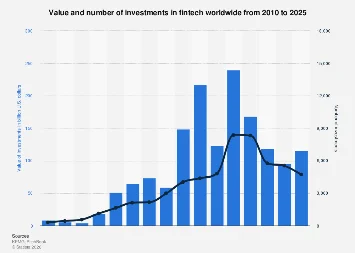
Global investment activity in the financial technology (fintech) sector has undergone a period of dramatic fluctuations, marked by unprecedented growth, a sharp downturn, and a subsequent, albeit uneven, recovery. Between 2010 and 2019, the industry experienced a sustained surge, culminating in a peak investment volume of approximately $216.8 billion USD. This decade-long ascent underscored the burgeoning potential of technology to reshape financial services, attracting significant capital from venture capitalists, private equity firms, and corporate investors alike. However, the optimistic trajectory encountered a significant disruption in 2020, with global investments plummeting to below $123.3 billion USD, a stark reflection of the economic uncertainty triggered by the COVID-19 pandemic and its widespread impact on market sentiment and capital allocation.
The fintech sector demonstrated remarkable resilience, staging a robust recovery in 2021. Investment levels surged dramatically, surpassing the previous peak to exceed $239.7 billion USD. This resurgence was fueled by several factors, including accelerated digital adoption across industries, a growing demand for innovative financial solutions, and a renewed investor confidence in the long-term prospects of technology-driven financial services. Yet, the euphoria of this 2021 peak proved to be short-lived. The subsequent years witnessed a considerable recalibration in investor appetite. By 2024, fintech investment levels had declined significantly, reaching their lowest point since 2017, with a recorded investment value of approximately $95.5 billion USD. This downturn can be attributed to a confluence of macroeconomic headwinds, including rising interest rates, inflationary pressures, and geopolitical instability, which collectively dampened risk appetites and led to more stringent valuation assessments for technology companies.
Despite these significant oscillations, a consistent trend has emerged throughout this dynamic period: the Americas have consistently commanded the lion’s share of global fintech investments. Representing over half of the total global investment volume, the region has solidified its position as the preeminent hub for financial technology innovation and capital deployment. This dominance is not merely a statistical anomaly but a testament to a sophisticated financial ecosystem, a culture of entrepreneurship, and a robust regulatory framework conducive to the growth of disruptive technologies.
The term "fintech" itself encapsulates a broad spectrum of innovative startups and established companies that leverage cutting-edge technology to reimagine and deliver financial services. These entities are instrumental in developing digitally enhanced products and platforms, thereby democratizing access to financial services. By optimizing operational efficiencies and reducing overheads, fintech firms are often able to offer their solutions at a lower cost compared to traditional financial institutions. Their innovations span a wide array of applications, including digital payments, lending, wealth management, insurance, and blockchain technology, collectively enhancing the efficiency, accessibility, and overall user experience of financial operations for millions worldwide.
As of early 2025, North America, specifically the United States and Canada, continues to lead the global fintech landscape by a considerable margin. The region is home to over 12,000 fintech businesses, a figure that underscores its unparalleled concentration of talent, capital, and innovative ventures. This vibrant ecosystem has cultivated a fertile ground for the emergence of influential players and groundbreaking technologies, solidifying its status as the world’s premier engine for financial technology advancement.
Within this burgeoning North American market, the landscape of "fintech unicorns" – privately held startups valued at over $1 billion USD – is particularly noteworthy. In early 2025, Stripe, a San Francisco-based company specializing in payment processing services, stood as the undisputed leader in the U.S. fintech unicorn sector. Its valuation of approximately $70 billion USD positioned it as the most valuable fintech unicorn in the United States, a testament to its dominant role in facilitating online commerce and digital transactions. Stripe’s innovative infrastructure has become indispensable for a vast array of businesses, from small startups to multinational corporations, enabling them to accept payments, manage subscriptions, and handle other financial operations with remarkable ease and scalability.
Following closely behind Stripe in terms of valuation was Chime, another significant force within the U.S. fintech arena. Valued at an impressive $25 billion USD, Chime has carved out a substantial niche by offering a suite of digital banking services, including checking accounts, savings accounts, and credit-building tools, all designed to be more accessible and user-friendly than traditional banking options. The company’s success is largely attributed to its focus on providing fee-free banking and its innovative approach to financial inclusion, attracting a significant customer base seeking alternatives to conventional financial institutions.
The sustained leadership of the Americas in fintech investment can be analyzed through several lenses. Firstly, the presence of deep capital markets and a mature venture capital industry provides the necessary funding for nascent fintech companies to scale and innovate. Secondly, a receptive consumer base, increasingly comfortable with digital solutions and demanding greater convenience and transparency in financial services, has created a strong market pull for fintech offerings. Furthermore, regulatory environments in countries like the United States, while evolving, have generally been more permissive of experimentation and innovation compared to some other regions, allowing fintech firms to rapidly develop and deploy new products.
Globally, the fintech sector continues to mature, with investors now scrutinizing business models more closely and seeking sustainable, profitable growth rather than solely focusing on rapid user acquisition. While investment levels may have moderated from their 2021 peak, the underlying demand for innovative financial solutions remains robust. Emerging markets, in particular, present significant opportunities for fintech adoption, as large unbanked and underbanked populations stand to benefit immensely from mobile-first financial services. This presents a compelling long-term growth narrative for the sector, even amidst the current recalibration of investment flows. The ongoing evolution of artificial intelligence, blockchain, and other emerging technologies will undoubtedly continue to shape the fintech landscape, promising further disruption and innovation in the years to come. The ability of companies to navigate regulatory complexities, demonstrate clear value propositions, and achieve sustainable profitability will be key determinants of success in this ever-evolving industry.