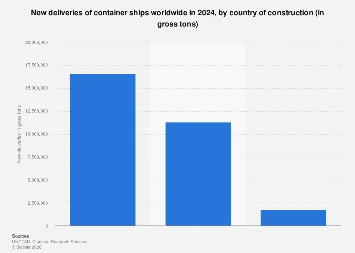
The global landscape of container ship construction is undergoing a significant transformation in 2024, with key shipbuilding nations vying for dominance in an industry critical to international trade. While specific, granular data on order books by country is often proprietary and subject to market dynamics, prevailing trends and industry analyses point to a concentrated manufacturing base, with East Asian economies continuing to lead the charge. South Korea, China, and Japan remain the undisputed titans in the construction of large, technologically advanced container vessels, which form the backbone of global supply chains.
The sheer scale of containerized shipping means that fluctuations in shipbuilding orders have profound implications for global economic activity, trade flow efficiency, and the maritime industry’s environmental footprint. As of early 2024, the order books for new container ships reflect a complex interplay of factors, including anticipated trade growth, evolving vessel design requirements driven by decarbonization efforts, and the strategic positioning of national shipyards.
South Korea, historically a powerhouse in high-value shipbuilding, continues to secure a substantial share of orders for ultra-large container vessels (ULCVs) and those equipped with advanced technologies, including those designed for future alternative fuels. Its shipyards are renowned for their technical expertise, precision engineering, and ability to deliver complex, specialized vessels on time. The country’s major players, such as Hyundai Heavy Industries Group and Samsung Heavy Industries, are at the forefront of developing and constructing vessels that meet stringent environmental regulations and offer enhanced cargo capacity. These ULCVs, often exceeding 23,000 TEU (Twenty-foot Equivalent Unit) capacity, are crucial for optimizing economies of scale on major trade lanes. Industry reports indicate that South Korean yards are particularly competitive in securing orders for the latest generation of dual-fuel vessels capable of running on LNG and increasingly, methanol, signaling a commitment to future-proofing their order books against a backdrop of tightening emissions standards.
China, however, has rapidly ascended to become the world’s largest shipbuilding nation by volume and is a formidable competitor in the container ship segment. Chinese shipbuilders, including giants like China State Shipbuilding Corporation (CSSC) and China Merchants Heavy Industry, have made significant strides in both capacity and technological sophistication. They are not only capable of producing a vast number of standard container vessels but are also increasingly venturing into more complex and larger ship designs. China’s competitive pricing, coupled with substantial government support and a burgeoning domestic shipping industry, has allowed it to capture a significant portion of global orders. In 2024, Chinese yards are expected to continue their strong performance, particularly in the mid-sized to large container ship categories, and are actively investing in research and development for greener shipping technologies to challenge South Korea’s dominance in the premium segment.
Japan, while perhaps not possessing the sheer volume of China or the specialized technological edge of South Korea in all segments, remains a critical player in the global shipbuilding arena. Japanese shipyards, represented by companies like Imabari Shipbuilding and Japan Marine United, are known for their high-quality construction, reliability, and focus on innovation, particularly in areas related to energy efficiency and vessel safety. They often secure orders for medium-sized container vessels and specialized carriers, catering to specific market niches and maintaining a strong reputation for durability and long-term operational performance. Their contribution to the global fleet, though less voluminous than their East Asian counterparts, is significant in terms of fleet modernization and the adoption of new technologies.
The global order book for container ships is a dynamic indicator of future trade patterns and the shipping industry’s capacity. As of early 2024, analysts suggest a continued strong demand for new vessels, driven by the need to replace older, less efficient tonnage and to accommodate projected increases in global trade volumes. However, the pace of new orders is also influenced by macroeconomic uncertainties, geopolitical tensions, and the ongoing evolution of environmental regulations. The International Maritime Organization’s (IMO) ambitious decarbonization targets, for instance, are prompting a significant shift towards vessels powered by cleaner fuels. This has led to an increasing proportion of new builds being ordered with dual-fuel capabilities, a trend that is reshaping the competitive landscape among shipbuilders, favoring those with the technological prowess to deliver these complex solutions.
The economic impact of container ship construction is substantial, creating thousands of high-skilled jobs in the shipbuilding and associated industries, including component manufacturing, engineering, and logistics. The export revenues generated by these large capital-intensive projects also contribute significantly to the national economies of the shipbuilding nations. Furthermore, the availability of modern, efficient container vessels is crucial for the smooth functioning of global supply chains, directly impacting the cost and reliability of international trade for businesses worldwide. Countries that lead in shipbuilding therefore exert considerable influence over the efficiency and cost-effectiveness of global commerce.
Global comparisons reveal that while other nations have shipbuilding capabilities, they are largely focused on different segments of the maritime market or have a more limited capacity for constructing the large, sophisticated container vessels that dominate international trade. European shipyards, for example, have historically specialized in cruise ships, ferries, and offshore vessels, while North American shipyards often focus on naval vessels and specialized commercial craft. This leaves the ULCV and large container ship market primarily in the hands of East Asian conglomerates.
The ongoing investments in research and development, particularly in areas of sustainable shipping technologies such as ammonia and hydrogen propulsion, are likely to further consolidate the leading positions of South Korea and China, as they are heavily investing in these future-oriented technologies. Japan, with its strong focus on incremental innovation and quality, is also expected to play a vital role in the transition to a greener maritime sector. The coming years will undoubtedly see continued competition among these shipbuilding powerhouses, shaping not only the future of shipping but also the very fabric of global trade. The dominance in container ship construction in 2024, therefore, is not merely about building ships; it is about positioning for a future of international commerce that is increasingly complex, environmentally conscious, and technologically driven.