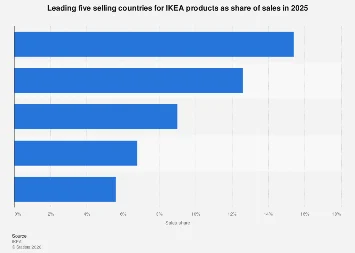
In the fiscal year 2025, Germany emerged as IKEA’s paramount market, generating 15.4 percent of the global sales revenue for the renowned home furnishing giant. Close on its heels, the United States secured the second position, contributing 12.6 percent to the company’s overall sales figures. These figures underscore the continued dominance of these two established economies in driving IKEA’s international expansion and financial performance, offering a crucial lens through which to view the broader trends in global retail and consumer spending on home goods.
Founded in 1943, IKEA has evolved from a modest mail-order business into the undisputed world leader in furniture retail. Its distinctive Scandinavian design aesthetic, coupled with its pioneering flat-pack furniture model, has become synonymous with affordable, stylish, and functional home solutions. This innovative approach to product design and distribution has been instrumental in IKEA’s rapid ascent, enabling significant cost reductions in manufacturing, packaging, and transportation. By requiring consumers to assemble their purchases, IKEA effectively shifts a portion of the labor cost, further contributing to its competitive pricing strategy. This model not only democratizes access to well-designed furniture but also fosters a sense of personal engagement with the product for the end-user.
A cornerstone of IKEA’s enduring success lies in its profound understanding of consumer behavior and purchasing motivations. The company invests heavily in market research and data analysis to decipher the intricate factors that influence consumer decisions, from aesthetic preferences and functional needs to budget considerations and lifestyle aspirations. This deep customer insight allows IKEA to meticulously tailor its product offerings, store layouts, and marketing campaigns to resonate with diverse demographics and cultural nuances across its vast global footprint. The unwavering commitment to "low prices" is not merely a marketing slogan but the very bedrock of IKEA’s business philosophy, compelling the company to continuously pursue operational efficiencies and cost-effectiveness in every facet of its operations.
This relentless pursuit of efficiency necessitates a culture of perpetual innovation. IKEA actively explores novel materials that not only contribute to environmental sustainability but also offer cost advantages. This includes research into recycled and bio-based materials, as well as optimizing the use of existing resources. Furthermore, the company consistently re-evaluates and refines its packaging, handling, and transportation logistics. Innovations in these areas, such as modular packaging designs that maximize container space and optimized delivery routes, play a critical role in minimizing waste, reducing carbon emissions, and ultimately keeping product prices accessible to a wider consumer base. This proactive approach to sustainability and cost management is crucial for maintaining a competitive edge in an increasingly price-sensitive global market.
The global recognition of IKEA’s brand strength is further evidenced by its consistent ranking among the world’s most valuable brands. According to the "Brandz Top 100 Most Valuable Global Brands 2025" report compiled by Kantar Millward Brown, IKEA is not only the preeminent furniture retailer brand globally but also ranks as the sixth most valuable retailer overall. Its brand valuation, estimated at approximately 25.7 billion U.S. dollars, reflects the immense trust and loyalty it has cultivated among consumers worldwide. This strong brand equity is a testament to the consistent delivery of value, quality, and design that consumers have come to expect from IKEA.
The sheer scale of IKEA’s operations is staggering, encompassing 604 stores strategically located in major global markets. This extensive retail network ensures accessibility for millions of consumers, facilitating an estimated 915 million customer visits annually. The geographical distribution of these visits and sales provides valuable insights into regional consumer preferences and economic conditions. While Germany and the United States represent the largest revenue generators, other markets are demonstrating significant growth potential, driven by burgeoning middle classes and increasing urbanization. Emerging economies in Asia and Latin America, for instance, are becoming increasingly important for IKEA’s long-term growth strategy, as consumers in these regions embrace modern living standards and seek affordable yet stylish home furnishings.
The economic impact of IKEA’s operations extends far beyond its direct sales figures. The company is a significant employer, creating jobs directly within its retail stores, distribution centers, and administrative offices. Furthermore, its extensive supply chain supports a vast network of suppliers, manufacturers, and logistics providers, stimulating economic activity and fostering innovation within these ancillary industries. The flat-pack model, while efficient for IKEA, also empowers local assembly and logistics partners in various regions, contributing to local economic development.
Analyzing the sales distribution reveals a complex interplay of economic factors, consumer demographics, and market maturity. Germany’s leading position can be attributed to a well-established consumer base with a strong appreciation for quality and design, coupled with IKEA’s long-standing presence and deep market penetration. The country’s robust economy and high disposable incomes provide a fertile ground for furniture retail. The United States, with its vast geographical expanse and diverse population, represents a market of immense potential and significant consumption. IKEA’s strategy in the U.S. has focused on adapting its store formats and product assortments to cater to varied regional preferences and urban density challenges.
Beyond these two giants, other markets are carving out significant shares. Countries in Northern Europe, such as Sweden (IKEA’s home country), the United Kingdom, and the Netherlands, consistently feature among the top performers, reflecting established consumer habits and a strong cultural affinity for IKEA’s brand ethos. In Asia, China has emerged as a rapidly growing market, driven by a massive population, increasing urbanization, and a burgeoning middle class with a growing appetite for Western consumer goods and home décor trends. IKEA’s expansion in China has been characterized by strategic adaptations to local tastes and consumption patterns.
The performance in fiscal year 2025 also highlights the resilience of the home furnishing sector, even amidst global economic fluctuations. While geopolitical events, inflation, and supply chain disruptions can pose challenges, the fundamental human need for comfortable and functional living spaces remains a constant driver of demand. IKEA’s business model, with its emphasis on affordability and efficiency, is particularly well-suited to navigate periods of economic uncertainty, as consumers tend to become more price-conscious.
Looking ahead, IKEA’s future growth will likely depend on its ability to continue innovating in product development, sustainability, and digital engagement. The rise of e-commerce and the increasing importance of online sales channels necessitate a robust digital strategy. IKEA has been investing in its online platforms and exploring new fulfillment models to meet evolving consumer expectations. Furthermore, adapting to the unique demands of emerging markets, understanding local design preferences, and navigating regulatory landscapes will be crucial for sustained expansion. The company’s commitment to its core values of affordability, sustainability, and democratic design, coupled with its data-driven approach to understanding consumers, positions it strongly to maintain its leadership in the global retail landscape for years to come. The sales figures from fiscal year 2025 serve as a strong indicator of its current market standing, while also providing a benchmark for future strategic planning and growth initiatives.