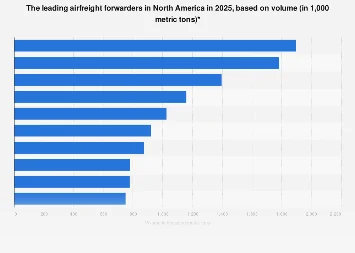
The airfreight sector in North America, a critical artery for global commerce, is currently dominated by a select group of powerful logistics players. In 2025, Swiss multinational K+N emerges as the undisputed leader in the United States, having facilitated the movement of nearly 2.2 million metric tons of air cargo. This impressive volume underscores the company’s extensive network, sophisticated operational capabilities, and deep understanding of the intricate demands of air transportation. Following closely behind K+N are German powerhouse DHL Supply Chain and Danish logistics titan DSV A/S, each commanding significant market share and demonstrating robust performance in this highly competitive arena.
This ranking is not merely a snapshot of current volumes but a reflection of evolving global supply chains, technological advancements, and strategic market positioning. The airfreight industry, inherently sensitive to economic fluctuations and geopolitical events, relies on forwarders to ensure timely and secure delivery of high-value goods, critical components, and time-sensitive perishables. The top companies in this space are characterized by their ability to manage complex international logistics, offer end-to-end solutions, and adapt to rapidly changing trade dynamics.
Examining the broader North American landscape, the data for 2025 reveals a nuanced picture of leadership based on freight volume in thousands of metric tons. K+N, representing Switzerland on the global stage, leads with a substantial 1,898,000 metric tons. DHL Supply Chain, a subsidiary of the German postal and logistics giant Deutsche Post DHL Group, is a formidable competitor, handling 1,785,000 metric tons. DSV A/S, another Swiss-headquartered entity with a strong European heritage, secures third place with 1,398,000 metric tons. These three entities collectively demonstrate the significant influence of European-based companies in shaping North American air cargo flows.
Beyond the top tier, German logistics behemoth DB Schenker USA, a division of Deutsche Bahn, occupies a strong fourth position with 1,160,000 metric tons. This consistent performance highlights DB Schenker’s deep integration into the US market and its comprehensive freight forwarding services. Chinese state-owned enterprise Sinotrans Ltd. also features prominently, ranking fifth with 1,028,000 metric tons, indicative of China’s growing role as both a manufacturing hub and a significant trading partner for North America. The inclusion of Sinotrans underscores the increasingly globalized nature of air cargo and the importance of partnerships that bridge continents.
Further down the list, Japanese logistics stalwart Nippon Express Co. ranks sixth, transporting 921,500 metric tons. This Japanese firm’s presence signifies the ongoing importance of trans-Pacific trade routes and its specialized expertise in handling diverse cargo types. American giants also hold their ground. Expeditors International of Washington, a U.S.-based global logistics and freight forwarding company, comes in seventh with 875,500 metric tons, showcasing strong domestic capabilities and international reach. Similarly, UPS Supply Chain Solutions, an integral part of the United Parcel Service empire, is positioned eighth, moving 783,000 metric tons, leveraging its extensive global network and robust infrastructure.
The list also includes AWOT Group from China, ranking ninth with 780,000 metric tons, further emphasizing the significant contribution of Chinese logistics providers to the North American market. Rounding out the top ten is Ceva Logistics, headquartered in France, which handles 750,000 metric tons. Ceva’s inclusion points to the continued presence and competitive strategy of European-based firms with a global footprint, actively participating in the North American airfreight sector.
The economic implications of these volumes are profound. Air cargo is crucial for industries reliant on rapid transit, such as pharmaceuticals, high-tech electronics, automotive parts, and luxury goods. The efficient movement of these commodities by forwarders like K+N, DHL, and DSV directly impacts manufacturing timelines, inventory management, and ultimately, consumer prices. A disruption in airfreight capacity or efficiency can lead to significant economic consequences, including production delays, increased costs, and potential shortages.
The sustained dominance of European and Asian players in the North American market suggests a few key dynamics. Firstly, these companies often possess decades of experience, extensive global infrastructure, and established relationships with airlines and customs authorities worldwide. Secondly, they have invested heavily in technology, including advanced tracking systems, predictive analytics, and digital platforms, which enhance operational efficiency and customer service. Thirdly, the sheer scale of their global operations allows them to negotiate favorable rates with carriers, offering competitive pricing to their clients.
For U.S.-based forwarders like Expeditors International and UPS Supply Chain Solutions, maintaining and growing their market share requires a continued focus on innovation, strategic partnerships, and leveraging their deep understanding of the domestic market. Their strengths often lie in their comprehensive domestic networks, seamless integration with other modes of transport, and tailored solutions for specific industries within the United States.
The international nature of the airfreight business means that global economic trends, trade agreements, and geopolitical stability have a direct bearing on these companies’ performance. For instance, shifts in manufacturing locations, the imposition of tariffs, or the resolution of international disputes can significantly alter trade flows and the demand for air cargo services. The ongoing digitalization of the supply chain is also a major transformative force, with companies that embrace advanced technologies likely to gain a competitive edge.
The data from 2025 serves as a critical benchmark for understanding the current state of the North American airfreight forwarding industry. It highlights the complex interplay of global economic forces, technological advancements, and strategic business decisions that shape the operations of these essential logistics providers. As global trade continues to evolve, the ability of these top companies to adapt, innovate, and maintain efficiency will be paramount in ensuring the smooth functioning of international supply chains and supporting economic growth across the continent and beyond. The landscape is dynamic, and while current leaders are well-established, continuous adaptation will be key to sustained success in the years to come.