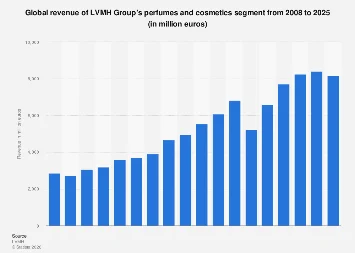
The global luxury conglomerate LVMH Moët Hennessy Louis Vuitton SE (LVMH) is projecting a significant upswing in its perfumes and cosmetics segment, with revenues anticipated to reach €8.17 billion in 2025. This forecast represents a substantial expansion from the €5.25 billion recorded in the pandemic-impacted year of 2020, underscoring the resilience and inherent strength of the luxury beauty market and LVMH’s dominant position within it. The projected figures indicate a consistent upward trajectory, building upon the €7.72 billion generated in 2022 and an estimated €8.27 billion for 2023, demonstrating a sustained recovery and growth phase post-2020.
This segment, a cornerstone of LVMH’s diverse portfolio, encompasses a curated collection of prestigious fragrance and beauty brands, each contributing to the group’s overall market leadership. While the fashion and leather goods division remains LVMH’s largest revenue generator, the perfumes and cosmetics arm has consistently proven its ability to capture consumer demand for high-quality, aspirational beauty products. The steady growth observed from 2008, when the segment generated €2.87 billion, to the projected €8.17 billion in 2025, illustrates a remarkable compound annual growth rate, reflecting strategic brand management, product innovation, and effective market penetration.
The growth narrative of LVMH’s beauty division is intricately linked to global consumer trends and evolving purchasing behaviors. The demand for luxury beauty products is driven by several key factors, including increasing disposable incomes in emerging markets, a growing consumer appreciation for premium ingredients and sophisticated formulations, and the powerful influence of social media and digital marketing on brand perception and product discovery. LVMH has adeptly leveraged these trends through its portfolio of brands, which often benefit from the heritage and prestige associated with their parent maison.
Brands such as Christian Dior, Guerlain, Givenchy Parfums, and Benefit Cosmetics, among others within the LVMH umbrella, have successfully navigated the competitive landscape by focusing on product innovation, iconic fragrances, and a strong emphasis on brand storytelling. The ability to translate the essence of haute couture and luxury lifestyle into compelling beauty offerings has been a critical differentiator. For instance, Dior’s J’adore and Sauvage fragrances have achieved enduring global popularity, becoming benchmarks in the fragrance industry. Similarly, Guerlain’s legacy in perfumery and cosmetics, coupled with its continuous reinvention, ensures its relevance among discerning consumers.
The global beauty market itself is a significant economic powerhouse. Projections suggest the worldwide beauty and personal care market will continue its expansion, driven by innovations in skincare, makeup, and fragrances. Within this expansive market, the luxury segment often exhibits greater resilience during economic downturns and faster recovery, as affluent consumers tend to maintain their spending on aspirational goods. LVMH’s strategic positioning within this luxury niche allows it to capitalize on these dynamics, often commanding premium pricing and benefiting from brand loyalty.
The figures from 2008 to 2025 reveal a dynamic period for LVMH’s beauty segment. While 2009 saw a slight dip, likely reflecting the global financial crisis, the segment demonstrated a robust recovery in the subsequent years. The period between 2014 and 2019 was particularly strong, with revenue more than doubling from €3.92 billion to €6.84 billion. The COVID-19 pandemic presented a significant challenge in 2020, leading to a contraction in revenue as lockdowns and reduced social gatherings impacted fragrance and makeup sales. However, the rebound in 2021 and the subsequent years, culminating in the €8.17 billion forecast for 2025, highlight the sector’s adaptability and the enduring consumer desire for luxury beauty experiences.
Looking at global comparisons, LVMH competes with other major luxury conglomerates and dedicated beauty players. Companies like Estée Lauder Companies and L’Oréal also command significant market share in the premium and luxury beauty space. LVMH’s strength lies in its integrated approach, where synergies between its fashion houses and its beauty brands often create a powerful ecosystem. The cross-pollination of brand aesthetics, marketing campaigns, and celebrity endorsements between couture and cosmetics amplifies brand visibility and consumer engagement.
The economic impact of LVMH’s perfumes and cosmetics division extends beyond its direct revenue generation. It supports a vast supply chain, including ingredient sourcing, manufacturing, packaging, distribution, and retail operations, creating numerous employment opportunities globally. Furthermore, the success of these brands contributes to France’s reputation as a global leader in luxury goods and innovation.
The strategic importance of the perfumes and cosmetics segment for LVMH cannot be overstated. It offers a relatively accessible entry point into the luxury world for many consumers, allowing them to engage with the LVMH universe through the purchase of a signature fragrance or a high-end skincare product. This accessibility fosters brand loyalty that can later translate into purchases of more high-value items, such as handbags or haute couture.
As LVMH looks towards 2025 and beyond, continued investment in research and development, sustainable sourcing, and digital transformation will be crucial for maintaining its competitive edge. The increasing consumer focus on ethical production, natural ingredients, and personalized beauty solutions presents both challenges and opportunities. LVMH’s commitment to innovation, evident in its acquisition strategies and internal R&D efforts, positions it well to adapt to these evolving market demands and solidify its leadership in the global luxury beauty arena. The projected €8.17 billion in revenue for 2025 is not merely a financial target but a testament to the enduring allure of luxury beauty and LVMH’s masterful execution in delivering it to a global clientele.