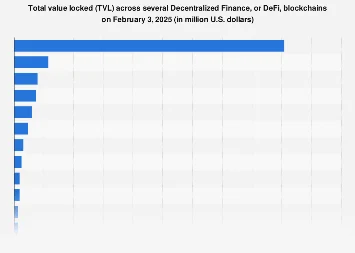
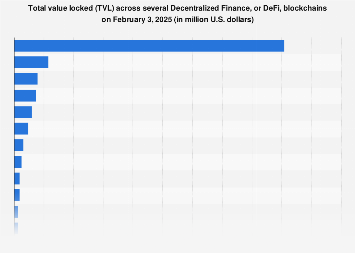
The decentralized finance (DeFi) sector, a rapidly evolving segment of the digital asset economy, is poised for significant growth and structural shifts by mid-2025. While precise, granular data on Total Value Locked (TVL) across all blockchains for a specific future date remains proprietary, available trends and expert projections indicate Ethereum’s continued, albeit potentially contested, leadership. TVL, a key metric representing the total value of assets deposited in DeFi protocols, serves as a crucial barometer for the sector’s overall size and investor confidence.
In 2021, the DeFi market experienced an unprecedented surge, with TVL reaching new all-time highs. Ethereum, as the foundational blockchain for the vast majority of DeFi applications, played a central role in this expansion. Its smart contract capabilities and established developer ecosystem made it the primary venue for innovative financial products, from decentralized exchanges (DEXs) and lending protocols to stablecoins and yield farming opportunities. Consequently, the price fluctuations of Ether (ETH), the native cryptocurrency of the Ethereum network, directly influenced the dollar-denominated value of DeFi assets locked on the platform. A notable example occurred in September 2021, when a significant overnight price drop in ETH led to a substantial decrease in Ethereum’s DeFi TVL, underscoring the strong correlation between the underlying asset’s value and the DeFi market’s reported size.
Looking ahead to 2025, projections suggest that Ethereum will maintain its position as the dominant DeFi blockchain, but its market share might face increasing pressure. The total value locked on the Ethereum network is expected to continue its upward trajectory, driven by ongoing innovation, layer-2 scaling solutions that aim to reduce transaction costs and improve throughput, and the increasing institutional adoption of DeFi protocols. However, this growth will likely occur within a more competitive multi-chain environment.
Several other blockchains have emerged as formidable contenders, attracting significant capital and developer interest. Solana, Avalanche, Binance Smart Chain (now BNB Chain), Polygon, and newer entrants like Aptos and Sui, have all developed robust ecosystems with unique value propositions. These platforms often tout higher transaction speeds, lower fees, and specialized features that appeal to different user segments and use cases. While they may not yet rival Ethereum’s sheer depth of liquidity and established network effects, their cumulative TVL is expected to represent a more substantial portion of the overall DeFi market by 2025 than it did in earlier years.
The narrative of DeFi is increasingly shifting from a singular blockchain focus to a more interconnected, interoperable ecosystem. Cross-chain bridges and protocols designed to facilitate the seamless transfer of assets and data between different blockchains are becoming increasingly sophisticated. This interoperability could lead to a more fluid distribution of capital, allowing users to access DeFi services across multiple networks without being confined to a single ecosystem. While Ethereum may continue to hold the largest share, the "rest of the market" – comprising these alternative Layer-1s and Layer-2 solutions – is projected to grow at a faster percentage rate, gradually chipping away at Ethereum’s dominance.
Market analysts point to several key drivers that will shape the DeFi landscape by 2025. Firstly, regulatory clarity will be a significant factor. As governments worldwide grapple with how to regulate the nascent digital asset space, clear and consistent frameworks could foster greater institutional trust and participation, leading to substantial capital inflows. Conversely, overly restrictive regulations could stifle innovation and lead to capital flight to more permissive jurisdictions. The industry is keenly watching developments in the United States, Europe, and Asia, as these regions are likely to set precedents for global regulatory approaches.
Secondly, the maturation of blockchain technology itself will be critical. Scalability remains a paramount concern. While Ethereum’s transition to a proof-of-stake consensus mechanism (Ethereum 2.0) and the ongoing development of its sharding capabilities aim to address this, the success of Layer-2 solutions like Optimistic Rollups and Zero-Knowledge Rollups will be pivotal. If these solutions can effectively reduce gas fees and increase transaction speeds to near-instantaneous levels without compromising security, they could solidify Ethereum’s position and make it more competitive with newer, faster blockchains.
Thirdly, user experience (UX) and accessibility are crucial for mainstream adoption. Currently, navigating the DeFi space can be complex for novice users, requiring a degree of technical understanding and familiarity with concepts like private keys, gas fees, and smart contract interactions. By 2025, there is an expectation that user interfaces will become more intuitive and streamlined, potentially mirroring the ease of use found in traditional financial applications. The development of user-friendly wallets, simplified onboarding processes, and automated management tools will be essential in attracting a broader demographic beyond crypto-native enthusiasts.
The economic impact of a thriving DeFi sector by 2025 is multifaceted. For developers and entrepreneurs, it presents a fertile ground for innovation, creating new job opportunities and driving technological advancements. For investors, it offers alternative avenues for wealth generation and portfolio diversification, potentially yielding higher returns than traditional asset classes, albeit with commensurate risks. For users, it promises greater financial inclusion, providing access to financial services for individuals who may be unbanked or underbanked, and offering more competitive rates for lending, borrowing, and savings.
However, the growth of DeFi is not without its challenges and inherent risks. Smart contract vulnerabilities, rug pulls, and exploits remain significant concerns, leading to substantial financial losses for users and undermining confidence in the ecosystem. The decentralized nature of DeFi also poses challenges for recourse and dispute resolution. Furthermore, the volatility of underlying crypto assets means that TVL figures can fluctuate dramatically, creating a perception of instability.
In conclusion, while Ethereum is expected to remain the cornerstone of the DeFi universe by 2025, its dominance will likely be more nuanced. The competitive landscape will be characterized by a growing number of capable alternative blockchains, increased interoperability, and a drive towards greater scalability and user-friendliness. The regulatory environment, technological advancements, and the ability of DeFi protocols to address security concerns will collectively shape the future trajectory of this transformative financial frontier. The total value locked across all these platforms will be a critical indicator to monitor, reflecting the evolving dynamics of this rapidly innovating sector.