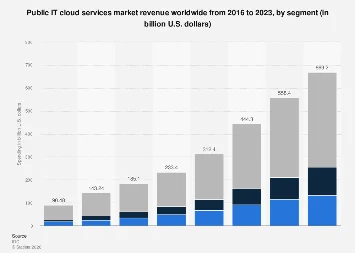
The global expenditure on public IT cloud services reached an estimated $600 billion in 2023, marking a significant milestone in the ongoing digital transformation across industries worldwide. Within this expansive market, Software as a Service (SaaS) continues to command the largest share, generating revenues approaching $300 billion. This segment’s robust growth is largely attributed to a widespread organizational shift away from outdated legacy business applications. Companies are increasingly adopting data-driven SaaS solutions that offer a more agile and appropriate fit for contemporary cloud architectures, enabling enhanced operational efficiency and strategic agility.
Understanding the pillars of cloud computing – SaaS, PaaS, and IaaS – is crucial to grasping the dynamics of this evolving landscape. These three models represent distinct tiers of cloud service delivery, each offering a different level of control and responsibility for the end-user organization. Software as a Service (SaaS) provides ready-to-use applications accessed over the internet, abstracting away the complexities of underlying infrastructure and maintenance. Platform as a Service (PaaS) offers a framework and tools for developers to build, deploy, and manage applications without needing to manage the underlying infrastructure. Infrastructure as a Service (IaaS) provides fundamental computing resources, such as servers, storage, and networking, on a pay-as-you-go basis, giving organizations maximum control over their IT environment. The choice among these models, or a combination thereof, depends on an organization’s specific IT management capabilities, strategic objectives, and desired level of flexibility.
The widespread adoption of these cloud service models signifies a profound shift in how businesses manage their technology. By leveraging third-party vendors for the delivery and management of these services over the internet, organizations can significantly reduce their capital expenditures on hardware and software. This economic advantage is compounded by the enhanced flexibility and speed with which applications can be deployed and scaled. Furthermore, a strategic embrace of cloud services can mitigate the risk of vendor lock-in, allowing businesses to maintain greater autonomy in their technology choices and partnerships. This move towards the cloud is not merely a cost-saving measure; it is a fundamental re-architecting of IT operations to support innovation and competitive advantage in an increasingly digital-first world.
Looking beyond the aggregate figures, the growth trajectory of the public cloud market has been nothing short of remarkable. Between 2016 and 2023, global public cloud spending has witnessed a compound annual growth rate (CAGR) that has consistently outpaced traditional IT spending. In 2016, the total market was estimated to be a fraction of its current size, underscoring the accelerating pace of cloud adoption. The SaaS segment, in particular, has been the engine of this expansion, consistently outperforming PaaS and IaaS in terms of sheer market value. This dominance is fueled by the increasing reliance on cloud-based productivity suites, customer relationship management (CRM) systems, enterprise resource planning (ERP) solutions, and a myriad of specialized business applications that are now readily available as SaaS offerings.
The competitive landscape within the SaaS market is intense, with established technology giants and agile startups vying for market share. Major cloud providers like Amazon Web Services (AWS), Microsoft Azure, and Google Cloud Platform not only offer IaaS and PaaS but also a vast array of proprietary and third-party SaaS solutions. This integrated approach allows them to offer comprehensive cloud solutions, simplifying the procurement and management process for enterprises. However, specialized SaaS providers are also thriving by focusing on niche industries or specific business functions, offering deep expertise and tailored solutions that larger platforms may not be able to match. This specialization fosters innovation and caters to the diverse needs of a global customer base.
The economic implications of this cloud spending surge are far-reaching. Beyond direct IT cost savings, businesses are realizing significant operational efficiencies, improved collaboration, and enhanced data analytics capabilities. The ability to access and process vast amounts of data in the cloud is empowering organizations to gain deeper insights into customer behavior, market trends, and internal operations, leading to more informed decision-making and strategic planning. For small and medium-sized enterprises (SMEs), cloud adoption has democratized access to sophisticated IT tools and capabilities that were previously only accessible to large corporations, leveling the playing field and fostering entrepreneurial growth.
Globally, cloud adoption rates vary, influenced by factors such as regulatory environments, internet infrastructure development, and the maturity of the local technology ecosystem. Developed economies in North America and Europe have been leading the charge, with high cloud penetration rates across various industries. Emerging markets in Asia-Pacific and Latin America are exhibiting the fastest growth, driven by rapid digitalization initiatives and a burgeoning tech-savvy population. This global expansion necessitates a nuanced understanding of regional market dynamics, data sovereignty concerns, and localized support requirements.
The ongoing evolution of cloud technology, including the rise of hybrid and multi-cloud strategies, further reshapes the market. Organizations are increasingly adopting a mix of public, private, and on-premises cloud environments to balance cost, security, and control. This complexity demands sophisticated management tools and expertise, creating opportunities for cloud management and orchestration service providers. Moreover, advancements in areas such as artificial intelligence (AI) and machine learning (ML) are being integrated into cloud platforms, enabling new levels of automation, predictive analytics, and personalized user experiences. The continuous innovation within the public cloud ecosystem ensures that its influence on global commerce and technology will only continue to grow in the years to come. The sustained investment in cloud infrastructure and services by businesses worldwide underscores its critical role as the foundation for digital innovation and economic competitiveness.