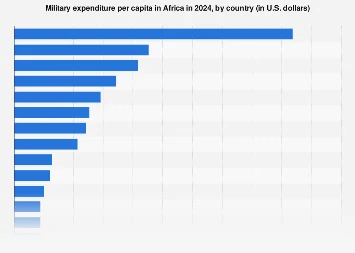
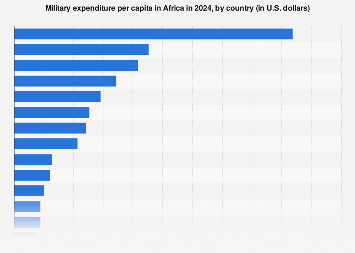
Algeria is projected to lead the African continent in per capita military expenditure for 2024, with an estimated outlay of approximately $469 U.S. dollars per person. This figure significantly surpasses that of other nations on the continent, underscoring a substantial investment in defense infrastructure and capabilities. Botswana follows as a distant second, allocating an estimated $227 U.S. dollars per capita towards its military. These leading figures are largely concentrated within North Africa, a region that consistently exhibits the highest defense spending budgets across the continent.
The disparity in per capita defense spending across Africa paints a complex picture of the continent’s diverse security priorities and economic realities. While some nations are channeling significant resources into their military, others are operating with considerably smaller defense budgets relative to their populations. This uneven distribution reflects a range of factors, including geopolitical tensions, internal security challenges, regional conflicts, and varying national development agendas.
Following Algeria and Botswana, Seychelles emerges with a notable per capita expenditure of $208.2 U.S. dollars, a figure that stands out given its status as a small island nation. South Sudan, grappling with prolonged internal conflict and humanitarian crises, is also listed with a per capita defense spending of $171.6 U.S. dollars, indicative of ongoing security imperatives. Morocco, a key player in North African geopolitics, follows with $145.6 U.S. dollars per capita, reflecting its strategic positioning and regional security concerns. Gabon rounds out the top tier with an expenditure of $127 U.S. dollars per capita.
The data also highlights a significant drop in per capita spending as one moves down the list. Namibia, for instance, spends $120.9 U.S. dollars per capita, while Tunisia allocates $107.3 U.S. dollars. Nations like Eswatini ($64.4), Equatorial Guinea ($60.5), and Mauritania ($51) represent a middle tier of spending. Further down, South Africa, a historically significant military power, registers $44.6 U.S. dollars per capita, while Burkina Faso, facing escalating security challenges in the Sahel, spends $44 U.S. dollars.
The distribution of defense spending per capita is not solely a reflection of absolute military might but also of a nation’s economic capacity and the perceived threats to its security. Countries with robust economies and significant regional influence, or those facing immediate and substantial security threats, tend to exhibit higher per capita expenditures. For example, Algeria’s high spending can be attributed to its considerable hydrocarbon revenues, which provide the fiscal space for substantial defense investments, coupled with regional security considerations and a desire to maintain military parity.
In contrast, nations in Sub-Saharan Africa often contend with more constrained economic resources, which inevitably impacts their defense budgets. Countries like Nigeria, Africa’s most populous nation and largest economy, have a per capita military expenditure of just $4.9 U.S. dollars. This relatively low figure, despite its significant overall defense budget, is a consequence of its vast population. Similarly, Ethiopia, a nation with a large population and a history of regional engagement and internal challenges, shows a per capita expenditure of $7.1 U.S. dollars, though this data is noted as highly uncertain.
The data also points to the complex security dynamics in the Sahel region. Countries like Mali ($38.5) and Burkina Faso ($44) are allocating significant portions of their per capita budgets to defense, reflecting the persistent threat of extremist insurgencies and political instability. This contrasts with some more stable economies where per capita spending might be lower.
Globally, Africa’s per capita military expenditures are generally lower than those in more developed regions. For instance, many European nations and North American countries have significantly higher per capita defense spending, often driven by larger global security commitments, advanced military technology, and alliance obligations. However, the absolute defense budgets of some African nations, particularly those with large populations and growing economies, can still represent substantial sums in real terms, impacting global defense markets and the arms trade.
The source data indicates that figures are in current U.S. dollars, implying that inflation and currency fluctuations can influence year-on-year comparisons. Furthermore, the data explicitly notes that figures for Ethiopia and Zimbabwe are highly uncertain, highlighting the challenges in data collection and verification in certain African contexts. Notably, data is unavailable for several key countries, including Djibouti, Egypt, Eritrea, Guinea-Bissau, Libya, and Sudan, which limits a comprehensive continental analysis.
The economic implications of military spending are multifaceted. For nations with abundant natural resources, like Algeria, high defense spending can be sustained, but it also raises questions about resource allocation and potential diversion from other crucial sectors such as education, healthcare, and infrastructure development. For less wealthy nations, even modest per capita military spending can represent a significant burden on public finances, potentially hindering economic growth and poverty reduction efforts.
However, defense spending can also be viewed as an investment in national security, which is a prerequisite for economic stability and foreign investment. A secure environment allows for trade, tourism, and industrial development to flourish. The challenge for many African governments lies in striking an optimal balance between ensuring national security and fostering sustainable economic development.
The rise of certain nations in the per capita spending rankings also signals shifts in regional power dynamics and security priorities. As some countries bolster their military capabilities, it can influence the strategic calculations of their neighbors, potentially leading to regional arms races or increased diplomatic engagement to manage security concerns. The data for 2024 suggests a continued emphasis on national defense, with significant variations across the continent, reflecting the diverse and evolving security landscape of Africa.
The concentration of higher per capita spending in North Africa, particularly by Algeria, points to the enduring geopolitical tensions and security challenges that characterize that region. The substantial figures for Botswana and Seychelles, while different in scale, also indicate that security is a priority even for nations not typically associated with large-scale military operations, perhaps reflecting maritime security concerns or a strategic decision to maintain a credible deterrent.
Understanding these spending patterns is crucial for international organizations, policymakers, and investors seeking to grasp the economic and security outlook of the African continent. The data, while incomplete for some nations, provides valuable insights into how African countries are prioritizing their resources in an era of evolving global and regional security threats. The projection for 2024 indicates that military expenditure remains a significant consideration for many African states, shaping their economic trajectories and their roles on the global stage.