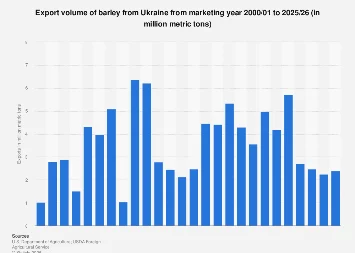
Ukraine’s agricultural sector, a significant contributor to global food supply chains, is projected to see a slight increase in barley exports for the 2025/26 marketing year, building upon anticipated performance in the preceding 2024/25 period. While the exact figures for the current and upcoming marketing years remain proprietary, historical data indicates a strong and often record-setting export capacity for Ukrainian barley over the past two decades. The marketing year 2008/09 stands out as a peak for the nation’s barley exports, underscoring its historical importance as a major global supplier of this versatile grain.
Barley, a staple crop with diverse applications ranging from animal feed and brewing to human consumption, plays a crucial role in international agricultural trade. Ukraine, endowed with fertile black soil (chernozem) and a favorable climate, has consistently been a formidable player in the global barley market. The country’s strategic Black Sea ports further facilitate efficient export logistics, enabling it to reach key importing regions across the Middle East, North Africa, and Europe.
The projected modest growth for the 2025/26 marketing year suggests a continued, albeit measured, recovery and expansion of Ukraine’s agricultural trade capabilities. This outlook is particularly significant given the ongoing geopolitical challenges that have impacted Ukraine’s broader economic and export landscape. The resilience of its agricultural sector, demonstrated through sustained export volumes, highlights its fundamental importance to both the Ukrainian economy and global food security.
Analyzing historical export trends provides crucial context for understanding Ukraine’s current and future role. The surge in barley exports seen in the mid-2000s, culminating in the 2008/09 record, was driven by a confluence of factors, including increased global demand, favorable weather conditions, and supportive agricultural policies. This period established Ukraine as a dominant force, influencing global barley prices and trade flows. While subsequent years have seen fluctuations influenced by market dynamics, weather patterns, and regional conflicts, the underlying capacity for high-volume production and export has remained a defining characteristic.
The upcoming marketing years will be closely watched for their ability to sustain and potentially enhance this export performance. Factors influencing these projections include domestic crop yields, international market prices for competing grains, the stability of export routes, and the broader economic conditions within Ukraine and its key trading partners. The global demand for barley, particularly from the feed and malting industries, remains robust, providing a steady market for Ukrainian producers.
The European Union, for instance, is a significant importer of barley, relying on external sources to supplement its domestic production, especially for malting purposes. Similarly, countries in North Africa and the Middle East depend heavily on imported grains, including barley, to meet their food security needs. Ukraine’s geographical proximity and established trade relationships make it a preferred supplier for these regions.
However, the agricultural sector is inherently susceptible to a myriad of external shocks. Climate change, with its potential for extreme weather events, poses a persistent challenge to crop yields. Furthermore, global economic volatility, currency fluctuations, and trade protectionism in importing countries can all impact export volumes and profitability. For Ukraine, the continued impact of the ongoing conflict remains a primary concern, affecting everything from land availability and labor resources to infrastructure and logistics. The disruption to traditional shipping routes, while mitigated by alternative corridors and agreements, continues to present operational complexities and potential cost increases.
The European Union’s Common Agricultural Policy (CAP) and its trade agreements also play a role in shaping the competitive landscape for Ukrainian agricultural products. While the EU has provided significant support to Ukraine’s agricultural exports, particularly in the wake of disruptions, understanding the long-term implications of these policies and potential shifts in trade dynamics is crucial for Ukrainian exporters.
Beyond direct export figures, the economic impact of barley cultivation and trade extends throughout Ukraine’s rural economy. It supports agricultural employment, drives investment in farming technologies and infrastructure, and contributes to foreign exchange earnings, which are vital for economic stability. The continued success of the barley sector is therefore intrinsically linked to the broader economic recovery and development of Ukraine.
In conclusion, the projected modest growth in Ukraine’s barley exports for the 2025/26 marketing year signals a continued commitment to its role as a key global supplier. While historical peaks demonstrate the sector’s immense potential, the path forward will be shaped by its ability to navigate domestic and international challenges, including geopolitical realities, climate variability, and evolving market demands. The resilience and strategic importance of Ukraine’s agricultural exports, particularly barley, underscore its enduring significance in the global food system.