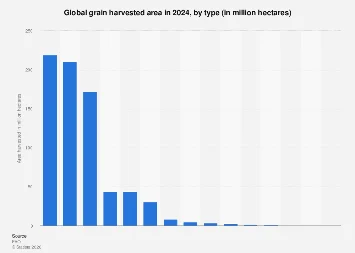
The global agricultural landscape in 2024 is characterized by a dynamic recalibration of cultivated areas across major grain types, a critical indicator for food security, commodity markets, and geopolitical stability. While precise, granular data on the exact harvested area for each grain type for the entirety of 2024 remains under compilation and often reserved for specialized market intelligence subscribers, prevailing trends and preliminary estimates from agricultural bodies and market analysts paint a complex picture. These shifts are influenced by a confluence of factors including evolving consumer demand, the economic viability of different crops, government agricultural policies, and the pervasive impact of climate change on planting conditions.
Wheat, often referred to as the "world’s breadbasket," continues to hold a dominant position in global grain production. Its cultivation is spread across diverse climatic zones, from the vast plains of North America and Eurasia to the fertile river valleys of Asia. In 2024, projections suggest a continued strong emphasis on wheat cultivation, driven by its staple status in diets worldwide and its resilience in various agricultural systems. However, this dominance is not without its challenges. Fluctuations in fertilizer prices, energy costs for farm operations, and the ongoing unpredictability of weather patterns, including prolonged droughts in some regions and excessive rainfall in others, are all contributing to a delicate balance in wheat acreage. For instance, while major producers like China, India, and the European Union are expected to maintain substantial wheat plantings, specific regional variations may emerge. Drought-prone areas in North America might see acreage shifts towards more drought-resistant varieties or even alternative crops, while regions with favorable moisture levels could expand wheat cultivation. The geopolitical landscape also plays a significant role; disruptions to traditional supply chains, as seen in recent years, can incentivize countries to bolster domestic production, thereby influencing planting decisions.
Corn (maize) remains another cornerstone of global agriculture, vital not only for human consumption but also as a key component in animal feed and a primary feedstock for biofuels. The acreage dedicated to corn is often more volatile than that of wheat, closely tied to its dual role in food and industrial markets. In 2024, the outlook for corn planting is being shaped by robust demand from the livestock sector, particularly in emerging economies undergoing dietary transitions, and the continued global push for renewable energy sources which often favor corn-based ethanol. However, corn is also a crop that demands significant water resources, making it susceptible to water scarcity and adverse weather events. Consequently, regions experiencing drought conditions may see a reduction in corn acreage, with farmers potentially opting for less water-intensive crops. Conversely, areas with ample rainfall and supportive government policies, such as those promoting biofuel production, might witness an expansion. The United States, as the world’s largest corn producer, plays a pivotal role, and its planting decisions are closely watched by global markets. Shifts in U.S. corn acreage can have ripple effects on international prices and trade flows.
Rice, the primary food staple for over half the world’s population, particularly in Asia, exhibits a different set of acreage dynamics. Rice cultivation is intrinsically linked to water availability and often requires extensive irrigation systems, making it highly sensitive to hydrological conditions. In 2024, while the fundamental demand for rice remains unwavering, acreage can be influenced by the availability of water resources, particularly in monsoon-dependent regions. El Niño and La Niña phenomena, which impact global weather patterns, can significantly alter monsoon rainfall, directly affecting rice planting seasons in countries like India and Southeast Asian nations. Government policies aimed at water conservation and promoting efficient irrigation techniques are also becoming increasingly important in shaping rice cultivation areas. Furthermore, the economic returns from rice cultivation compared to other crops, coupled with labor availability in labor-intensive paddy farming, can also lead to subtle shifts in planted area.
Barley, often used for animal feed, malting for beverages, and as a food grain, presents another facet of the global grain market. Its acreage is often influenced by its competitiveness against other feed grains and its suitability for specific climatic conditions, particularly in cooler, drier regions where it can outperform other crops. In 2024, the demand for barley in the feed sector, coupled with a consistent demand from the brewing industry, underpins its cultivation. However, its flexibility in terms of planting windows and its relative drought tolerance can lead to acreage adjustments based on the perceived profitability and the performance of competing crops like wheat and corn in specific locales.
The overarching theme for 2024 is the increasing complexity of agricultural decision-making at the farm level, influenced by a multitude of interconnected global forces. Climate volatility is no longer a theoretical concern but a tangible reality impacting planting schedules, crop yields, and ultimately, the area dedicated to each grain. Extreme weather events, from heatwaves and droughts to severe floods, can necessitate last-minute changes in planting decisions or lead to crop failures, forcing farmers to reconsider their cultivation strategies for subsequent seasons. This unpredictability contributes to greater price volatility in global grain markets, as supply expectations are constantly recalibrated.
Economic factors are equally influential. The cost of inputs, including fertilizers, seeds, fuel, and labor, directly impacts the profitability of farming operations. Fluctuations in global commodity prices for these inputs, often driven by geopolitical events and supply chain disruptions, can significantly alter the economic calculus for farmers. For example, a surge in fertilizer prices might discourage the planting of nitrogen-intensive crops like corn, potentially leading to an increased focus on less input-dependent grains. Conversely, strong global demand for a particular grain, leading to higher market prices, can incentivize farmers to allocate more land to that crop, provided the economic conditions are favorable.
Government policies, ranging from direct subsidies and price support mechanisms to trade agreements and environmental regulations, continue to play a crucial role in shaping agricultural landscapes. Subsidies for specific crops can encourage their cultivation, while import/export tariffs can influence domestic planting decisions by altering the competitive landscape. Furthermore, growing global emphasis on sustainable agriculture and climate-resilient farming practices is beginning to influence crop choices and land management. Policies promoting crop diversification, water-efficient irrigation, and reduced reliance on synthetic inputs could lead to subtle but significant long-term shifts in the global distribution of grain cultivation areas.
The interconnectedness of the global food system means that trends in one region can have far-reaching consequences. For instance, a significant reduction in wheat production in a major exporting country due to adverse weather can lead to increased global prices, impacting food affordability in import-dependent nations. Similarly, shifts in corn acreage in the U.S. can influence global feed prices, affecting the cost of meat and dairy products worldwide. Therefore, understanding the evolving global grain harvested area is not merely an exercise in tracking agricultural statistics; it is essential for forecasting food security, analyzing commodity market movements, and comprehending the complex interplay of economic, environmental, and political forces that shape our world. As 2024 progresses, ongoing monitoring of these acreage trends will be critical for policymakers, agricultural stakeholders, and businesses reliant on the global grain supply chain.