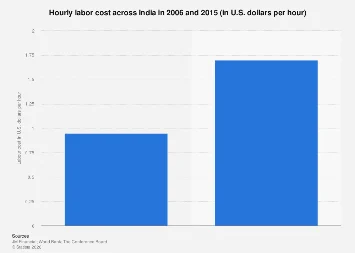
In 2015, India’s average hourly labor cost stood at a modest figure, positioning the nation as a highly competitive destination for businesses seeking to leverage cost-effective human capital. While specific figures from that year provide a baseline, understanding this number requires a broader economic context, delving into the factors that influence wage determination, the implications for foreign investment, and the trajectory of India’s labor market in the years that followed.
The economic narrative of India in 2015 was one of burgeoning growth and increasing integration into the global supply chain. The country was actively promoting itself as a manufacturing and service hub, attracting significant foreign direct investment (FDI). A key component of this attractiveness was its vast and relatively inexpensive labor pool. For many multinational corporations, the ability to access skilled and unskilled labor at a fraction of the cost in developed economies was a compelling proposition, driving decisions to establish operations or outsource functions to India.
While precise, universally agreed-upon figures for average hourly labor costs can vary depending on the source, methodology, and the specific sector surveyed, the general consensus for 2015 placed India significantly below the global average. For instance, comparing it to developed economies like the United States or Western European nations, the hourly cost in India would have been several multiples lower. This stark difference was a primary driver for companies in sectors ranging from information technology and business process outsourcing to manufacturing and textiles.
The composition of this hourly cost is multifaceted. It includes not only the direct wage paid to the employee but also the employer’s contributions towards social security, statutory benefits, and other indirect costs mandated by Indian labor laws. While these additional costs exist, they were, and largely remain, considerably lower than those in many other major economies. This comprehensive cost structure further enhanced India’s appeal for cost-conscious investors.
The implications of these low labor costs in 2015 were profound. For India, it facilitated job creation, particularly in the services sector, which had become a significant contributor to the nation’s GDP. The IT and BPO industries, in particular, flourished, creating millions of employment opportunities and fostering a generation of skilled professionals. This growth not only boosted household incomes but also contributed to a rising middle class, further stimulating domestic consumption.
Globally, India’s competitive labor costs played a crucial role in reshaping supply chains. Companies were able to maintain or even increase production volumes while simultaneously reducing operational expenses. This strategy allowed them to offer more competitive pricing for their goods and services in the international market, enhancing their global market share. Furthermore, it encouraged the development of specialized industrial clusters and economic zones, often benefiting from government incentives aimed at promoting manufacturing and exports.
However, the economic picture is rarely static. While 2015 represents a specific point in time, the Indian labor market has been on a dynamic trajectory. Factors such as rising inflation, increasing demand for higher wages driven by skill development and experience, and the implementation of new labor codes have influenced the cost of labor in subsequent years. The government’s focus on "Make in India" and other industrial policies aimed at boosting domestic manufacturing have also contributed to evolving wage structures and expectations.
Statistical data from international organizations and economic research firms often highlight the gap between India and its peers. For example, by 2015, while countries like China were already experiencing significant wage inflation due to their own economic maturation and the resulting shift in labor dynamics, India continued to offer a more favorable cost structure. This difference became increasingly important for companies looking for long-term, sustainable cost advantages.
The impact of these costs extends beyond mere financial calculations. It influences decisions about where to locate research and development centers, customer service hubs, and manufacturing facilities. The availability of a large, English-speaking workforce in India, coupled with competitive wages, made it an attractive destination for knowledge-intensive industries, allowing for scalability and operational flexibility.
It is also important to consider the regional variations within India. Labor costs can differ significantly between major metropolitan areas and rural or semi-urban regions. While national averages provide a broad overview, specific investment decisions often take into account the localized cost of labor, infrastructure, and skill availability. The cost of living also plays a role, with wages often reflecting the prevailing economic conditions in different states and cities.
Looking back at 2015, the prevailing hourly labor cost in India was a powerful economic lever, facilitating growth, attracting investment, and integrating the nation more deeply into the global economic fabric. It underscored India’s position as a key player in the global labor market, offering a compelling value proposition for businesses worldwide. While the landscape has evolved since then, the underlying principles of supply, demand, skill development, and government policy continue to shape the cost of labor and its impact on India’s economic trajectory. The ability to provide context and comparative data for this period is essential for understanding the long-term economic strategies that have been employed by both domestic and international entities operating within the Indian subcontinent. This historical data point serves as a crucial benchmark for evaluating the progress and challenges in India’s ongoing journey of economic development and global competitiveness.