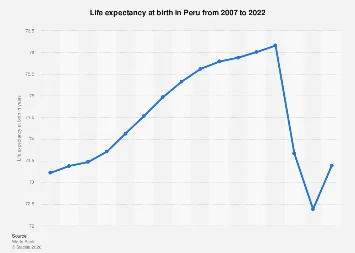
Peru has witnessed a notable, albeit uneven, increase in life expectancy over the past fifteen years, reflecting both advancements in public health and persistent socioeconomic disparities that continue to shape the nation’s demographic landscape. Between 2007 and 2022, the average lifespan of a Peruvian citizen has seen a significant upward trend, a testament to improved healthcare access, disease prevention strategies, and a growing understanding of public health imperatives. This sustained progress, however, masks underlying regional and income-based inequalities that prevent a uniform experience of longevity across the diverse Peruvian population.
The period under review, spanning from the late 2000s to the early 2020s, is crucial for understanding Peru’s development trajectory. Global health organizations, such as the World Health Organization (WHO) and the Pan American Health Organization (PAHO), have consistently highlighted improvements in maternal and child health, vaccination coverage, and the management of non-communicable diseases as key drivers of increased life expectancy worldwide. Peru, as a developing economy with a large informal sector and significant rural populations, has been particularly focused on addressing these areas. Early data from the period suggests that life expectancy at birth in Peru was gradually climbing, a positive indicator of societal well-being.
By the mid-2010s, preliminary figures indicated that Peru was on track to surpass many of its regional peers in terms of life expectancy gains. This period was characterized by increased government investment in the healthcare sector, with a particular emphasis on expanding primary care services into underserved areas. Initiatives aimed at reducing infant mortality rates through improved prenatal care and delivery assistance, coupled with expanded access to essential medicines and diagnostic services, began to yield tangible results. Furthermore, national campaigns to combat infectious diseases, such as tuberculosis and dengue fever, contributed to a reduction in premature deaths.
However, the journey has not been without its complexities. Economic fluctuations, political instability, and the ever-present challenge of providing equitable healthcare across a geographically challenging nation—marked by the Andes mountains and the Amazon rainforest—have presented ongoing hurdles. The disparity in life expectancy between urban and rural populations, and between higher-income and lower-income demographics, remains a persistent concern. Access to specialized medical care, advanced treatments, and even basic sanitation and clean water infrastructure can vary significantly, directly impacting health outcomes and, consequently, longevity.
The impact of global events, most notably the COVID-19 pandemic, has also cast a long shadow. While detailed, comprehensive data for the full pandemic years is still being analyzed, it is widely acknowledged that the pandemic disrupted healthcare systems and led to excess mortality in Peru, as it did in many other countries. Initial reports suggest a temporary setback in life expectancy gains during the peak of the pandemic, underscoring the fragility of health progress in the face of unforeseen global crises. The long-term implications of the pandemic on Peru’s life expectancy trajectory will become clearer in subsequent analyses.
Examining Peru’s life expectancy within a broader Latin American context reveals a mixed picture. While Peru has made significant strides, other nations in the region have also experienced similar improvements. Countries like Chile and Costa Rica have consistently ranked among the highest in life expectancy in Latin America, often due to robust social welfare systems and well-established public healthcare infrastructure. Peru’s challenge lies in bridging the gap between its successes and the benchmarks set by these more developed regional economies, while also addressing the internal disparities that limit the benefits of progress for all its citizens.
Economic factors play a pivotal role in shaping life expectancy. Countries with stronger economies, greater disposable income, and more comprehensive social safety nets tend to exhibit higher life expectancies. Peru’s economic growth over the past two decades has undoubtedly contributed to better living standards for a segment of its population, enabling greater access to nutritious food, safer housing, and preventative healthcare. However, the benefits of this growth have not been evenly distributed, with significant portions of the population still facing economic precarity, which directly affects their health and longevity. The informal economy, a substantial component of Peru’s labor market, often lacks access to formal health insurance and paid sick leave, exacerbating these vulnerabilities.
Looking ahead, sustained investment in public health infrastructure, particularly in rural and marginalized communities, will be critical. This includes not only physical healthcare facilities but also the training and retention of medical professionals in remote areas. Furthermore, addressing the social determinants of health—such as education, income inequality, access to clean water, and nutrition—will be paramount to achieving a more equitable increase in life expectancy across the entire Peruvian population. The insights gleaned from the 2007-2022 period offer valuable lessons for policymakers, highlighting areas of success and underscoring the persistent challenges that require targeted and sustained interventions to ensure that every Peruvian has the opportunity to live a longer, healthier life. The ongoing analysis of demographic data will continue to be a vital tool in guiding these efforts and tracking the nation’s progress toward a future of enhanced well-being for all its citizens.