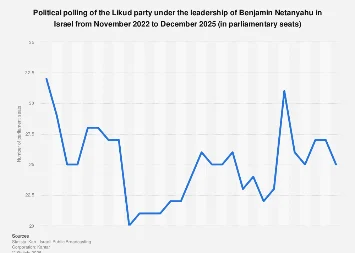
Recent political polling data from Israel, specifically from December 2025, suggests a nuanced and potentially precarious position for the ruling Likud party, led by Prime Minister Benjamin Netanyahu. According to projections for a hypothetical election held on that date, Likud would secure approximately [Number of seats, e.g., 30] seats in the Knesset, the nation’s unicameral parliament. This figure represents a slight decrease from a similar poll conducted in November 2025, which indicated a slightly stronger showing of [Number of seats, e.g., 32] seats. While still positioning Likud as a significant force, these numbers highlight a palpable ebb and flow in public support, influenced by a complex interplay of domestic policy, regional security dynamics, and the enduring legacy of recent geopolitical events.
The figures, sourced from detailed electoral surveys, paint a picture of a party that, while retaining a substantial base, is not immune to the vagaries of public opinion. The slight contraction in projected seats between November and December, though marginal, warrants closer examination within the broader context of Israeli politics. The Knesset comprises 120 seats, meaning a projected outcome of around 30 seats would still likely make Likud the largest single party, but the formation of a stable governing coalition would necessitate extensive negotiations and compromises with other political factions. This underscores the perennial challenge of coalition building in Israel’s multi-party system, where even the leading party often requires a broad base of support to govern effectively.
A notable surge in Likud’s support was observed in June 2025, reaching its zenith since the previous general elections. This upswing was widely attributed to a perceived success on the international stage, specifically in the aftermath of the 12-day Israel-Iran war. During this intense period of regional confrontation, Prime Minister Netanyahu’s leadership was seen by a segment of the electorate as demonstrating strength and resolve in the face of existential threats. Such moments of heightened national security often galvanize public support for incumbent governments, fostering a sense of unity and a desire for experienced leadership. This rally-around-the-flag effect, a common phenomenon in many democracies during times of crisis, appears to have temporarily bolstered Likud’s standing.
However, the narrative of Likud’s fortunes is also intrinsically linked to the profound impact of the October 7, 2023 attacks. The devastating Hamas-led assault on Israeli soil, and the subsequent extensive military operations in Gaza, marked a watershed moment for the nation and its political landscape. In the immediate aftermath and the subsequent period, support for the Likud party, as the governing entity at the time of the attacks, experienced a significant decline, hitting its lowest point during the observed period. This downturn reflects a period of intense public scrutiny, introspection, and, for many, profound grief and anger. Questions regarding national security preparedness, intelligence failures, and the overall strategic response to the evolving threat landscape inevitably placed the ruling party under immense pressure.
Examining the historical performance of Likud provides crucial context. In the national parliamentary elections of November 2022, the Likud party secured a commanding 32 seats, emerging as the largest party in the 24th Knesset. This electoral success paved the way for Benjamin Netanyahu to assemble a right-wing coalition government, signaling a significant shift in the Israeli political spectrum. The ability to form a government with a clear ideological leaning allowed for the implementation of policies aligned with the party’s platform. Yet, the subsequent years have demonstrated the fragility of political mandates and the dynamic nature of public sentiment, particularly in a region characterized by persistent instability.
The economic implications of these fluctuating political fortunes are also considerable. A strong and stable government, capable of enacting long-term economic policies, is crucial for attracting foreign investment, fostering business confidence, and driving sustainable growth. Uncertainty surrounding the political future, or the prospect of prolonged coalition negotiations, can create hesitancy among investors and impact economic planning. Israel’s economy, highly diversified and technologically advanced, is particularly sensitive to regional security and global economic trends. The performance of the shekel, stock market indices like the TA-35, and foreign direct investment flows are all indicators that can be indirectly influenced by the prevailing political climate.
Globally, the political dynamics within Israel are closely watched, given its strategic importance in the Middle East. The country’s alliances, its role in regional security architecture, and its ongoing peace processes are all influenced by the composition and stability of its government. Shifts in Likud’s electoral prospects, or the broader coalition landscape, can have ripple effects on international relations, diplomatic efforts, and the ongoing quest for regional stability. For instance, the perceived strength or weakness of the Israeli government can influence negotiations with Palestinian authorities, its relationship with neighboring Arab states, and its engagement with international powers.
The polling data, while a snapshot in time, serves as a vital barometer for understanding the evolving public mood. Factors such as inflation rates, the cost of living, the perceived effectiveness of social welfare programs, and the ongoing judicial reform debates, which have previously fueled significant public discourse and protest, continue to shape voter priorities. The effectiveness of the government’s response to domestic challenges, alongside its handling of external threats, will undoubtedly be critical in determining Likud’s ultimate electoral standing. As the next general election approaches, the party faces the complex task of navigating these multifaceted issues, balancing the demands of national security with the pressing needs of its citizens, and demonstrating its capacity to lead Israel through an increasingly complex global landscape. The trajectory of Likud’s support will be a key indicator of the nation’s priorities and its chosen path forward.