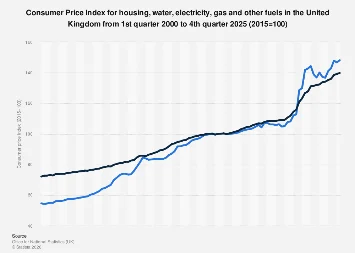
In the final quarter of 2025, the United Kingdom witnessed a pronounced divergence in price inflation, with the Consumer Price Index (CPI) for housing, water, and fuels reaching 148.2. This figure signifies a substantial 48.2% increase in the cost of these essential services since 2015. In stark contrast, the broader measure of overall prices across the UK economy registered a 39.8% increase over the same period, indicating that the combined expenses of shelter, water, and energy have escalated at a considerably faster pace.
This widening gap in inflation rates highlights a critical economic challenge for households and policymakers. The data, compiled from quarterly figures spanning from the first quarter of 2000 to the fourth quarter of 2025, provides a detailed historical perspective on the trajectory of these vital expenditure categories. The baseline year of 2015 (indexed at 100) allows for a clear comparison of price changes.
Analysis of the quarterly data reveals a fluctuating but consistently upward trend in housing and utility costs. While overall price inflation saw some moderation in certain quarters, the housing and utilities sector demonstrated remarkable resilience in its upward price movement. For instance, in the third quarter of 2025, housing and utility prices stood at 146.7, while overall prices were 139.2. By the fourth quarter, both categories saw increases, but the gap widened, with housing and utilities climbing to 148.2 against overall prices of 139.8.
This sustained inflationary pressure on essential household outgoings has significant implications for consumer spending power and economic stability. In the UK, housing costs, encompassing rent and mortgage payments, have been a persistent driver of inflation for years, influenced by factors such as limited housing supply, increased construction costs, and investment demand. Simultaneously, the price of water, electricity, and gas has been subject to global energy market volatility, domestic energy policy, and infrastructure investment needs.
The divergence is particularly noticeable when examining periods of economic stress. For example, in the third quarter of 2022, housing and utility prices stood at 129.9, while overall prices were 123.2. This trend continued, with both categories experiencing significant jumps. By the first quarter of 2023, housing and utility prices reached 142.7, significantly outpacing the overall CPI of 127.7. This pattern underscores the sensitivity of these specific costs to broader economic shocks and geopolitical events that can disrupt energy supplies and impact the cost of living.
Economists point to several contributing factors behind this persistent premium in housing and utility inflation. On the housing front, the structural undersupply of homes across the UK remains a fundamental issue. Decades of underbuilding, coupled with stringent planning regulations and rising material and labor costs, have created a competitive market where prices for both ownership and rental properties have been pushed upwards. Furthermore, the increasing costs associated with maintaining and improving housing stock, particularly in light of energy efficiency mandates and the transition to greener energy sources, add another layer of expense that is eventually passed on to consumers.
The energy component of this index – electricity, gas, and other fuels – has been exceptionally volatile in recent years. Global supply chain disruptions, geopolitical tensions impacting natural gas markets, and the ongoing transition to renewable energy sources have all contributed to price fluctuations. While the immediate shockwaves of the energy crisis of 2022 might have subsided somewhat by late 2025, the underlying structural costs associated with energy infrastructure, carbon pricing mechanisms, and the investment required for grid modernization continue to exert upward pressure.
This sustained rise in housing and utility costs has a disproportionate impact on lower-income households, who typically spend a larger percentage of their income on these necessities. The Office for National Statistics (ONS), the original source of much of this data, has consistently highlighted the regressive nature of inflation when it heavily impacts essential goods and services. This can lead to increased income inequality, a rise in fuel poverty, and a strain on social welfare systems.
From a macroeconomic perspective, the persistent high inflation in housing and utilities can have a dampening effect on broader economic growth. When households are forced to allocate a larger portion of their budget to these essentials, discretionary spending on other goods and services declines. This can lead to reduced demand, lower business investment, and a slower overall pace of economic expansion. Central banks, like the Bank of England, often grapple with this challenge, balancing the need to control inflation with the risk of stifling economic activity through aggressive interest rate hikes, which can further exacerbate mortgage costs.
Looking ahead, the outlook for housing and utility inflation remains a key concern for the UK economy. While projections vary, many analysts anticipate continued upward pressure, albeit potentially at a more moderate pace than the peak of recent years. Government policies aimed at increasing housing supply, investing in renewable energy infrastructure, and providing targeted support to vulnerable households will be crucial in mitigating the long-term economic and social consequences of these rising costs. The ability of the UK to navigate this inflationary environment will depend on a multi-faceted approach, addressing both supply-side constraints and demand-side pressures, while ensuring that essential services remain affordable for all citizens. The trend observed through 2025 clearly indicates that the cost of keeping a roof over one’s head and the lights on remains a significant and growing economic burden.