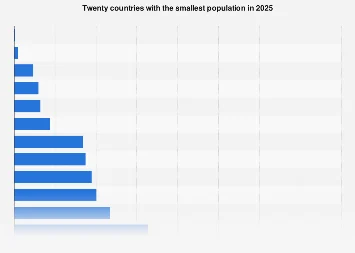
As global demographics continue to shift, with the world population projected to surpass 8 billion by mid-2025, attention often focuses on the megacities and burgeoning nations. However, a fascinating counterpoint exists in the form of the world’s smallest sovereign states, entities that, despite their minuscule populations, play unique roles on the international stage and face distinct economic challenges and opportunities. These micronations, defined by their extremely limited geographical footprint and correspondingly small citizenry, offer a compelling case study in sovereignty, economic resilience, and diplomatic engagement against the backdrop of a highly interconnected global economy.
Vatican City, the smallest independent state by both area and population, consistently ranks at the forefront of this category. With an estimated population hovering around 800 individuals, its economy is intrinsically linked to its spiritual and administrative functions as the headquarters of the Roman Catholic Church. The Vatican Museums, St. Peter’s Basilica, and the sale of stamps and coinage are significant revenue generators. Its economic model is less about traditional GDP growth and more about maintaining its unique cultural and religious heritage, which attracts millions of pilgrims and tourists annually. This influx provides substantial income, enabling the Holy See to fund its extensive diplomatic corps and charitable works worldwide. The economic stability of Vatican City is thus a testament to the power of unique cultural and religious assets in driving economic activity, even with a population smaller than many a small town.
Following closely is Nauru, a Pacific island nation with a population that has seen significant fluctuations but remains well under 11,000. Nauru’s economic history is a stark illustration of the boom-and-bust cycle associated with natural resource dependence. Once buoyed by vast phosphate reserves, the depletion of this primary resource led to severe economic hardship. Today, Nauru grapples with the challenge of economic diversification, relying on foreign aid, fisheries licensing, and its role in regional diplomacy, including hosting an Australian immigration detention center. The economic imperative for Nauru is clear: to build sustainable industries that are not vulnerable to external shocks or the exhaustion of finite resources. Its future economic trajectory will likely depend on its ability to leverage its maritime exclusive economic zone for fisheries and potentially for renewable energy projects, while also fostering human capital development to support a more diversified service sector.
Another notable entity in this demographic echelon is Tuvalu, an island nation in Polynesia with a population also under 11,000. Tuvalu’s economy is characterized by its vulnerability to climate change, with rising sea levels posing an existential threat. Remittances from Tuvaluan citizens working abroad, particularly in the maritime industry and as seasonal agricultural workers in countries like Australia and New Zealand, form a crucial pillar of its economy. The nation also generates revenue from fishing licenses and its .tv domain name registry, a clever monetization of its unique internet country code. Tuvalu’s economic strategy is heavily influenced by international climate finance and its advocacy on the global stage for climate action. Its survival and economic well-being are inextricably linked to the world’s collective response to climate change, making its economic future a bellwether for other low-lying island nations.
The economic structures of these smallest nations are profoundly different from those of larger economies. They often lack the economies of scale that drive industrial production and consumer markets. Instead, their economic models tend to be highly specialized, relying on unique endowments, strategic positioning, or international recognition. For instance, Monaco, while larger in population than Vatican City or Nauru, with around 36,000 residents, presents a different economic paradigm. Its prosperity is built on luxury tourism, high-end real estate, and its status as a tax haven for the wealthy. This model, while successful, highlights the challenges of dependency on specific niche markets and the potential for external regulatory pressures to impact revenue streams. Monaco’s economic resilience is a testament to its ability to attract and retain a wealthy populace and its sophisticated financial services sector, but it also underscores the importance of maintaining a favorable regulatory and security environment.
San Marino, an enclave within Italy with a population approaching 34,000, offers another perspective. Its economy is diversified, with significant contributions from manufacturing, financial services, and tourism. Its long history of independence and stable governance have fostered a favorable business climate. San Marino’s success lies in its ability to integrate its economy with that of its larger neighbor while maintaining its distinct identity and fiscal policies. This model of close economic integration with a larger economic bloc, while preserving sovereignty, is a strategy that other small nations might consider.
The economic challenges faced by these small states are multifaceted. They include limited access to capital, reliance on a narrow range of export products or services, susceptibility to external economic shocks, and the high cost of providing public services to a dispersed or very small population. Furthermore, many of these nations are highly dependent on foreign aid and international financial institutions for development projects and budgetary support. The global economic landscape, with its intricate trade agreements, fluctuating commodity prices, and evolving regulatory frameworks, presents a complex environment for these entities to navigate.
However, these small nations also possess certain advantages. Their size can foster a strong sense of national identity and social cohesion, which can be a bedrock for economic stability. Their governments are often more agile and responsive to the needs of their citizens. Moreover, their unique status can be leveraged for diplomatic influence, as seen in the international advocacy of nations like Tuvalu on climate change. The digital economy also offers new avenues for growth, allowing these nations to participate in global markets without necessarily requiring large physical infrastructure. The .tv domain name example is indicative of how even intangible assets can become significant revenue streams in the digital age.
Looking ahead to 2025 and beyond, the economic prospects for the world’s smallest nations will continue to be shaped by global trends such as climate change, technological innovation, and geopolitical shifts. For nations like Tuvalu and the Maldives, adaptation to rising sea levels will remain the paramount economic and societal challenge, requiring sustained international cooperation and innovative financing mechanisms. For others, the focus will be on further diversification, leveraging their unique cultural heritage, or embracing new digital economic models. The ability of these micronations to thrive will depend on their strategic foresight, their capacity to forge strong international partnerships, and their resilience in the face of unprecedented global challenges. Their continued existence and economic evolution serve as a potent reminder that in the complex tapestry of the global economy, even the smallest threads can play a significant and unique role.