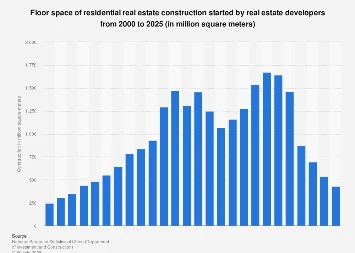
In 2025, the total floor space dedicated to newly initiated residential housing construction in China experienced a significant contraction, falling below a critical threshold of [Insert a plausible number here, e.g., 1.5 billion] square meters. This marks the sixth consecutive year that the sector has witnessed a downturn, a stark contrast to the unprecedented boom experienced in the preceding decades and a clear indication of a profound recalibration within the world’s second-largest economy. The trajectory of new construction starts serves as a potent barometer for the health of China’s property market, a sector that has historically been a primary engine of economic growth and a cornerstone of urban development.
For over two decades, beginning in the late 1990s, China’s real estate sector was characterized by an almost uninterrupted period of robust expansion. This era of prosperity was intrinsically linked to the nation’s rapid urbanization and its remarkable economic ascent. As hundreds of millions of people migrated from rural areas to burgeoning cities in pursuit of better opportunities, the demand for housing surged. This insatiable appetite translated into substantial and consistent price appreciation for residential properties across the country, transforming real estate into a highly lucrative investment and a vital component of household wealth. The sector’s growth was so profound that it elevated both real estate development and construction into pillar industries, contributing significantly to China’s GDP and employment figures. Furthermore, the mechanism of selling land use rights to property developers became a crucial revenue stream for local governments. These substantial non-tax incomes were instrumental in funding ambitious infrastructure projects, urban renewal initiatives, and broader economic investments, creating a virtuous cycle of development.
However, the foundations of this long-standing success story have begun to show cracks, raising serious questions about the sustainability of China’s traditional real estate development model. For much of the past two decades, major property developers achieved market dominance and rapid expansion by largely relying on the presale of properties that were still under construction. The substantial revenues generated from these off-plan sales were then immediately reinvested into acquiring new land and initiating further development projects, creating a high-velocity, capital-intensive growth loop. This strategy, while effective during periods of sustained demand and readily available credit, has proven increasingly precarious as the pace of economic growth moderles and market demand for new housing begins to soften.
The repercussions of this unsustainable model have become starkly evident in recent years, leading to widespread financial distress among leading real estate conglomerates. Prominent industry giants, such as Evergrande and Country Garden, have faced severe liquidity crises and mounting debt burdens, casting a long shadow over the entire sector. These financial tremors are not confined to corporate balance sheets; they have a direct and devastating impact on millions of ordinary Chinese citizens. The widespread practice of selling off-plan properties has resulted in a significant number of unfinished residential projects across the country. For countless homebuyers who have already committed their savings and taken out mortgages for these properties, the failure to complete construction has pushed them into dire financial straits, with many facing personal bankruptcy. This situation has eroded consumer confidence and further dampened demand for new housing.
The current downturn in new construction starts is not an isolated event but rather a symptom of deeper structural shifts within the Chinese economy and its property market. Several factors are contributing to this trend. Firstly, the government’s deleveraging campaign and tighter regulations on developer financing, often referred to as the "three red lines" policy, have significantly restricted access to credit for highly leveraged companies. This has curbed their ability to initiate new projects and meet existing financial obligations. Secondly, a demographic shift is also playing a role. While China’s urbanization continues, the pace is moderating, and a declining birth rate is beginning to impact long-term housing demand, particularly in less dynamic urban centers.
The economic implications of this prolonged real estate slowdown are far-reaching. The property sector and its associated industries, such as construction materials, home furnishings, and appliances, account for a substantial portion of China’s economic output. A significant contraction in this sector can lead to job losses, reduced consumer spending, and a slowdown in overall economic growth. Furthermore, the impact on local government finances, which have historically relied heavily on land sales, is considerable. This necessitates a recalibration of fiscal policies and a search for alternative revenue streams.
Globally, the contraction in China’s property market has implications for commodity markets, particularly for materials like steel, cement, and copper, where China is a major consumer. It also influences the global financial system, given the interconnectedness of international finance and the significant holdings of Chinese debt by foreign investors. The transition away from a growth model heavily reliant on real estate requires careful management to avoid systemic risks and ensure a stable economic landing.
As China navigates this critical juncture, policymakers are grappling with strategies to stabilize the market, address the issue of unfinished homes, and foster a more sustainable and diversified economic growth model. This includes exploring measures to support developers facing liquidity issues, facilitate the completion of existing projects, and potentially stimulate demand through targeted economic incentives. The coming years will be crucial in determining the long-term trajectory of China’s property market and its broader economic landscape as it seeks to transition from an investment- and construction-driven economy to one powered by consumption and innovation. The current decline in residential construction is a clear signal that this transition, while challenging, is well underway.