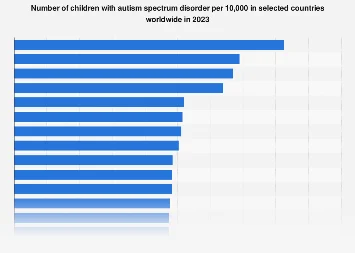
Global disparities in the reported prevalence of Autism Spectrum Disorder (ASD) among children are significant, with data from 2023 indicating a wide range of diagnoses across selected countries. While some nations report over 125 cases per 10,000 children, others fall below 40 cases per 10,000. This wide spectrum of figures underscores complex interactions between diagnostic practices, awareness levels, and potentially biological factors. Brunei, for instance, recorded the highest prevalence at 165.13 cases per 10,000 children, followed closely by Singapore (138.17), Japan (133.96), and South Korea (127.89). These East Asian nations consistently appear at the higher end of reported prevalence rates, suggesting a potential confluence of advanced diagnostic capabilities and a high level of public and medical awareness.
In contrast, countries like the United States reported a prevalence of 96.92 cases per 10,000 children, placing it just outside the top ten highest rates globally. This figure, while substantial, is considerably lower than the leading nations. The nuanced interpretation of such statistics is critical. As noted by data aggregators, a higher prevalence rate does not automatically signify a greater incidence of ASD. Instead, it may reflect a healthcare system’s enhanced capacity for early detection, accurate diagnosis, and comprehensive assessment compared to systems in other regions. This distinction is crucial for avoiding misinterpretations and for directing resources effectively.
The economic implications of these variations are multifaceted. For countries with higher reported prevalence rates, there is a corresponding demand for specialized educational services, therapeutic interventions, and long-term support systems. This can place a considerable strain on public health budgets and social welfare programs. Investment in early intervention services, for example, has been shown to improve long-term outcomes for individuals with ASD and can lead to significant cost savings in terms of reduced need for intensive support in adulthood. However, the initial investment can be substantial.
The United Nations’ Sustainable Development Goals, particularly Goal 3 (Good Health and Well-being) and Goal 4 (Quality Education), implicitly address the need for equitable access to healthcare and education for all children, including those with developmental disorders. Understanding the global landscape of ASD prevalence is a foundational step in developing targeted policies and interventions that align with these global objectives. The disparities observed in the data highlight the need for international collaboration in research, training of healthcare professionals, and the development of standardized diagnostic criteria.
The economic impact extends beyond direct healthcare and education costs. Families of children with ASD often face increased financial burdens due to therapy expenses, specialized care, and potential limitations on parental employment. This can affect household income and contribute to broader economic disparities. Furthermore, the long-term economic productivity of individuals with ASD can be influenced by the availability and quality of support they receive throughout their lives. Empowering individuals with ASD to reach their full potential through appropriate interventions contributes to a more inclusive and productive society.
Several factors contribute to the observed differences in prevalence data. Diagnostic criteria for ASD have evolved over time, and the understanding and recognition of the spectrum’s nuances vary geographically. In regions with more developed healthcare infrastructure, there is often greater access to specialists trained in diagnosing ASD, leading to higher identification rates. Public awareness campaigns and increased parental advocacy can also play a significant role in driving early diagnoses. Conversely, in regions with limited healthcare resources, underdiagnosis may be a significant issue, meaning the true prevalence could be higher than reported figures suggest.
The economic landscape of ASD diagnosis and support also varies significantly. In high-income countries, robust insurance systems and government funding often facilitate access to a range of services. However, waiting lists for assessments and therapies can still be long, and the cost of specialized private services can be prohibitive for many families. In low- and middle-income countries, the challenges are often more profound, with limited availability of trained professionals, lack of specialized facilities, and significant out-of-pocket expenses for families. This creates a stark inequity in access to care and support.
Comparing the prevalence rates across continents offers a broader perspective. While East Asian countries lead in reported prevalence, many African nations, such as Bangladesh (33.99 cases per 10,000), Nepal (37.36), and Bhutan (39.59), report significantly lower figures. This gap might reflect a combination of factors, including lower diagnostic capacity, cultural perceptions of developmental differences, and a greater burden of other pressing health concerns. However, it is imperative to consider that these lower numbers could also represent significant underreporting rather than actual lower incidence.
The economic implications of addressing ASD are increasingly being recognized as a critical component of public health and social policy. Investing in comprehensive diagnostic services, early intervention programs, inclusive education systems, and vocational training for individuals with ASD can yield significant returns, not only in terms of individual well-being but also in fostering a more diverse and productive workforce. The economic argument for increased investment in ASD support is becoming increasingly compelling, supported by research demonstrating the long-term benefits of early and sustained intervention.
Furthermore, the global economic impact of ASD needs to be viewed through the lens of research and development. Investment in understanding the genetic, environmental, and neurological underpinnings of ASD can lead to more effective diagnostic tools and therapeutic strategies. International collaboration in research is vital for accelerating progress and for sharing best practices in diagnosis and intervention. This collaborative approach can help to bridge the knowledge and resource gaps that currently exist between different regions of the world.
The economic burden associated with ASD is not solely confined to direct costs. It also includes indirect costs such as reduced productivity of caregivers, strain on social support systems, and the societal cost of underutilized human potential. Addressing these challenges requires a holistic approach that integrates healthcare, education, social services, and economic development policies. By investing in comprehensive support systems, societies can not only alleviate the burden on families but also unlock the full potential of individuals with ASD, contributing to a more equitable and prosperous global future. The economic imperative to understand and address ASD is therefore intrinsically linked to the social and ethical imperative to support all individuals, ensuring they have the opportunity to thrive.