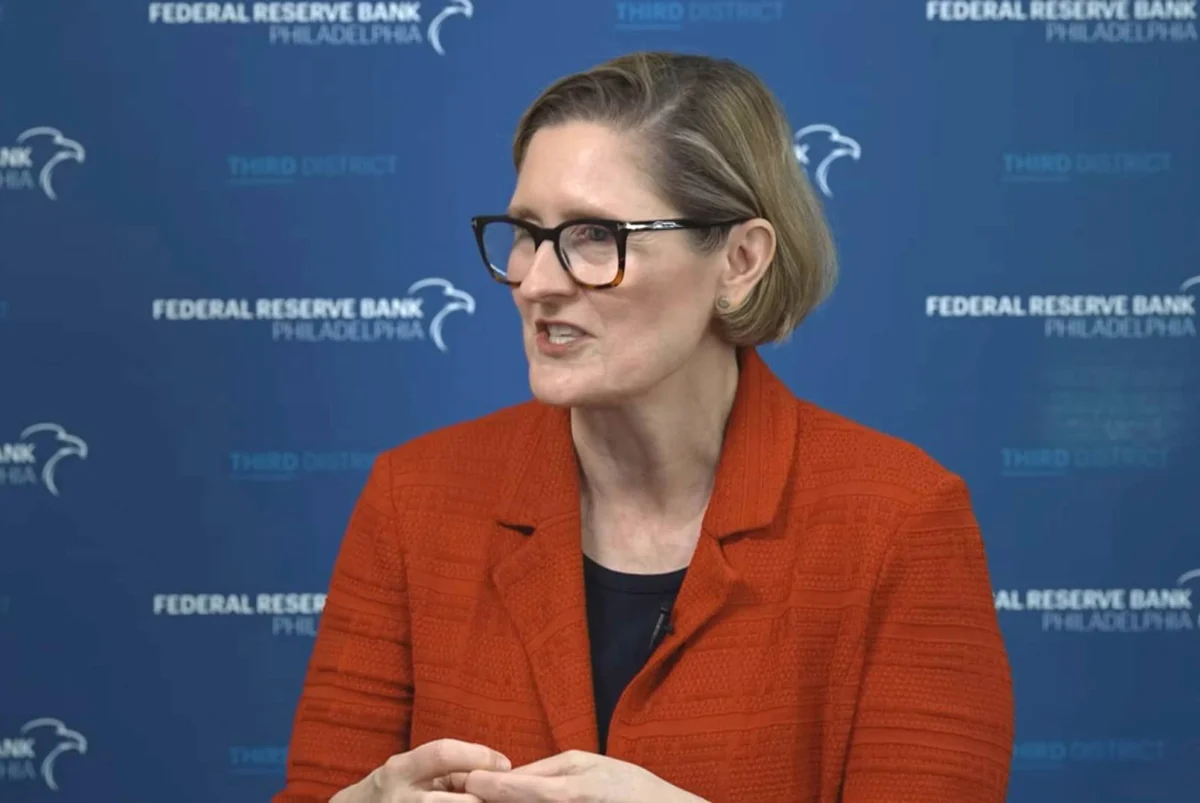
In the complex landscape of post-pandemic monetary policy, the Federal Reserve finds itself at a critical juncture, balancing the need for price stability against the risks of overtightening. Philadelphia Federal Reserve President Anna Paulson recently stepped into the spotlight to articulate a vision of cautious persistence, suggesting that the current federal funds rate—anchored between 3.5% and 3.75%—is effectively positioned to steer the U.S. economy toward its elusive 2% inflation target. Speaking in her first major televised interview since the July 2026 policy meeting, Paulson characterized the current monetary stance as "mildly restrictive," a middle-ground approach designed to dampen inflationary pressures without triggering a sharp contraction in labor markets or industrial output.
Paulson’s remarks come at a time of heightened internal debate within the Federal Open Market Committee (FOMC). The most recent policy decision, which saw the committee vote 9-3 to maintain the status quo, revealed a growing rift among policymakers. While the majority favored a "wait-and-see" approach, the three dissenting votes signaled a more aggressive hawkish contingent concerned that the current rate level lacks the necessary "bite" to fully extinguish stubborn price increases. For Paulson, however, the decision to hold steady was far from a difficult choice. She emphasized that the cumulative effects of previous rate adjustments are still filtering through the broader economy, and that patience is currently a more valuable asset than further intervention.
The core of the debate lies in the interpretation of "restrictiveness." In economic theory, the neutral rate—often referred to as r-star—is the interest rate at which policy is neither stimulative nor contractionary. If the neutral rate has drifted higher due to structural changes in the global economy, such as shifting demographics or increased government spending, then a 3.5% nominal rate might not be as restrictive as it appears on paper. Paulson acknowledged this uncertainty but maintained that the current trajectory is sufficient. She argued that the goal is to achieve a "soft landing," where inflation returns to the 2% mandate while the economy continues to grow, albeit at a moderated pace.
The data backdrop for this policy stance is nuanced. According to recent reports from the Commerce Department, core inflation—the Fed’s preferred gauge which excludes volatile food and energy costs—stood at 3.3% in June. While this is a significant retreat from the peaks seen in previous years, it remains well above the 2% threshold. Paulson, however, offered a more optimistic "underlying" view of the inflationary environment. By stripping away idiosyncratic factors such as temporary energy supply shocks, the impact of new trade tariffs, and other exogenous variables, she estimates that the true underlying inflation rate sits somewhere between 2.4% and 2.8%.
This distinction between headline data and "underlying" trends is crucial for market participants trying to forecast the Fed’s next move. If Paulson’s assessment is correct, the U.S. is closer to its target than the raw numbers suggest. However, she was careful to leave the door open for a pivot should the data fail to cooperate. The Philadelphia Fed chief noted that if progress toward the 2% goal stalls or reverses, she would be "open to recalibrating" policy. This "data-dependent" mantra has become a hallmark of the current Fed leadership under Chairman Kevin Warsh, reflecting a desire to avoid the forward-guidance traps that sometimes constrained the central bank in the past.
The broader economic environment further complicates the Fed’s calculus. The U.S. economy grew at a 1.5% annualized rate in the second quarter of 2026, a deceleration that suggests the central bank’s previous tightening cycles are indeed cooling demand. For Paulson and the majority of the FOMC, this cooling is a sign that the "mildly restrictive" policy is working as intended. A sharper slowdown could raise the specter of recession, while a re-acceleration of growth could force the Fed to resume its hiking cycle. This delicate balancing act is being watched closely by global markets, as the U.S. interest rate environment dictates capital flows and currency valuations across the globe.

In a global context, the Fed’s current stance places it in a unique position among major central banks. While some European counterparts have begun to experiment with modest rate cuts to support flagging growth, and the Bank of Japan continues its slow exit from ultra-loose policy, the Fed’s "higher for longer" strategy maintains the U.S. dollar’s strength. This divergence has significant implications for international trade, as a strong dollar makes U.S. exports more expensive while helping to keep domestic import costs down, providing an additional, if indirect, deflationary tailwind.
Beyond interest rate levels, Paulson also addressed potential institutional changes within the Federal Reserve itself. Chairman Kevin Warsh has floated the idea of reducing the frequency of FOMC meetings from the current schedule of eight per year. The rationale behind such a move would be to reduce short-term market volatility and allow policymakers more time to digest comprehensive data sets between decisions. Paulson expressed an "open mind" regarding this proposal, noting that it is healthy for the institution to reflect on its operational efficiency. Proponents of fewer meetings argue that the current six-week cycle often forces the Fed to react to "noise" rather than "signal," whereas a longer interval could promote a more strategic, long-term outlook.
The reaction from the financial sector to Paulson’s comments has been one of cautious relief. Treasury yields remained relatively stable following her interview, as investors interpreted her stance as a signal that the bar for further rate hikes is high, even if cuts are not yet on the horizon. However, the three dissenting votes at the last meeting serve as a reminder that the consensus is fragile. The "hawks" on the committee likely remain concerned about a potential wage-price spiral or a rebound in commodity prices that could de-anchor inflation expectations.
As the FOMC looks toward its upcoming meetings in the final half of the year, the focus will remain squarely on labor market resilience and consumer spending. If the unemployment rate, which has remained historically low, begins to creep upward significantly, the pressure on Paulson and her colleagues to pivot toward a more accommodative stance will intensify. Conversely, if consumer demand proves too resilient, the "mildly restrictive" label may be discarded in favor of more aggressive measures.
Paulson’s emphasis on "progress" is the key takeaway for economists. By defining her position through the lens of incremental improvement rather than a fixed timeline, she provides the Fed with the maximum possible flexibility. This approach acknowledges that the path to 2% inflation is rarely a straight line and is often subject to global shocks beyond a central bank’s control. Whether it is geopolitical instability affecting shipping routes or domestic fiscal policy shifts, the Fed must remain an anchor of stability in a volatile world.
In summary, Philadelphia Fed President Anna Paulson’s current outlook represents the majority view of a central bank determined to finish the job on inflation without overstaying its welcome in restrictive territory. By defending the current 3.5%-3.75% rate range, she is betting that the current "mildly restrictive" settings are the correct dosage for an economy that is slowing but not yet breaking. As the Fed navigates the remainder of 2026, the success of this strategy will depend on whether the "underlying" inflation she monitors continues its descent, or whether the dissenting voices on the committee were right to warn of a more persistent inflationary threat. For now, the message from Philadelphia is clear: stay the course, watch the data, and keep all options on the table.