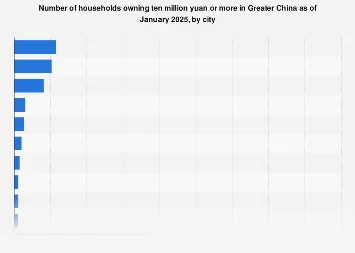
As of January 2025, Greater China’s urban centers continue to be magnets for high-net-worth individuals, with Beijing, Shanghai, and Hong Kong firmly establishing themselves as the preeminent cities for millionaire households. These economic powerhouses are home to the lion’s share of individuals possessing assets equivalent to ten million yuan or more, signaling a robust and concentrated wealth distribution within the region. While precise figures for specific cities remain proprietary, early indicators suggest a continued upward trajectory in the number of affluent households across these key metropolitan areas.
The concentration of wealth in these select cities is not merely a statistical anomaly but a reflection of deep-seated economic and structural factors. Beijing, as the political and cultural capital, benefits from a concentration of state-owned enterprises, government-backed technology initiatives, and a burgeoning service sector that attracts top talent and capital. Its ecosystem fosters innovation and provides fertile ground for high-value ventures, particularly in technology, finance, and real estate. Shanghai, long recognized as China’s financial heartland, continues to leverage its status as a global trade and financial hub. Its sophisticated financial markets, international business environment, and advanced infrastructure draw both domestic and foreign investment, fueling wealth creation in sectors ranging from finance and manufacturing to logistics and luxury goods.
Hong Kong, despite geopolitical shifts, retains its critical role as a gateway to mainland China and a vital international financial center. Its well-established legal framework, low tax regime, and deep capital markets continue to attract global investors and entrepreneurs, solidifying its position as a prime location for wealth management and international business operations. The city’s resilience and adaptability have enabled it to maintain its allure for the ultra-wealthy, particularly those seeking to bridge East and West.
The broader economic landscape of Greater China underscores this wealth accumulation trend. The region has witnessed decades of unprecedented economic growth, lifting millions out of poverty and creating a substantial middle and upper class. This expansion has been driven by a confluence of factors including rapid industrialization, a burgeoning export-oriented economy, significant domestic consumption, and increasing foreign direct investment. As the economy matures, a greater proportion of this wealth is consolidating within urban centers where opportunities for high-skilled employment, entrepreneurial ventures, and strategic investments are most prevalent.
Examining the global context, the concentration of millionaires in a few key cities is a common phenomenon. Major global financial centers such as New York, London, and Tokyo also exhibit similar patterns of wealth aggregation. However, the speed and scale of wealth creation in Greater China in recent decades are remarkable. Emerging markets, in particular, often see wealth becoming increasingly localized in their most dynamic urban areas as infrastructure, talent pools, and market access converge.
The implications of this concentrated wealth are multifaceted. On one hand, it signifies economic dynamism and the success of specific urban development strategies. These cities become engines of innovation, consumption, and job creation, attracting further investment and talent. The presence of a large affluent population also fuels demand for high-end goods and services, supporting sectors like luxury retail, premium hospitality, and specialized financial services. This, in turn, can lead to further economic multiplier effects.
Conversely, such a high degree of wealth concentration can exacerbate income inequality within the broader region and even within these cities themselves. While the millionaire population grows, the disparity between the ultra-wealthy and the rest of the population can widen, posing potential social and economic challenges. Policymakers in these regions often grapple with balancing strategies to foster continued wealth creation with initiatives aimed at ensuring broader economic inclusion and social mobility.
The definition of "rich" in this context – households owning ten million yuan or more – translates to approximately $1.4 million USD or €1.3 million EUR (based on August 2026 exchange rates). This benchmark, while significant, is a stepping stone for many aspiring individuals in these rapidly growing economies. The continued expansion of the middle class and the increasing accessibility of investment opportunities suggest that the number of households meeting or exceeding this threshold is likely to continue its upward trajectory.
Looking ahead, the economic trajectories of Beijing, Shanghai, and Hong Kong are expected to remain robust, albeit with potential shifts influenced by global economic headwinds, geopolitical developments, and domestic policy changes. Investments in technology, green energy, and advanced manufacturing are likely to continue driving economic growth and wealth creation. Furthermore, the ongoing integration of the Greater Bay Area, encompassing Hong Kong, Macau, and nine cities in Guangdong Province, holds the potential to create new economic synergies and further concentrate wealth and opportunity within this dynamic region.
The data, even in its aggregated form, provides a clear picture of where significant wealth resides within Greater China. It underscores the critical role these urban centers play not only within China’s economy but also on the global stage, as they continue to shape markets, drive innovation, and attract the world’s affluent. The story of millionaire growth in these cities is intrinsically linked to the broader narrative of China’s economic ascendancy and its evolving place in the global economic order.