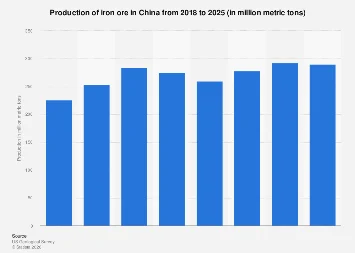
China’s domestic iron ore production is poised for a period of dynamic change leading up to 2025, driven by a confluence of strategic industrial policy, technological advancements, and evolving global commodity markets. While specific, granular production figures for future years often remain proprietary and subject to revision, industry analyses and government directives provide a clear trajectory for the nation’s commitment to bolstering its self-sufficiency in this critical raw material. The ongoing emphasis on high-quality domestic ore extraction, coupled with a concerted effort to optimize the utilization of existing resources, signals a significant shift in the country’s approach to securing the foundational elements of its vast steel industry.
The sheer scale of China’s steel production, which consistently accounts for over half of the global output, underpins the paramount importance of iron ore. This insatiable demand has historically led China to be the world’s largest importer of iron ore, relying heavily on major suppliers like Australia and Brazil. However, recent years have witnessed a strategic pivot. Beijing’s industrial planners are increasingly prioritizing the development of domestic mines and the exploration of new deposits, aiming to reduce reliance on foreign sources and mitigate supply chain vulnerabilities. This national imperative is not merely about quantity but also about quality and efficiency, pushing for the adoption of more sophisticated mining techniques and the processing of lower-grade domestic ores into higher-value products.
Projections and targets, though not always publicly stated as hard production numbers for specific years, are embedded within broader industrial development plans. For instance, China’s "Made in China 2025" initiative, while focusing on a range of advanced manufacturing sectors, indirectly influences the steel industry by demanding higher quality and more specialized steel products, which in turn necessitates a greater focus on the quality and consistency of iron ore inputs. Furthermore, policies aimed at consolidating the mining sector, phasing out inefficient and polluting smaller operations, and encouraging larger, state-backed enterprises to invest in advanced extraction and processing technologies are all contributing factors to the anticipated evolution of domestic production.
The economic implications of this domestic focus are substantial. A significant increase in China’s self-produced iron ore could alter global trade flows and impact the revenue streams of major iron ore exporting nations. While it is unlikely that China will achieve complete self-sufficiency in the short to medium term, any reduction in its import dependency, even by a few percentage points, would be keenly felt in the international market. This could lead to greater price volatility as global demand-supply dynamics adjust. For example, fluctuations in Chinese import demand have historically been a major driver of iron ore price movements. A more domestically oriented China could create a more stable, albeit potentially smaller, international market for its iron ore exports.
Technological innovation plays a crucial role in this strategic recalibration. Chinese mining companies are investing heavily in automation, artificial intelligence, and advanced geological surveying techniques to improve efficiency, reduce operational costs, and enhance safety. The development of new processing technologies that can extract more value from lower-grade domestic ores is also a key area of focus. This includes advancements in beneficiation techniques, which can upgrade the iron content of ore concentrates, making them more suitable for modern blast furnace operations. The goal is to transform China’s vast, often lower-grade, iron ore reserves into competitive domestic supply.
Moreover, the environmental aspect of mining is receiving increased attention. As China pursues its ambitious climate goals, including carbon neutrality targets, the mining sector is under pressure to adopt more sustainable practices. This includes reducing water usage, minimizing land disruption, and controlling emissions. Investments in cleaner mining technologies and more efficient processing methods are thus intertwined with the drive to increase domestic production. Companies that can demonstrate superior environmental performance may gain a competitive edge and access to more favorable regulatory frameworks.
The global context for China’s iron ore ambitions is shaped by the ongoing energy transition and the decarbonization efforts of industries worldwide. While steel production remains a carbon-intensive process, the demand for steel is expected to remain robust, particularly in developing economies and for infrastructure projects. China’s role as a dominant player in the global steel market means that its decisions regarding iron ore sourcing and production will have far-reaching consequences. The nation’s efforts to enhance its domestic iron ore capabilities are not just an internal matter but a significant factor in the global commodity landscape.
The development of large-scale, high-quality domestic iron ore mines often requires substantial capital investment and long lead times. However, with government support and strategic planning, China is steadily working towards increasing its self-reliance. The country possesses significant iron ore reserves, and unlocking their potential through modern technology and efficient management is a key objective. This long-term strategy aims to create a more resilient and sustainable steel industry, less susceptible to the vagaries of international commodity markets and geopolitical influences.
Looking ahead to 2025, the trend of increasing domestic iron ore production in China is expected to continue, albeit with an emphasis on quality and efficiency rather than sheer volume increases that could overwhelm environmental regulations or market absorption capabilities. This strategic evolution is a testament to China’s determination to secure its industrial future by strengthening its foundational resource base, a move that will undoubtedly continue to shape global commodity markets for years to come. The world will be watching closely as China navigates this complex and crucial aspect of its economic development.