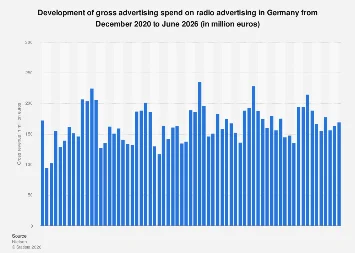
Gross revenues generated by radio advertising in Germany in June 2026 registered an estimated figure of approximately [Redacted] million euros, indicating a discernible downturn of around [Redacted] percent when contrasted with the corresponding period in the preceding year. This period, however, saw the fourth quarter emerge as a consistent peak for revenue generation thus far within the observed timeframe. Examining the broader landscape of the German radio advertising sector for the entirety of 2025, gross advertising revenues were estimated at around [Redacted] billion euros. This positioned radio as a significant, albeit not dominant, player, contributing approximately [Redacted] percent to the total share of gross advertising investment within Germany. For comparative context, television advertising unequivocally held the largest segment, commanding a substantial portion of nearly [Redacted] of all revenues. Newspapers, while historically a cornerstone of advertising, followed television in terms of market share.
The advertising expenditure landscape in Germany is a complex ecosystem, with various media vying for consumer attention and advertiser budgets. While television remains the behemoth, its dominance has been steadily challenged by the proliferation of digital platforms. Radio, often considered a more traditional medium, continues to demonstrate resilience, particularly in reaching specific demographics and in local advertising contexts. The enduring appeal of radio lies in its accessibility, its ability to integrate seamlessly into daily routines, and its cost-effectiveness compared to some other mass-market channels. This makes it a valuable tool for businesses seeking consistent brand presence and targeted campaign execution.
The economic climate plays an undeniable role in shaping advertising expenditure across all media. Fluctuations in consumer confidence, inflation rates, and overall economic growth can directly impact marketing budgets. In periods of economic uncertainty, advertisers often become more cautious, scrutinizing return on investment more rigorously and potentially shifting funds towards channels perceived as offering greater accountability or a more direct path to sales. The observed decline in June 2026’s radio advertising revenues may reflect broader economic pressures affecting discretionary spending by both consumers and businesses.
Looking ahead, projections for the radio advertising medium offer a mixed but cautiously optimistic outlook. According to analyses from PricewaterhouseCoopers (PwC), the net advertising revenues for the radio sector in 2024 were estimated at approximately [Redacted] million euros. This figure represented a modest, yet positive, increase compared to the previous year, suggesting a stabilization or even a nascent recovery. PwC’s forecasts extend to 2029, anticipating a continued upward trajectory for radio advertising revenues, with projections indicating a rise to approximately [Redacted] million euros. This forward-looking perspective suggests that despite the challenges, the radio medium is expected to retain and potentially grow its market share, adapting to evolving media consumption habits.
The resilience of radio advertising can be attributed to several factors. Firstly, its pervasive nature means it reaches a broad audience, often during commuting hours or while engaged in other activities, making it a constant companion for many. Secondly, technological advancements have enabled greater sophistication in radio advertising, including more targeted advertising capabilities through programmatic buying and data analytics, allowing advertisers to reach specific listener demographics with greater precision. Furthermore, the integration of radio with digital platforms, such as online streaming services and podcasts, offers new avenues for advertisers to engage with audiences across multiple touchpoints.
The competitive landscape for advertising revenue is intensifying, with digital media, including social media, search engines, and video-on-demand services, capturing an ever-larger share of the market. This digital shift has necessitated strategic adjustments from traditional media players. Radio broadcasters are increasingly investing in digital strategies, developing their own streaming platforms, podcasts, and social media presences to complement their traditional terrestrial broadcasts. This omnichannel approach allows them to offer advertisers integrated campaigns that leverage the strengths of both traditional and digital channels. The ability to offer cross-platform advertising solutions is becoming a crucial differentiator in securing and retaining advertising revenue.
The economic impact of a robust advertising sector extends beyond the media industry itself. Advertising fuels consumer demand, drives innovation, and supports economic growth by enabling businesses to reach new customers and expand their markets. A healthy advertising market is indicative of a confident business environment and a thriving consumer economy. Conversely, a significant contraction in advertising expenditure can signal broader economic headwinds, leading to reduced investment, slower job creation, and a dampening of consumer spending. Therefore, the trends observed in the German radio advertising market offer insights into the broader economic health of the nation.
Global comparisons highlight the diverse performance of radio advertising across different regions. While some mature markets might experience slower growth or even declines due to intense digital competition, emerging markets can see significant expansion as radio penetration increases and digital infrastructure develops. The German market, being a developed economy with a high level of digital adoption, faces a more complex challenge in maintaining its advertising revenue share against sophisticated digital alternatives. However, the established infrastructure and trusted brand recognition of many German radio stations provide a solid foundation for continued relevance.
The ongoing evolution of consumer behavior, particularly the shift towards on-demand content consumption and personalized media experiences, presents both challenges and opportunities for the radio advertising sector. Broadcasters that can effectively adapt to these changes, offering flexible and data-driven advertising solutions, are likely to thrive. The continued investment in content quality, technological innovation, and strategic partnerships will be crucial for the German radio advertising market to navigate the dynamic media landscape and secure its long-term economic viability. The ability to demonstrate tangible results and a strong return on investment will remain paramount for advertisers in their allocation of marketing budgets.