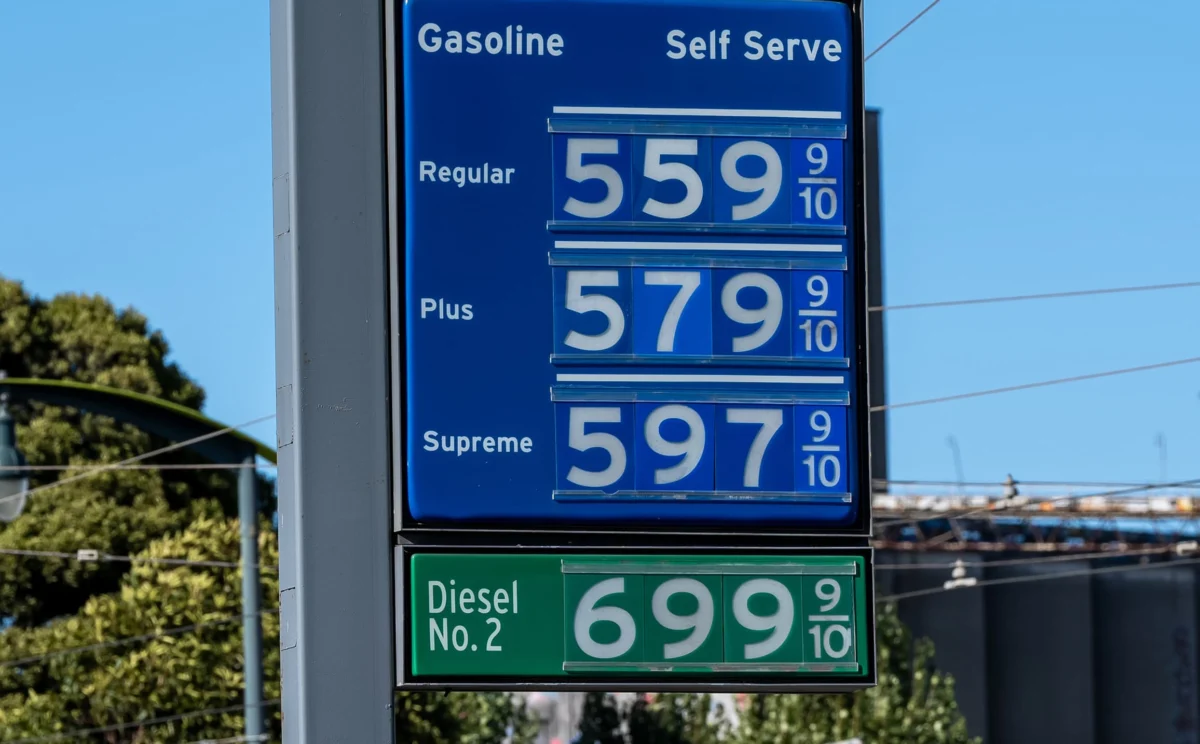
As the conflict involving Iran enters its sixth month, the geopolitical tremors originating in the Middle East are being felt most acutely at the fuel pumps of California, creating a fiscal shockwave that threatens to destabilize the broader American economy. While international attention has largely focused on the fluctuations of crude oil benchmarks like Brent and West Texas Intermediate, a more insidious crisis is brewing in the refined petroleum markets. Diesel, the indispensable "workhorse" of global commerce, has seen its price surge to levels that are now exerting significant pressure on supply chains, freight costs, and the ultimate price of consumer goods from coast to coast.
The economic geography of the United States dictates that California serves as the primary gateway for trans-Pacific trade. The San Pedro Bay port complex, which encompasses the Ports of Los Angeles and Long Beach, handles approximately one-third of all containerized imports and exports for the nation. This logistical dominance means that a substantial portion of the goods destined for shelves in the Midwest, the South, and the Atlantic seaboard begins its overland journey in a state where fuel costs are the highest in the country. Before a television, a crate of electronics, or a shipment of apparel reaches a distribution center in a lower-cost state, it is first hauled by heavy-duty trucks and locomotives powered by California-priced diesel.
Currently, the disparity between California’s energy market and the rest of the nation is stark. According to data from AAA, the national average for a gallon of diesel sits at approximately $5.36. However, in California, that figure has ballooned to $6.92—a dramatic increase from the $5.10 average recorded prior to the onset of the hostilities with Iran. This premium is not merely a local inconvenience; it functions as a hidden tax on the American consumer. As analysts at JPMorgan, led by Natasha Kaneva, noted in a recent briefing to clients, a "meaningful share of America’s supply chain pays West Coast fuel prices." These elevated costs directly influence transportation margins and freight rates, which are inevitably passed down the value chain.
The root of this price escalation is a perfect storm of geopolitical instability and structural refining deficits. The world is currently grappling with a shortfall of roughly 8% of global diesel demand. This deficit is driven by two primary factors: the ongoing war in the Middle East and the escalating Ukrainian drone strikes on Russian refining infrastructure. While the potential closure of the Strait of Hormuz remains a catastrophic risk for crude oil flows, the immediate bottleneck is the global capacity to process that crude into usable middle distillates like diesel.
ExxonMobil CEO Darren Woods recently highlighted this disconnect, suggesting that the refining challenge will likely persist for the foreseeable future. Even if geopolitical tensions ease and maritime corridors like the Strait of Hormuz remain open, the global market must still contend with the permanent or long-term loss of Russian refining capacity. Furthermore, the role of China remains a significant variable; the degree to which Beijing decides to export its surplus refined products could either alleviate or exacerbate the current global shortage.
California’s vulnerability to these global shifts is compounded by its unique domestic energy landscape. Historically, the state has functioned as something of an "energy island." Unlike the Gulf Coast or the East Coast, California lacks major interstate pipelines that could transport fuel from other refining hubs in the U.S. This isolation means the state is heavily reliant on its own refining capacity and waterborne imports. Over the past decade, however, California’s fossil fuel industry has contracted significantly. Stringent environmental regulations, high operational costs, and a strategic pivot toward renewable energy have led to the closure of several major refineries, leaving the remaining facilities to operate under immense pressure.

The state’s regulatory environment, while aimed at aggressive decarbonization, adds another layer of cost. California’s unique fuel specifications, designed to reduce smog and greenhouse gas emissions, mean that refiners cannot easily swap in fuel produced in other states or countries without extensive modifications. This lack of fungibility creates a rigid market where any supply disruption—whether caused by a refinery maintenance issue or a geopolitical event—leads to immediate and sharp price spikes.
The implications for the broader U.S. economy are profound. Diesel is the lifeblood of the industrial sector. It powers the tractors that harvest American crops, the construction equipment that builds infrastructure, and the massive engines of the Class I railroads. When diesel prices remain elevated for an extended period, the inflationary pressure is felt across multiple sectors simultaneously. In the agricultural sector, higher fuel costs increase the overhead for farmers, which eventually manifests as higher grocery prices for families. In the logistics sector, trucking companies, many of which operate on razor-thin margins, are forced to implement fuel surcharges that increase the "landed cost" of every item they carry.
Market analysts are closely watching the "crack spread"—the difference between the price of crude oil and the price of the refined products produced from it. Currently, the crack spread for diesel is significantly wider than historical norms, indicating that the problem is not just the cost of raw oil, but a fundamental lack of refining "space." This suggests that even if crude prices were to soften due to increased production from OPEC+ or U.S. shale basins, the price of diesel at the pump might remain stubbornly high until global refining capacity expands or demand significantly cools.
Looking ahead, the trajectory of diesel prices will depend on several moving parts. The first is the duration and intensity of the conflict with Iran. Any escalation that threatens the physical infrastructure of Middle Eastern refineries or further disrupts shipping lanes will keep the risk premium high. Second is the resilience of the Russian energy sector under continued pressure from Ukrainian tactical strikes. Third is the domestic policy environment in the United States, particularly in California, where the balance between environmental mandates and energy affordability is under constant debate.
The current crisis serves as a reminder of the fragility of the global energy transition. While the shift toward electric vehicles and renewable fuels is underway, the global economy remains tethered to the "workhorse" of diesel for its heavy-duty requirements. The transition period, characterized by declining investment in traditional refining and a slow ramp-up of alternatives, is proving to be a period of intense volatility.
For the American consumer, the message is clear: the war in the Middle East is not a distant event with no domestic consequence. Through the lens of California’s diesel prices, the conflict is reaching into the wallets of every citizen. As long as the San Pedro Bay remains the primary artery for American trade, and as long as the global refining market remains in a structural deficit, the high cost of fuel in the West will continue to be an inflationary anchor for the entire nation. The "hidden tax" of $6.92 diesel is no longer just a California problem; it is a national economic challenge that requires both geopolitical resolution and a long-term strategy for refining stability.