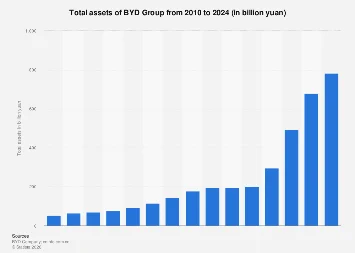
The total assets of BYD Group, a formidable player in the new energy vehicle (NEV) sector, are projected to surpass a significant milestone in 2024, reflecting the company’s aggressive growth trajectory and its deepening influence within the global automotive and energy industries. While precise figures remain under proprietary access, preliminary indicators suggest a substantial year-on-year increase, underscoring BYD’s strategic investments and expanding operational scale. This surge in asset valuation is not merely a financial metric; it represents the tangible manifestation of BYD’s burgeoning production capacity, advanced technological development, and widening market penetration across key international territories.
Founded in 1995, BYD’s evolution from a rechargeable battery manufacturer to a comprehensive NEV powerhouse is a compelling narrative of strategic diversification and technological prowess. The company’s integrated business model, encompassing battery technology, vehicle manufacturing, and even components like semiconductors, provides a unique competitive advantage. This vertical integration allows BYD to maintain greater control over its supply chain, optimize production costs, and accelerate innovation cycles, all of which contribute to its impressive financial performance and asset accumulation. The substantial growth in total assets for 2024 is a direct consequence of this multifaceted approach, allowing the company to channel resources into research and development, expand manufacturing facilities, and bolster its global sales and service networks.
The automotive industry, particularly the NEV segment, is experiencing unprecedented transformation, driven by increasing environmental consciousness, supportive government policies, and advancements in battery technology. BYD has positioned itself at the vanguard of this revolution. Its commitment to developing a full spectrum of NEVs, from electric buses and trucks to passenger cars, caters to a diverse range of market needs and mobility solutions. The company’s recent financial reports, even with masked aggregate figures, point towards a consistent upward trend in its balance sheet, a testament to its robust sales performance and strategic capital allocation. The estimated increase in total assets for 2024 is expected to be in the high single or low double digits, a figure that, given BYD’s already substantial asset base, translates into billions of yuan in added value.
This expansion of assets can be dissected into several key areas. Firstly, significant capital has been directed towards expanding and upgrading its manufacturing infrastructure. BYD operates numerous state-of-the-art production facilities across China and is increasingly establishing manufacturing hubs in international markets, such as Thailand, Brazil, and Hungary. These investments encompass not only assembly lines but also advanced battery production facilities and research centers, ensuring that BYD remains at the forefront of NEV technology. Secondly, the company has made substantial investments in research and development. This includes pioneering advancements in battery chemistry, such as its proprietary blade battery technology, which offers enhanced safety and energy density, and in electric powertrain efficiency. Furthermore, BYD is actively investing in autonomous driving technology and intelligent vehicle systems, positioning itself for the future of mobility.
The global market for NEVs is fiercely competitive, with established automotive giants and agile startups vying for market share. However, BYD has consistently outpaced many of its rivals. In 2023, the company surpassed Tesla in terms of pure electric vehicle sales, a landmark achievement that underscored its manufacturing scale and pricing competitiveness. This sales momentum directly translates into increased revenue and, consequently, a growing asset base. The demand for BYD’s vehicles is not confined to China; the company has aggressively expanded its export markets, becoming a leading NEV exporter from China. Its vehicles are now sold in over 70 countries and regions across the globe, from Europe and Asia to Latin America and the Middle East. This international expansion requires significant investment in logistics, distribution networks, and local market adaptation, all of which contribute to the company’s overall asset growth.
Economically, BYD’s expanding asset base has far-reaching implications. For China, BYD represents a crucial pillar of its advanced manufacturing and green energy strategy. The company’s success contributes significantly to the national GDP, employment figures, and technological advancement. On a global scale, BYD’s growth is accelerating the transition to sustainable transportation. By offering compelling and increasingly affordable NEV options, BYD is making electric mobility accessible to a broader segment of the global population, thereby contributing to the reduction of carbon emissions and combating climate change. The company’s investments in new markets also foster local economic development, creating jobs and stimulating related industries.
Looking ahead, the trend of asset growth for BYD is likely to continue. The company has ambitious plans for further capacity expansion, both domestically and internationally. It is also exploring new avenues for growth, including energy storage solutions and the integration of its vehicles with smart grid technologies. The global shift towards electrification and decarbonization provides a strong tailwind for BYD’s business model. As regulatory pressures on internal combustion engine vehicles intensify and consumer preferences continue to evolve, BYD is exceptionally well-positioned to capitalize on these trends. The ongoing development and application of cutting-edge technologies, coupled with strategic market expansion, will undoubtedly fuel further increases in its total assets, solidifying its position as a dominant force in the global NEV landscape for years to come. The sheer scale of its operations, from battery innovation to global distribution, makes BYD a critical case study in how integrated industrial strategies can drive unprecedented financial and market success in the 21st century.