The widespread integration of artificial intelligence into creative workflows is reshaping the landscape of innovation, promising unprecedented gains in productivity and efficiency across industries. From conceptual design in automotive engineering to scriptwriting in media and marketing campaign development, generative AI tools are being hailed as potent accelerators for human ingenuity. Yet, beneath this veneer of enhanced individual capability lies a complex paradox: while AI undeniably empowers individual creators to generate ideas with greater speed and fluency, emerging research indicates a significant, often overlooked, cost to collective innovation – a narrowing of the diversity of ideas produced by groups. This phenomenon presents a critical challenge for business leaders, especially given that a staggering 83% of senior executives consistently rank innovation among their top three strategic priorities. Understanding this duality is paramount for organizations striving to harness AI’s potential without inadvertently undermining the very source of breakthrough ideas.
Traditionally, creativity is understood as the confluence of novelty and usefulness. An idea is considered creative if it is both original and valuable in achieving a specific purpose. While these criteria effectively measure the merit of a single concept, the true engine of sustained innovation within an organization, or indeed an economy, lies in the diversity of ideas generated collectively. A rich tapestry of varied perspectives, approaches, and solutions is what fuels disruptive innovation, enabling companies to explore uncharted territories and uncover truly transformative market opportunities. Without this diversity, even a collection of individually "good" ideas can lead to convergent thinking, market saturation with similar offerings, and a reduced capacity for radical change.
Recent comprehensive studies underscore this critical distinction. Across four distinct research contexts – involving short-story writing, the development of circular-economy solutions, humor generation, and collaborative storytelling – a consistent pattern emerged: AI assistance invariably led to an increase in the average quality and quantity of individual output, but simultaneously correlated with a marked decrease in the collective diversity of ideas. Participants leveraging AI were more productive and their individual contributions often scored higher on conventional measures of quality and usefulness. However, when the entire pool of ideas from AI-assisted groups was analyzed, the range of concepts explored was significantly narrower compared to groups operating without AI. This implies a trade-off: higher average quality at the expense of fewer truly novel, outlier ideas – the very kind that often lead to groundbreaking discoveries and competitive differentiation.
The mechanisms behind this paradox are multifaceted. On the one hand, generative AI acts as an incredibly powerful brainstorming partner, capable of rapidly prototyping concepts, providing immediate feedback, and overcoming creative blocks. It democratizes access to advanced ideation capabilities, allowing individuals to quickly iterate and refine their thoughts. This fluency can be particularly beneficial for tasks requiring speed or a large volume of initial ideas. For example, a marketing team might use AI to generate hundreds of taglines in minutes, or a product designer might explore dozens of visual motifs.
However, this very efficiency can also become a constraint. Users, faced with a deluge of AI-generated suggestions, may inadvertently anchor their thinking on these initial outputs. The "good enough" effect can set in, where readily available AI-crafted solutions deter deeper, more divergent human exploration. If multiple individuals or teams within an organization are using the same or similar AI models with comparable prompting strategies, the collective ideation space can become homogenized. AI models, by their nature, are trained on vast datasets of existing information, which inherently biases them towards generating outputs that reflect established patterns and common solutions. While sophisticated prompt engineering can encourage more varied responses, without deliberate human intervention to push boundaries, the default tendency is towards convergence rather than radical divergence.

The economic implications of this "algorithmic conformity" are substantial. In an era where technological innovation is a primary driver of economic growth and competitive advantage, a reduction in the diversity of ideas could lead to a less dynamic, more predictable market landscape. Industries reliant on continuous innovation, such as pharmaceuticals, technology development, and creative arts, could see a decline in truly disruptive products or services. Instead, companies might find themselves competing on incremental improvements, leading to commoditization and margin compression. For instance, if all design agencies use similar AI tools for initial concept generation, the aesthetic outputs could become indistinguishably similar, making it harder for brands to stand out. Similarly, in scientific research, an over-reliance on AI for hypothesis generation could inadvertently steer collective inquiry away from unconventional yet potentially revolutionary avenues.
Addressing this conundrum requires a proactive and strategic approach to integrating AI into organizational workflows. Rather than viewing AI as a direct replacement for human creativity, businesses must reposition it as a sophisticated augmentation tool that requires intelligent human oversight and strategic deployment. Leading institutions like the University of Pennsylvania’s Wharton School, the University of Washington’s Foster School of Business, UCL School of Management, and the University of Exeter’s Institute for Data Science and Artificial Intelligence are actively exploring frameworks to navigate this "jagged technological frontier," where AI excels in certain aspects while human judgment remains indispensable for others.
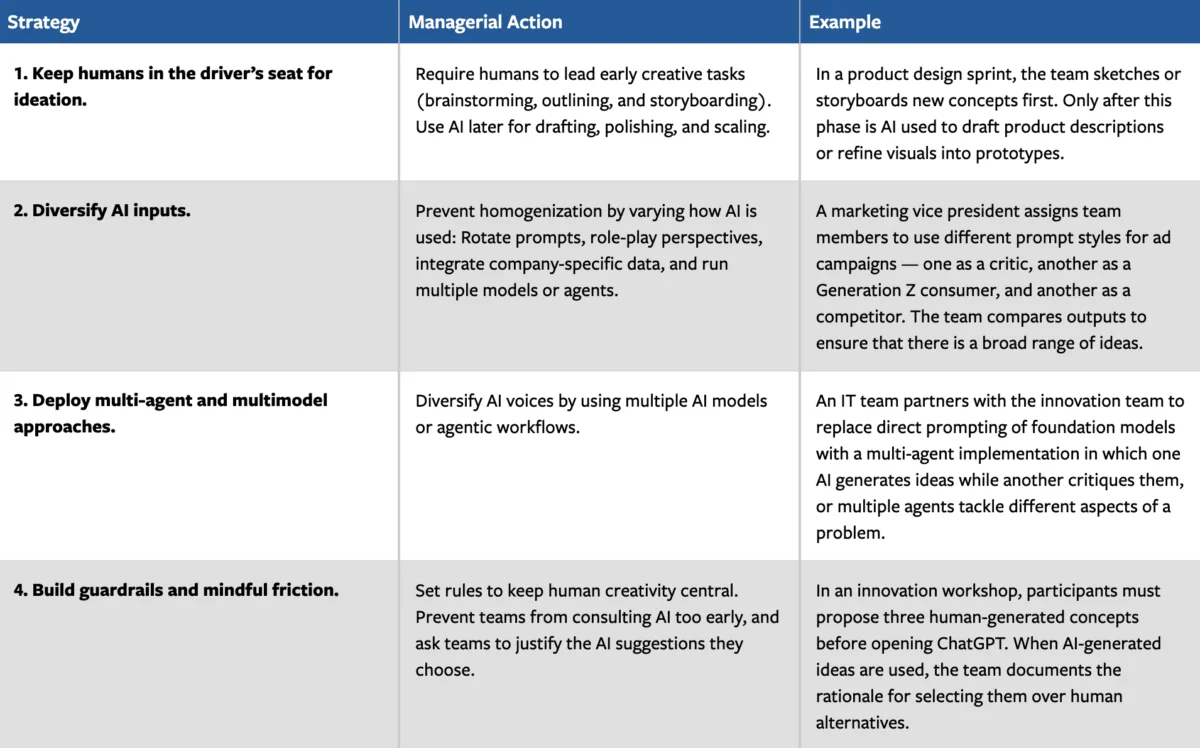
One key strategy involves a phased approach to human-AI collaboration. For example, AI could be leveraged in the initial ideation phases to rapidly generate a broad volume of diverse, even outlandish, concepts. However, the subsequent filtering, synthesis, and further development of these ideas should be human-led, with explicit instructions to seek out and champion the truly novel or unconventional. This involves cultivating an organizational culture that rewards risk-taking and divergent thinking, encouraging employees to challenge AI’s initial suggestions rather than passively accepting them.
Furthermore, advanced prompt engineering techniques are proving crucial. Instead of generic prompts, users can be trained to craft instructions that specifically demand novelty, variety, and even contradictory perspectives from AI. For instance, asking for "ten radically different solutions, including one that challenges industry norms and another that seems counter-intuitive" can push AI towards generating a wider spectrum of ideas. Regular audits of AI-generated content can also help identify patterns of convergence and inform adjustments to prompting strategies or AI model fine-tuning.
Organizations must also invest in developing a deeper understanding of human-AI interaction. This includes training employees not just on how to use AI tools, but critically, on how to critically evaluate AI outputs, understand their inherent biases, and identify where human insight is irreplaceable. The goal is to cultivate "AI literacy" that empowers individuals to be effective collaborators, rather than mere operators. Diversifying the AI tools and models used within an organization can also mitigate the risk of collective homogenization, as different models often exhibit varying biases and generative styles.
Ultimately, the future of innovation in an AI-powered world hinges on the ability of businesses to consciously design workflows that harness AI’s undeniable power to boost individual productivity while safeguarding and actively cultivating collective idea diversity. The challenge is not merely technological; it is deeply organizational and cultural. By acknowledging the paradox of AI-assisted creativity and implementing thoughtful strategies to counteract its narrowing effect, businesses can ensure that the promise of AI translates into sustained, breakthrough innovation, rather than a future of uniformly good, but ultimately uninspired, ideas. The global race for innovation will be won by those who master this intricate balance, leveraging AI to expand human potential in unprecedented ways, while preserving the spark of truly original thought.