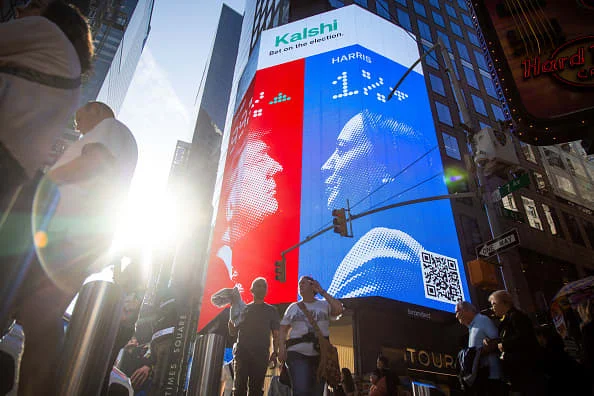
The landscape of American political forecasting is undergoing a fundamental transformation as the boundary between speculative finance and democratic participation continues to blur. Kalshi, the first regulated prediction market in the United States, has officially launched its "Midterms Hub," a sophisticated digital nerve center designed to aggregate real-time betting data, traditional polling, and financial disclosures ahead of the upcoming congressional elections. This move represents more than just a product update; it signifies the increasing institutionalization of "event contracts" as a legitimate alternative to traditional political science and opinion polling. By providing a centralized platform for tracking the odds of individual Senate and House races, Kalshi is positioning itself as a primary source of truth in an era where traditional polling has faced significant criticism for its perceived inaccuracies.
The newly unveiled Midterms Hub is structured as a comprehensive analytical dashboard. It allows observers to navigate an interactive map of the United States, drilling down into specific districts and states to see how traders are pricing the probability of various outcomes. Beyond the raw odds, the hub integrates polling averages to provide a direct comparison between what voters say to pollsters and where speculators are putting their capital. Furthermore, the platform incorporates Federal Election Commission (FEC) fundraising reports, offering a multi-dimensional view of a candidate’s viability by combining their financial war chest with their market-implied probability of victory.
This integration of disparate data sets addresses a growing demand for "noise reduction" in political media. According to Kalshi, approximately 75% of the platform’s visitors do not actually execute trades; instead, they use the site as a sophisticated information terminal. This suggests that the value proposition of prediction markets has expanded from a niche gambling activity to a vital tool for business leaders, policy analysts, and journalists who require real-time, objective indicators of political momentum. In a fragmented media environment, the "price" of a political outcome serves as a singular, digestible metric that captures the collective intelligence of thousands of participants.
Tarek Mansour, the co-founder and CEO of Kalshi and an alumnus of MIT with a professional pedigree at Goldman Sachs and Citadel, views this development as a necessary evolution of the information economy. Mansour argues that prediction markets possess a unique structural advantage over traditional punditry: the absence of ideological incentive. In a statement accompanying the launch, Mansour emphasized that these markets "cut through polarization" by focusing on the "wisdom of the crowds" backed by financial commitment rather than rhetorical posturing. The underlying theory is rooted in the "efficient market hypothesis," suggesting that when individuals are forced to back their opinions with money, they are incentivized to seek out the most accurate information rather than the most comforting narrative.
The economic implications of this shift are substantial. The 2024 presidential election served as a watershed moment for the industry, witnessing a massive surge in trading volume across various platforms. Kalshi is clearly betting that the 2026 midterms will sustain this momentum. Already, more than $30 million has been traded on contracts tied to which party will control the House and Senate. This volume is not merely a reflection of public interest; it represents the birth of a new asset class. For institutional investors and corporations, these contracts function as a form of "political insurance." A firm heavily dependent on renewable energy subsidies, for instance, might use prediction markets to hedge against the risk of a legislative shift that could jeopardize those incentives.
The launch of the Midterms Hub follows Kalshi’s introduction of the "American Power Index" earlier this year. Often described as the "S&P 500 for politics," the index tracks the relative strength of the Democratic and Republican parties across a basket of key indicators. These tools are designed to professionalize political speculation, moving it away from the "smoke-filled rooms" of legacy politics and into the transparent, high-frequency environment of modern financial exchanges. By standardizing how political sentiment is measured, Kalshi is creating a benchmark that could eventually influence broader market volatility and investment strategies.

However, the rise of prediction markets is not without its detractors and regulatory hurdles. For years, the Commodity Futures Trading Commission (CFTC) resisted the expansion of political betting, citing concerns over market manipulation and the potential for these platforms to undermine the integrity of elections. Kalshi’s ability to operate in this space is the result of a protracted legal battle that culminated in a landmark court ruling, effectively greenlighting the trading of election contracts in the U.S. under specific regulatory frameworks. This legal victory has opened the floodgates for competitors, including traditional brokerages like Robinhood, which has also moved to capture a share of the election-trading zeitgeist.
From a global perspective, the United States is actually a latecomer to the widespread adoption of political prediction markets. In the United Kingdom, "political punting" has been a staple of the betting industry for decades, with bookmakers often providing more accurate forecasts of General Elections than traditional exit polls. The difference in the U.S. market is the emphasis on "exchange-traded" models rather than "house-led" betting. In an exchange model like Kalshi’s, the platform does not take a position against the user; instead, it facilitates trades between participants, creating a more transparent and competitive pricing mechanism.
The debate over whether markets are more accurate than polls remains a central theme in economic journalism. Critics argue that prediction markets can become "echo chambers," reflecting the biases of a specific demographic—typically younger, more tech-savvy, and more male than the general electorate. They point to instances where markets have overreacted to news cycles or failed to account for "silent majorities" that traditional polling occasionally captures. Conversely, proponents argue that markets are faster to react to breaking news—such as a poor debate performance or a sudden legal development—whereas polls often lag by several days or weeks.
The Midterms Hub aims to bridge this gap by presenting both data points side-by-side. This dual-track approach allows users to identify "arbitrage" opportunities between public opinion and market sentiment. If a candidate is leading in the polls but their "win probability" on Kalshi is low, it may indicate that traders are anticipating a specific headwind—such as a late-game advertising blitz or a demographic shift—that the polls have yet to quantify.
As the midterm elections approach, the role of platforms like Kalshi will likely expand beyond mere forecasting. They are becoming integral components of the political ecosystem, used by campaign managers to gauge the effectiveness of their messaging and by donors to determine where their contributions might have the most impact. The financialization of these races creates a feedback loop: market odds influence media coverage, which in turn influences voter perception, which then moves the market odds.
In the broader context of the digital economy, Kalshi’s initiative reflects a move toward the "democratization of data." By providing the public with tools previously reserved for elite hedge funds or internal campaign pollsters, the platform is leveling the informational playing field. Whether this leads to a more informed electorate or merely a more speculative one remains to be seen. What is certain, however, is that the era of viewing elections solely through the lens of social science is ending. In its place is a new, high-stakes environment where the ballot box and the ticker tape are increasingly intertwined, and where the "wisdom of the crowd" is priced in real-time, one contract at a time.