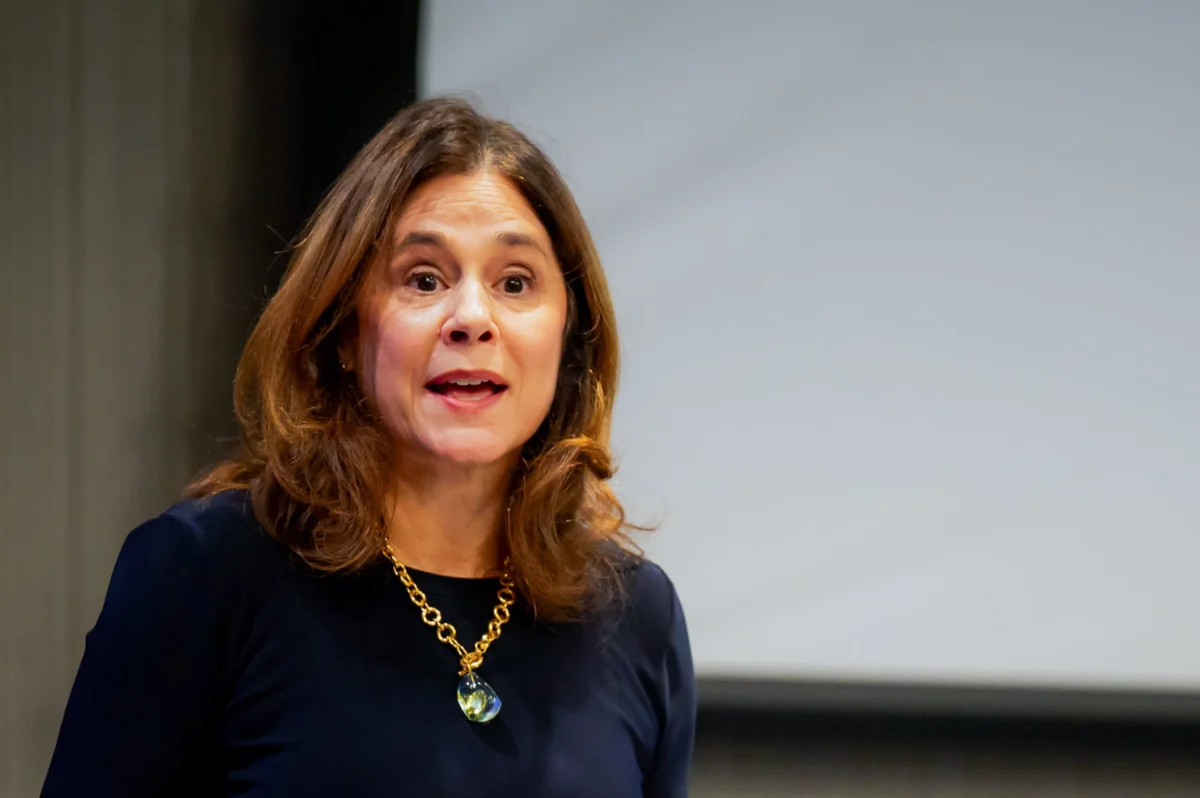
The persistent challenge of returning the United States economy to a state of long-term price stability has entered a critical new phase, as Lorie Logan, President and Chief Executive Officer of the Federal Reserve Bank of Dallas, issued a firm call for "modestly" higher interest rates. Speaking at a research conference in Houston, Logan argued that while recent data suggests a cooling of inflationary pressures, the Federal Reserve’s battle against rising costs is far from over. Her remarks underscore a growing divide within the Federal Open Market Committee (FOMC) regarding the "last mile" of the central bank’s tightening cycle and whether current policy is restrictive enough to finish the job it started more than three years ago.
Logan, who serves as a voting member on the rate-setting committee this year, articulated a hawkish stance that stands in contrast to a growing sentiment among some market participants that the Federal Reserve might soon pivot toward easing. Instead, Logan suggested that the risk of doing too little outweighs the risk of a slight over-tightening. She asserted that despite a series of favorable data points in June, the broader trajectory of inflation remains unacceptably high for the average American household, which has been grappling with elevated costs for services, housing, and essential goods since the early months of 2021.
The Dallas Fed President’s intervention comes at a delicate moment for the U.S. economy. Earlier this week, the Bureau of Labor Statistics released figures showing that consumer prices for June retreated by 0.4%, marking the most significant monthly contraction since the early days of the pandemic in April 2020. Simultaneously, wholesale prices saw a 0.3% dip. While these figures provided a brief reprieve for financial markets, Logan was quick to temper expectations of a policy reversal. She noted that these declines were largely driven by a temporary slump in global oil prices, a volatile metric that often masks more persistent underlying inflationary trends in the "core" economy.
"One month of relief is not enough," Logan stated, using a sports analogy to describe the forward-looking nature of monetary policy. "In monetary policy as in hockey, you have to skate where the puck is going. Unfortunately, inflation does not appear to be headed sustainably back all the way to 2 percent." This 2% target has remained the North Star for the Federal Reserve since it was formally adopted, yet the consumer price index (CPI) currently sits at 3.5% on an annual basis, while wholesale costs—often a precursor to retail price shifts—are up 5.5% over the same period.
The economic impact of this "above-target" environment is multifaceted. For the Federal Reserve, the primary concern is that if inflation remains mired at 3% or 4%, it could become entrenched in the public’s expectations. Once businesses and consumers begin to expect high inflation, they adjust wages and prices accordingly, creating a self-fulfilling cycle that is significantly more difficult and painful to break. Logan warned that if the FOMC allows inflation to become entrenched now, the eventual remedy would require much sharper interest rate increases in the future, likely resulting in a more severe contraction of the labor market and a higher risk of a deep recession.
Market analysts have been closely monitoring the "FedWatch" tools provided by groups like the CME, which track the probability of future rate movements based on fed funds futures pricing. Currently, the consensus suggests that while the FOMC is likely to maintain the status quo at its upcoming July 28-29 meeting—with traders pricing in only a 12.3% chance of a hike—the likelihood of an increase in September or October is rising. Logan’s comments have added weight to the argument that the central bank’s peak rate has not yet been reached.
A significant portion of Logan’s concern stems from the components of inflation that have remained "sticky." While energy and commodity prices can fluctuate wildly based on geopolitical events—such as recent tensions in the Middle East—housing and services costs tend to be much more rigid. Housing, in particular, continues to be a primary driver of the CPI, as high mortgage rates have frozen the housing market, limiting supply and keeping rents elevated. Logan pointed to alternative measures, such as core prices excluding housing, to demonstrate that even when the most volatile sectors are removed, the economy is still running too hot for the Fed’s comfort.
The global context also plays a vital role in the Dallas Fed’s calculus. Central banks around the world, from the European Central Bank to the Bank of England, are facing similar dilemmas. However, the U.S. economy has shown a surprising level of resilience compared to its European counterparts. Strong consumer spending, fueled by a robust labor market and lingering pandemic-era savings, has allowed the Fed to maintain higher rates without triggering a widespread spike in unemployment. This economic strength, while positive for workers, complicates the Fed’s mission by providing a floor for demand that keeps prices from falling as quickly as policymakers would like.
Logan’s call for "modest restriction" is essentially a risk-management strategy. By advocating for incremental increases now, she hopes to avoid a scenario where the Fed is forced to take more drastic action later. This "insurance" approach to monetary policy aims to gently guide the economy toward a soft landing—a scenario where inflation returns to 2% without a significant increase in the unemployment rate. However, the path to a soft landing is narrow. Every rate hike increases the cost of borrowing for businesses, potentially curbing investment, and puts additional pressure on consumers who are already dealing with high credit card interest rates and more expensive auto loans.
Furthermore, the impact of these potential hikes extends to the broader financial system. Higher rates generally strengthen the U.S. dollar, which can have a cooling effect on exports but makes imports cheaper, theoretically helping to lower inflation. However, a stronger dollar also places immense pressure on emerging markets that hold debt denominated in U.S. currency, adding a layer of global financial instability that the Fed must consider, even if its primary mandate is domestic.
Expert insights into Logan’s remarks suggest that she is positioning herself as a leading voice for the "hawkish" wing of the Fed, ensuring that the committee does not declare victory over inflation too early. History provides a cautionary tale: in the 1970s, the Federal Reserve prematurely eased policy after inflation appeared to be cooling, only to see it roar back with greater intensity, eventually requiring the double-digit interest rates of the Volcker era to tame.
As the FOMC prepares for its late July gathering, the debate will likely center on whether the "modest" hike Logan envisions is necessary to provide the final nudge toward the 2% goal. While she did not explicitly commit to a hike at the next meeting, her rhetoric suggests that she will be a strong advocate for action if the data in the coming weeks does not show a more definitive and broad-based decline in prices.
The strain on American budgets remains the central human element of this economic debate. While macroeconomic indicators like GDP and the unemployment rate remain healthy, the "compounded strain" Logan mentioned refers to the cumulative effect of several years of high prices. Even if the rate of inflation drops to zero tomorrow, the price level remains significantly higher than it was in 2020, permanently altering the purchasing power of many households. For Logan and her colleagues at the Dallas Fed, "finishing the job" is not just a matter of hitting a statistical target, but of restoring a sense of economic predictability that has been missing for half a decade.
In the coming months, the Federal Reserve will continue to navigate this complex landscape, balancing the need for price stability with the goal of maximum employment. Logan’s clear-eyed assessment serves as a reminder that the path to economic equilibrium is rarely a straight line and that the final stages of the fight against inflation may require the most resolve. As the "puck" continues to move, the central bank’s ability to anticipate its trajectory will determine the health of the American economy for years to come.