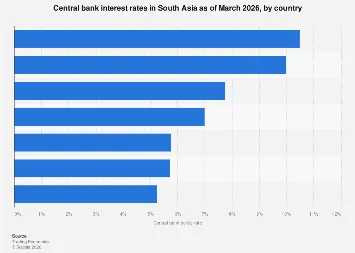
The economic landscape of South Asia is anticipated to witness a complex interplay of monetary policies among its key central banks heading into 2026. Projections indicate a period of nuanced decision-making, driven by a confluence of domestic inflation pressures, global economic headwinds, and evolving growth trajectories. While some nations may opt for a steady hand, maintaining current policy rates to consolidate recent gains or address lingering price stability concerns, others are likely to consider adjustments, either to stimulate flagging economic activity or to preemptively manage potential inflationary surges.
The prevailing sentiment among economists and market analysts suggests that inflation will remain a central concern for many central banks across the region. For instance, countries that have recently grappled with elevated consumer price indices may prioritize a hawkish stance. This could translate into holding benchmark interest rates at their current levels or even contemplating further hikes if inflationary pressures prove more persistent than anticipated. Such a strategy aims to anchor inflation expectations and safeguard purchasing power, a crucial element for sustained economic development. The effectiveness of these policies will, however, be closely scrutinized against their potential impact on economic growth, as higher borrowing costs can dampen investment and consumption.
Conversely, nations experiencing a moderation in inflation, coupled with concerns about economic deceleration, might explore a more accommodative monetary policy. This could involve cautious rate cuts, signaling a commitment to supporting domestic demand and fostering job creation. The timing and magnitude of any such easing will be critical, requiring a delicate balance to avoid reigniting inflationary pressures. Furthermore, global economic conditions, including the trajectory of major economies and commodity prices, will exert a significant influence on these domestic policy decisions. A global economic slowdown, for example, could necessitate a more supportive monetary stance to buffer domestic economies from external shocks.
Looking at specific country-level projections, India, as the region’s largest economy, is expected to continue its data-dependent approach. The Reserve Bank of India (RBI) has demonstrated a commitment to price stability, and projections for 2026 suggest that policy rates will likely remain in a zone that balances inflation control with growth support. The RBI’s forward guidance will be closely watched for any signals of a potential shift in its stance, particularly in response to evolving inflation dynamics and the government’s fiscal policies. Recent inflation figures and the outlook for monsoon patterns, which significantly influence agricultural output and food prices, will be key determinants of the RBI’s decisions.
Pakistan’s monetary policy in 2026 is likely to be shaped by its ongoing efforts to stabilize its economy and manage external debt. The State Bank of Pakistan (SBP) has historically navigated a challenging economic environment, and projections indicate a cautious approach to policy rates. Any significant reduction in interest rates will likely be contingent on a sustained improvement in the country’s balance of payments and a demonstrable decline in inflation. The International Monetary Fund (IMF) program, if active, will also play a crucial role in guiding the SBP’s policy decisions, emphasizing fiscal discipline and price stability.
Bangladesh, with its robust economic growth trajectory, may find itself in a different position. The Bangladesh Bank might be inclined to maintain a relatively stable policy rate, focusing on ensuring financial sector stability and managing any nascent inflationary pressures that could arise from sustained demand. However, if global commodity prices surge, or if domestic demand significantly outstrips supply, the central bank may need to consider tightening its monetary stance to preemptively curb inflation. The country’s increasing integration into global supply chains also means that external economic developments will play a more prominent role in shaping its monetary policy outlook.
Sri Lanka’s central bank, the Central Bank of Sri Lanka (CBSL), will likely continue its efforts to consolidate the gains made in its economic recovery program. Projections for 2026 suggest that the CBSL will remain focused on bringing down inflation to its target range and restoring confidence in the Sri Lankan rupee. Policy rates may see a gradual easing only after a sustained period of price stability and improved fiscal health. The success of debt restructuring efforts and the ability to attract foreign investment will be critical factors influencing the CBSL’s room for maneuver.
Nepal, Bhutan, and the Maldives, while smaller economies, will also see their central banks navigating unique domestic and regional economic currents. The Nepal Rastra Bank (NRB) will likely be influenced by the economic performance of its larger neighbors, India and China, as well as its own domestic inflation and growth dynamics. Bhutan’s monetary policy, closely linked to India’s, will largely mirror the policy direction of the Reserve Bank of India, with a focus on maintaining exchange rate stability and controlling inflation. The Maldives Monetary Authority (MMA) will be particularly sensitive to global tourism trends and their impact on the domestic economy, potentially influencing its approach to interest rates to support the vital tourism sector while managing inflation.
The effectiveness of these monetary policy decisions will be amplified or constrained by various factors. Fiscal policy plays a crucial role; if governments pursue expansionary fiscal policies, central banks might need to adopt a more contractionary monetary stance to counter potential inflationary pressures. Similarly, structural reforms aimed at improving productivity, enhancing competition, and boosting supply-side capacity can create a more favorable environment for central banks to achieve their inflation and growth objectives.
Furthermore, the exchange rate dynamics will remain a significant consideration. For import-dependent economies, a depreciating currency can fuel inflation, prompting central banks to consider higher interest rates to stabilize the currency. Conversely, a strengthening currency can help to dampen imported inflation, providing central banks with more flexibility. Global interest rate differentials, particularly the monetary policy stances of major central banks like the US Federal Reserve and the European Central Bank, will also influence capital flows and exchange rates in South Asia, indirectly impacting domestic monetary policy decisions.
In conclusion, 2026 is poised to be a year of strategic monetary policy recalibration across South Asia. While the overarching goal of price stability will remain paramount for most central banks, the path to achieving it will be diverse. A careful assessment of domestic economic conditions, coupled with a keen understanding of global economic trends and the effectiveness of supporting fiscal and structural policies, will be essential for navigating this intricate monetary landscape and fostering sustainable economic prosperity across the region. The divergence in policy stances underscores the varied economic challenges and opportunities faced by individual nations within this dynamic geographical bloc.