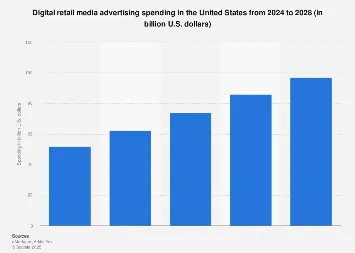
The digital retail media advertising sector in the United States is on a trajectory of significant expansion, projected to more than double in value between 2024 and 2028. Industry forecasts indicate that spending in this dynamic arena will surge from an estimated $52 billion in 2024 to a formidable $97 billion by the close of 2028, reflecting a compound annual growth rate (CAGR) of approximately 16%. This rapid evolution positions retail media as a dominant force within the broader digital advertising landscape, challenging established channels and reshaping how brands connect with consumers at the point of purchase.
The current market size of $52 billion in 2024 already represents a substantial portion of the overall digital ad spend. To provide perspective, this figure approaches the entirety of Amazon’s global advertising revenue, which was reported to be around $56 billion in the same year. This comparison underscores the immense scale and impact of retail media networks, which leverage first-party shopper data and in-store or on-site placement opportunities to offer advertisers unparalleled targeting capabilities and measurable return on investment. The growth forecast suggests that retail media will not only capture a larger share of existing ad budgets but also attract new investments as brands recognize its efficacy in driving sales conversions.
By 2025, the market is expected to reach $62.35 billion, demonstrating a robust year-over-year increase. This momentum is projected to continue, with spending climbing to $74.06 billion in 2026 and $85.98 billion in 2027, culminating in the $97.01 billion projection for 2028. These figures highlight a sustained period of hyper-growth, driven by several interconnected factors. Retailers are increasingly capitalizing on their vast troves of consumer data – purchase history, browsing behavior, loyalty program engagement – to create sophisticated advertising platforms. This first-party data offers a significant advantage over third-party data, which is facing increasing scrutiny and limitations due to privacy regulations and browser changes.
The allure of retail media lies in its inherent connection to commerce. Advertisers can reach consumers when they are in a buying mindset, directly on the platforms where they make purchasing decisions. This immediacy and intent-driven environment translate into higher conversion rates and more attributable sales, a critical metric for marketing departments facing pressure to demonstrate ROI. Major retail players, from e-commerce giants like Amazon and Walmart to brick-and-mortar behemoths with robust online presences such as Target and Kroger, are investing heavily in their media capabilities, offering a range of ad formats including sponsored product listings, display ads on their websites and apps, and even off-site advertising powered by their data.
The expansion of retail media is also being fueled by a growing recognition among brands of the limitations of traditional digital advertising channels. As privacy concerns intensify and ad blockers become more prevalent, the ability to target consumers with precision and transparency becomes paramount. Retail media networks, by their very nature, operate within a walled garden environment where data is collected and utilized with explicit consent, offering a more privacy-compliant approach to audience segmentation. Furthermore, the ability to measure the direct impact of an ad campaign on sales, often within the same platform, provides a level of accountability that can be challenging to achieve with broader programmatic advertising.
Economically, this burgeoning sector has significant implications. It represents a new, high-margin revenue stream for retailers, diversifying their business models beyond traditional product sales. This diversification can lead to greater financial stability and allow retailers to reinvest in their core operations, customer experience, and technological infrastructure. For advertisers, the growth of retail media offers a more efficient and effective way to reach target audiences, potentially leading to increased market share and profitability. The competition among retailers to build out their media offerings is also driving innovation in ad tech, leading to more sophisticated targeting, measurement, and creative tools.
Global comparisons further illustrate the U.S. market’s leadership. While retail media is gaining traction in Europe and Asia, the U.S. market, with its mature e-commerce infrastructure and highly developed advertising ecosystem, is currently at the forefront of this trend. The sheer volume of consumer spending and the concentration of large retail players provide a fertile ground for the rapid growth observed in the United States. As other regions develop their own retail media capabilities, the U.S. model is likely to serve as a blueprint, albeit with necessary adaptations to local market conditions and regulatory environments.
The projected $97 billion market value by 2028 signifies more than just an increase in ad spend; it represents a fundamental shift in the advertising paradigm. It signals a move towards a more integrated approach where media, commerce, and data converge. Brands that effectively navigate this evolving landscape, by building strong partnerships with retailers and leveraging the unique capabilities of retail media networks, are poised to gain a significant competitive advantage. The continued investment in this sector by both retailers and advertisers underscores its critical role in the future of digital marketing and consumer engagement. The coming years will undoubtedly see further innovation and consolidation within the retail media space, solidifying its position as a cornerstone of the modern advertising industry.