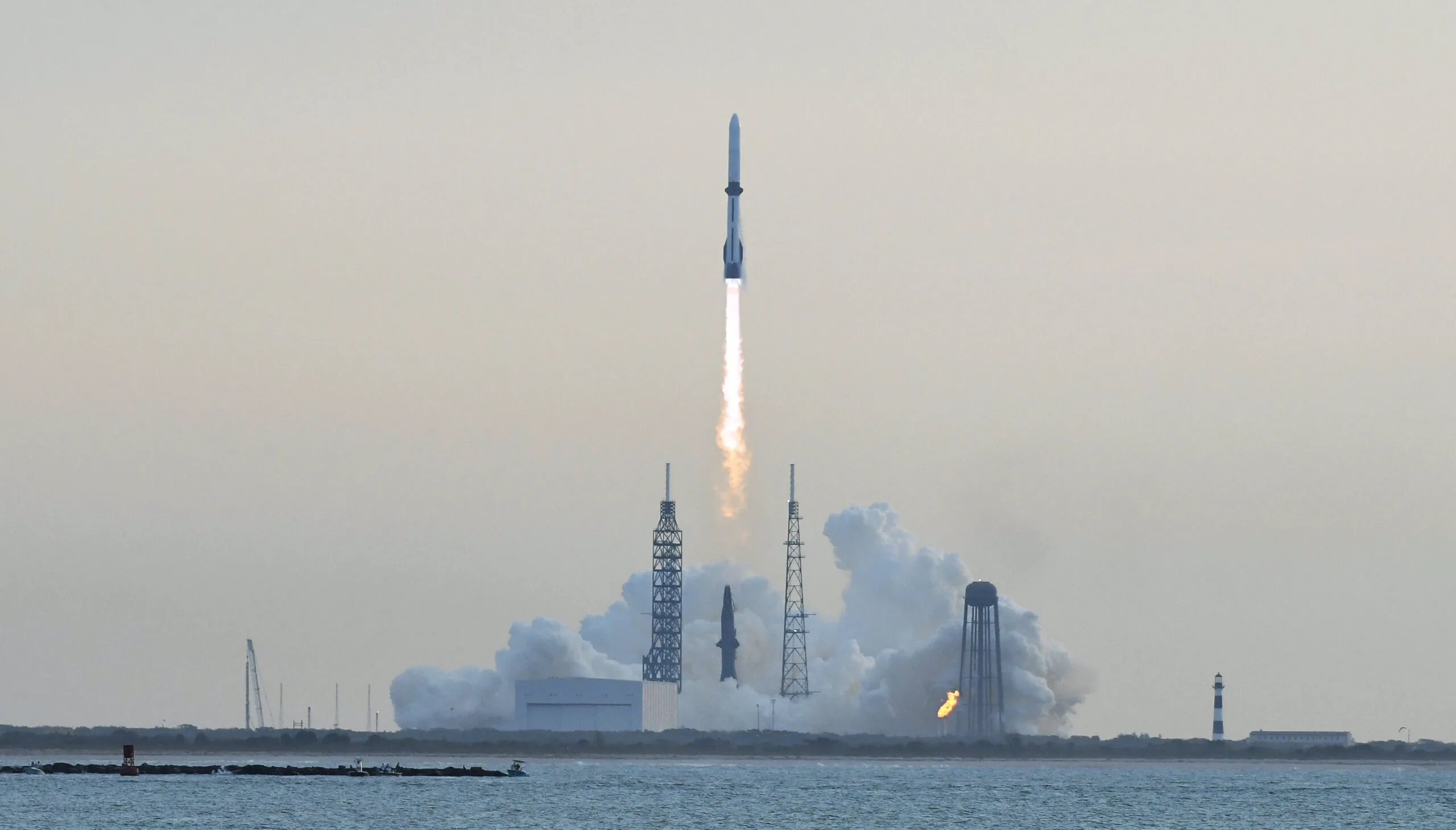
The high-stakes race to blanket the globe in space-based cellular connectivity hit a significant atmospheric bump this week as AST SpaceMobile, a pioneer in the direct-to-cell satellite industry, saw its latest mission compromised by a launch anomaly. Shares of the Texas-based telecommunications firm retreated more than 5% in Monday trading following reports that its BlueBird 7 satellite was deployed into an incorrect orbit by Blue Origin’s New Glenn rocket. The incident, which occurred during a Sunday launch from the Cape Canaveral Space Force Station, has reignited discussions regarding the inherent risks of the burgeoning "NewSpace" economy and the heavy reliance of satellite operators on a limited pool of heavy-lift launch providers.
The BlueBird 7 was intended to be the eighth cornerstone of AST SpaceMobile’s growing constellation in Low Earth Orbit (LEO). However, Blue Origin—the aerospace venture founded by Amazon billionaire Jeff Bezos—acknowledged shortly after liftoff that the New Glenn vehicle failed to reach the precise orbital parameters required for the mission. While the rocket successfully cleared the pad and navigated its initial ascent phases, the upper stage apparently released the payload into a trajectory significantly lower than the intended altitude. In the unforgiving physics of orbital mechanics, being placed too low often results in excessive atmospheric drag, preventing the satellite from maintaining its position and eventually leading to a premature, fiery re-entry into the Earth’s atmosphere.
For AST SpaceMobile, the loss of BlueBird 7 is more than just a hardware setback; it is a disruption to a meticulously timed deployment schedule designed to provide continuous cellular broadband directly to unmodified smartphones. The company has positioned itself as a revolutionary bridge for the world’s "unconnected," partnering with global telecom giants like AT&T, Verizon, and Vodafone to eliminate dead zones. To achieve this, the company requires a dense constellation of satellites. While the loss of a single unit is manageable in the long term, the immediate market reaction reflected investor anxiety over the reliability of the launch vehicle and the potential for cascading delays in the company’s 2026 and 2027 roadmaps.
Despite the orbital failure, AST SpaceMobile moved quickly to reassure the markets, noting that the financial blow is largely mitigated by a comprehensive insurance policy. In the satellite industry, launch insurance typically covers the cost of the hardware and the launch services in the event of a total loss. However, insurance cannot compensate for the "opportunity cost"—the lost time and the delay in revenue generation that occurs when a critical asset fails to come online. The company maintained a defiant posture, stating that production of its next units—BlueBirds 8, 9, and 10—is proceeding on schedule, with shipping expected within the next 30 days. AST remains committed to a launch cadence of roughly one satellite every one to two months throughout 2026.
The incident also places a spotlight on Blue Origin’s New Glenn rocket, a massive heavy-lift vehicle designed to compete with SpaceX’s Falcon 9 and Falcon Heavy. This was only the third flight of the New Glenn, and the "under-delivery" of the payload highlights the growing pains often associated with new launch platforms. While Blue Origin stated it is "assessing the situation," the silence following the official declaration of the satellite’s loss has left analysts pondering the technical root cause. For the broader space industry, the success of New Glenn is vital for maintaining a competitive market. Currently, SpaceX dominates the commercial launch sector, and any struggle by Blue Origin to prove New Glenn’s reliability could further entrench a monopoly that many satellite operators are desperate to avoid.
Financial analysts have begun recalibrating their outlooks for AST SpaceMobile in light of the launch failure. Louie DiPalma, an analyst at William Blair, suggested that the company’s ambitious target of having 45 satellites in orbit by the end of the year is now significantly harder to achieve. However, DiPalma noted a "silver lining" in the technical integration process. The mission allowed AST to gain invaluable experience in mating its hardware with the New Glenn system—a process that will be essential for future missions that are expected to carry as many as eight BlueBird satellites at once. The "all-eggs-in-one-basket" risk was actually minimized this time, as only one satellite was on board for this specific test-heavy flight.
Other Wall Street voices were more cautious but remained long-term bulls. Greg Pendy of Clear Street maintained a "buy" rating on the stock but adjusted his price target downward from $137 to $115. Even with the reduction, the target represents a substantial upside from current trading levels, suggesting that the underlying technology and market demand for space-based cellular services remain robust. Pendy’s adjustment reflects a higher "risk premium" now associated with the stock, as investors must account for the possibility of further launch anomalies as the constellation expands.
The economic implications of this failure extend into the broader telecommunications and satellite services market, which Morgan Stanley estimates could be worth $1 trillion by 2040. The direct-to-cell segment is particularly competitive. AST SpaceMobile is racing against SpaceX’s Starlink, which has already begun testing its own direct-to-cell capabilities using its massive, existing constellation. While Starlink has the advantage of owning its own "ride" to space, AST SpaceMobile claims a technological edge with larger, more powerful phased-array antennas that can provide higher data speeds. The "wrong orbit" incident, however, underscores the vulnerability of companies that must outsource their logistics to third-party rocket providers.
Furthermore, the link between AST SpaceMobile and Blue Origin has become a focal point for institutional investors. Christopher Schoell, an analyst at UBS, pointed out that AST’s share price performance is now intrinsically tied to the operational success of Jeff Bezos’ aerospace firm. If New Glenn continues to face hurdles, AST may be forced to seek alternative launch providers—such as India’s ISRO or Europe’s Arianespace—which could involve significant redesigns of the satellite’s deployment interfaces and further delay the 2027 revenue goals. Schoell noted that until Blue Origin provides a clear post-mortem of the failure and demonstrates a "return to flight" capability, uncertainty will likely weigh on investor sentiment.
From a global economic perspective, the AST SpaceMobile mission is a microcosm of the shift toward "Space 2.0." Traditionally, satellites were the size of school buses and cost hundreds of millions of dollars, launched into high geostationary orbits where they stayed for decades. Today’s LEO constellations rely on smaller, more numerous, and more replaceable units. While this "distributed" model makes the system more resilient to a single failure, it requires a flawless supply chain and a relentless launch schedule. The loss of BlueBird 7 is a reminder that despite the commercialization of the cosmos, the "final frontier" remains a high-risk environment where a few meters per second of velocity can make the difference between a multi-billion dollar breakthrough and a total loss.
As the week progresses, the market will be watching for more detailed telemetry data from Blue Origin. For AST SpaceMobile, the task is now one of damage control and operational acceleration. The company’s ability to bounce back, ship its next three satellites, and perhaps more importantly, secure a successful subsequent launch, will determine if this event was a minor "speed bump" or a systemic indicator of deeper challenges in the partnership between the telecom and aerospace industries. For now, the loss of BlueBird 7 serves as a sobering lesson in the volatility of the space-tech sector, where the path to global connectivity is paved with both immense technological promise and the stark reality of orbital failure.