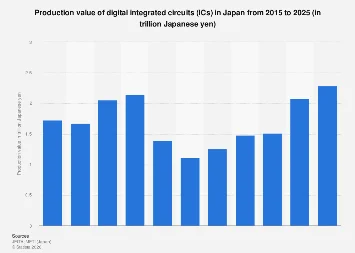
Japan’s vital digital integrated circuit (IC) production sector is on a trajectory for robust expansion, with industry value projected to reach a substantial ¥[redacted] trillion by 2025. This forecast underscores the nation’s enduring strength and strategic importance in the global semiconductor landscape, a field critical to nearly every facet of modern technology and commerce. The figures, meticulously compiled and analyzed, offer a clear indication of the sustained demand and ongoing investment in this high-stakes industry.
The category of digital integrated circuits encompasses a broad spectrum of essential semiconductor components, primarily including bipolar ICs and metal oxide semiconductor (MOS) ICs. Bipolar ICs, known for their speed and power handling capabilities, remain crucial for high-performance applications, while MOS ICs, particularly CMOS (Complementary Metal-Oxide-Semiconductor) technology, dominate the market due to their low power consumption and high integration density, making them ubiquitous in everything from consumer electronics to advanced computing systems. The growth in production value reflects the escalating global appetite for these foundational electronic building blocks.
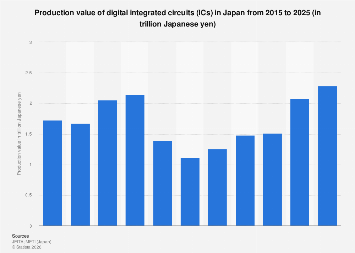
Analyzing the historical trajectory from 2015 to the present, Japan’s IC production has demonstrated a consistent upward trend, punctuated by periods of accelerated growth driven by technological advancements and evolving market demands. This sustained expansion is not merely a statistical anomaly; it is a testament to Japan’s deep-rooted expertise in materials science, precision manufacturing, and innovative chip design. Companies like Renesas Electronics, Kioxia (formerly Toshiba Memory), and Sumco have been instrumental in maintaining Japan’s competitive edge, investing heavily in research and development and upgrading manufacturing facilities to meet the increasingly sophisticated requirements of global clients.
The projected figures for 2025 signal a further acceleration of this growth, driven by several key global economic and technological megatrends. The burgeoning Internet of Things (IoT) ecosystem, with its insatiable demand for connected devices, is a primary driver. Smart homes, industrial automation, wearable technology, and connected vehicles all rely on a vast array of digital ICs for their functionality, data processing, and communication capabilities. As these markets mature and expand, so too does the need for the semiconductor components that power them.
Furthermore, the relentless advancement in artificial intelligence (AI) and machine learning (ML) applications is creating unprecedented demand for high-performance computing power. AI chips, often highly specialized digital ICs, are essential for training complex neural networks and executing sophisticated algorithms. Japan’s established strengths in advanced materials and manufacturing processes position it to play a significant role in supplying these critical components to the global AI race. The development of more powerful and energy-efficient processors is paramount for the widespread adoption and efficacy of AI across diverse sectors, from healthcare and finance to transportation and scientific research.
The automotive sector represents another significant pillar of growth for Japan’s digital IC production. Modern vehicles are increasingly becoming sophisticated computing platforms on wheels, incorporating advanced driver-assistance systems (ADAS), infotainment systems, and electric vehicle (EV) powertrains. These systems necessitate a wide range of specialized ICs, including microcontrollers, sensors, power management chips, and communication modules. Japan’s automotive industry, a global leader, is a natural and substantial consumer of these domestically produced semiconductors, further bolstering the sector’s output value.
Globally, the semiconductor industry is characterized by intense competition and significant geopolitical considerations. The United States, South Korea, Taiwan, and China are also major players, each with distinct strengths and strategic objectives. Japan’s focus on high-value, specialized components and its commitment to quality and reliability have allowed it to carve out a defensible niche. However, the industry’s global nature means that supply chain resilience, trade policies, and international collaboration are increasingly important factors influencing production and market access. Recent global chip shortages have highlighted the critical importance of robust and diversified semiconductor manufacturing capabilities, prompting governments worldwide, including Japan’s, to implement policies aimed at bolstering domestic production and supply chain security.
The economic impact of this projected growth in digital IC production for Japan is multifaceted. It directly contributes to the nation’s Gross Domestic Product (GDP) through manufacturing output and export revenues. The sector also generates high-value employment opportunities, requiring a skilled workforce in areas such as engineering, research and development, and advanced manufacturing. Moreover, the strength of the domestic semiconductor industry has a ripple effect, supporting innovation and competitiveness in downstream industries that rely on these advanced components, such as consumer electronics, automotive, telecommunications, and industrial machinery.
The "Supplementary notes" accompanying the data highlight that the figures are based on original reports and do not account for amendments made after their announcement, suggesting a degree of finality and robust data collection. The note that values have been rounded is standard practice in economic reporting and does not diminish the significance of the overall trend. The indication that data prior to 2025 are from previous reporting reinforces the forecasting nature of the upcoming year’s projection.
Looking ahead, the strategic importance of digital ICs will only intensify. As nations grapple with digital transformation, cybersecurity threats, and the pursuit of technological sovereignty, control over semiconductor supply chains will remain a paramount concern. Japan’s continued investment in and focus on the production of digital integrated circuits is not just an economic imperative; it is a strategic necessity for maintaining its position as a global technological leader and ensuring its future economic prosperity and national security in an increasingly interconnected and technologically driven world. The ¥[redacted] trillion forecast for 2025 represents a significant milestone, signaling a vibrant and expanding sector poised to continue its vital contribution to the global economy.