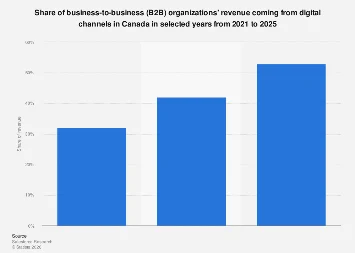
The landscape of business-to-business (B2B) commerce in Canada is undergoing a profound transformation, with projections indicating a substantial acceleration in the proportion of revenue generated through digital channels by 2025. This anticipated surge underscores a fundamental evolution in how Canadian businesses engage with their customers, conduct transactions, and ultimately drive growth. As digital capabilities become increasingly sophisticated and integrated into core business operations, companies are reallocating resources and strategic focus towards online platforms, a trend that is set to redefine market dynamics and competitive advantages.
This shift is not merely a matter of adopting new technologies; it represents a strategic imperative for businesses seeking to remain relevant and competitive in an increasingly interconnected global economy. The COVID-19 pandemic acted as a significant catalyst, compelling many organizations to accelerate their digital transformation initiatives out of necessity. However, the underlying drivers of this digital adoption predate the pandemic and are rooted in evolving customer expectations, the pursuit of operational efficiencies, and the promise of expanded market reach. For Canadian businesses, particularly those operating in sectors with traditionally higher reliance on in-person interactions or lengthy sales cycles, the embrace of digital channels presents both challenges and immense opportunities.
Data and market analysis suggest that the revenue share from digital channels within Canada’s B2B sector is on an upward trajectory. While specific percentage figures can vary based on methodology and the scope of "digital channels" included (e.g., e-commerce platforms, digital marketing, online sales enablement tools, virtual consultations), the consensus points towards a notable increase. This trend is mirrored globally, where B2B e-commerce has experienced exponential growth. For instance, global B2B e-commerce sales are projected to reach trillions of dollars in the coming years, with North America, including Canada, being a key contributor to this expansion.
Several factors are converging to fuel this digital revenue growth. Firstly, the increasing digital fluency of business buyers is paramount. Procurement professionals and decision-makers are now accustomed to researching, comparing, and even purchasing goods and services online, mirroring their B2C experiences. This has led to a demand for seamless, intuitive, and data-rich online purchasing journeys. Secondly, the efficiency gains offered by digital channels are compelling. Automation of sales processes, streamlined order management, and reduced transaction costs contribute to improved profitability and allow sales teams to focus on higher-value activities such as strategic account management and complex problem-solving.
Furthermore, digital channels provide unparalleled opportunities for data collection and analysis. By tracking customer interactions, purchase patterns, and engagement metrics, Canadian businesses can gain deeper insights into buyer behavior, personalize their offerings, and optimize their marketing and sales strategies. This data-driven approach enables more targeted campaigns, improved customer segmentation, and ultimately, a more effective allocation of marketing and sales budgets. The ability to measure ROI with greater precision also becomes a significant advantage in justifying investments in digital infrastructure and capabilities.
The impact of this digital revenue shift extends beyond individual company performance to the broader Canadian economy. Increased digital trade can foster greater market accessibility for small and medium-sized enterprises (SMEs), allowing them to compete on a more level playing field with larger corporations. By leveraging e-commerce platforms and digital marketing tools, SMEs can reach customers beyond their immediate geographical proximity, potentially unlocking new revenue streams and contributing to job creation and economic diversification.
Moreover, the growth of digital B2B commerce is likely to stimulate investment in related industries, such as logistics and supply chain management, digital marketing agencies, software development, and cybersecurity. As businesses invest in their online presence and capabilities, there will be a corresponding demand for skilled professionals in these areas, creating a positive ripple effect throughout the Canadian workforce. The development of robust digital infrastructure, including high-speed internet access and secure payment gateways, becomes increasingly critical to supporting this economic evolution.
However, the transition to a digitally-driven B2B revenue model is not without its hurdles. For some Canadian businesses, particularly those in traditional industries or with established legacy systems, the upfront investment in new technologies and the retraining of staff can be a significant challenge. Concerns around data security, privacy, and the complexities of integrating disparate digital platforms also require careful consideration and strategic planning. Building trust and rapport in a purely online environment can also be more challenging than in face-to-face interactions, necessitating a focus on building strong digital customer service and support mechanisms.
Industry experts emphasize that a hybrid approach, often referred to as "phygital," is likely to be the most effective strategy for many Canadian B2B companies. This involves seamlessly integrating online and offline touchpoints to provide a cohesive and enhanced customer experience. For example, a buyer might research a product online, request a virtual demonstration, and then finalize the purchase through a direct sales interaction, or vice versa. The key is to ensure that the customer journey is consistent and convenient, regardless of the channel they choose to engage through.
Looking ahead, the continued evolution of technologies such as artificial intelligence (AI), machine learning, and the Internet of Things (IoT) will further shape the future of B2B digital revenue. AI-powered chatbots and virtual assistants can provide instant customer support and product recommendations, while IoT devices can offer real-time data on product usage and performance, creating opportunities for proactive service and customized offerings. The adoption of these advanced technologies will likely accelerate the digital transformation and unlock new avenues for revenue generation within Canada’s B2B sector.
In conclusion, the projected increase in B2B revenue share from digital channels in Canada by 2025 signifies a fundamental shift in the country’s economic operating model. Driven by evolving buyer behavior, the pursuit of efficiency, and technological advancements, this trend presents substantial opportunities for growth, innovation, and enhanced competitiveness for Canadian businesses. While challenges remain, strategic adaptation, investment in digital capabilities, and a focus on creating seamless, data-driven customer experiences will be crucial for businesses to thrive in this increasingly digital future. The economic implications are far-reaching, promising to boost productivity, foster wider market access, and stimulate investment in key technological and service sectors across the nation.