Since the inception of Bitcoin in 2008, the trajectory of cryptocurrencies has been anything but linear. Initially heralded by free-market evangelists as a revolutionary monetary system, immune to governmental control and inflation, and capable of facilitating frictionless global transactions, the digital asset landscape has undergone a profound metamorphosis. The utopian vision of Bitcoin – combining the scarcity of gold with the utility of the US dollar – has not materialized in its envisioned form. The US dollar remains firmly entrenched as the world’s reserve currency, and gold continues its role as a long-term value benchmark. Cryptocurrencies, despite their ambitious experiments, have struggled to establish themselves as stable mediums of exchange, hindered by persistent volatility, stringent regulatory hurdles, and limited widespread adoption.
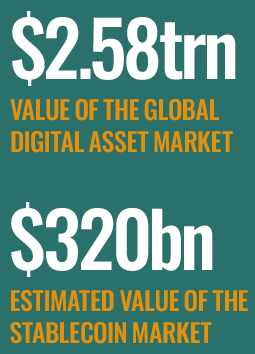
However, to characterize cryptocurrency as a failure based solely on its unmet monetary aspirations would be a misreading of its evolution. Far from fading into obscurity, digital assets have blossomed into a market valued at approximately $2.58 trillion, increasingly serving not as a direct replacement for money, but as a crucial layer of financial infrastructure. This infrastructure is often most visible not at the core of the global economy, but rather at its periphery, addressing systemic weaknesses and circumventing established channels.
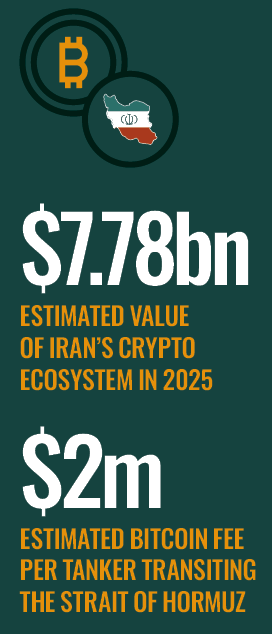
This emergent role has become particularly pronounced in recent months, underscored by the innovative use of cryptocurrencies in geopolitically complex environments. Amid ongoing international tensions, Iranian officials and industry representatives have explored proposals to levy a tariff of $1 per barrel on tankers transiting the Strait of Hormuz, payable in Bitcoin. Hamid Hosseini, a spokesperson for Iran’s Oil, Gas and Petrochemical Products Exporters’ Union, noted that vessels are afforded a brief window to remit payment in Bitcoin, thereby rendering transactions untraceable and resilient to sanctions. This initiative, equating to a potential $2 million fee per tanker, effectively integrates digital assets into one of the world’s most critical trade arteries. This pragmatic adaptation is less about embracing a new financial doctrine and more about establishing a payment channel that bypasses the dollar-centric system and remains difficult to monitor or obstruct.
The initial allure of cryptocurrency stemmed from a deep-seated mistrust of traditional financial institutions following the 2008 global financial crisis. As highlighted by Hyun Song Shin, economic adviser and head of research at the BIS, in a 2022 op-ed for the Financial Times, cryptocurrency emerged as a direct response to the perceived failings of the conventional financial system, promising a self-sustaining, peer-to-peer network that sidestepped banks. However, the reality has seen the rise of centralized intermediaries, such as cryptocurrency exchanges like Binance, Coinbase, and Kraken. Shin further observes that while traditional banks operate under regulatory oversight, the governance of cryptocurrency protocols often rests with founders and a select group of venture capital investors.
The dramatic collapse of FTX and the subsequent imprisonment of its founder, Sam Bankman-Fried, serve as a stark illustration of the risks inherent in systems lacking robust governance and risk management. The exchange’s liquidity crisis exposed an $8 billion fraud, where customer deposits were allegedly siphoned for investments, loans, and personal acquisitions. The sheer scale of this fraudulent activity underscores the significant growth of the cryptocurrency sector, a growth heavily facilitated by these centralized entities. While a return to the original decentralized ethos remains an ideal for some, its practical implementation faces considerable challenges. As Shin posits, the industry’s current scale would be unattainable without these entities channeling capital into the sector.
At its fundamental level, any financial system relies on money serving as a medium of exchange, a store of value, and a unit of account. Evidence suggests that cryptocurrencies have faltered in consistently fulfilling these roles. Transaction inefficiencies plague their use as a medium of exchange, with slow confirmation times for Bitcoin and potential failures during contract execution. Economic factors, such as extreme price volatility, further complicate real-time payments. This is compounded by substantial energy consumption; a 2025 report by Digiconomist estimated that if Bitcoin were a country, its energy usage would rank 23rd globally, consuming 204.44 terawatt-hours annually.
As a store of value, cryptocurrency’s extreme volatility makes it an unreliable asset. Bitcoin’s price fluctuations are exacerbated by its characteristic boom-and-bust cycles, occurring roughly every four years. Research published in Empirical Economics by Baur and Dimpfl indicates that Bitcoin’s price volatility is nearly ten times higher than that of major exchange rates. Furthermore, as a unit of account, cryptocurrency has largely remained tethered to the US dollar, with markets predominantly priced in USD and minimal real-world pricing denominated in digital assets.
If cryptocurrency has fallen short of its currency ambitions, its utility has become evident at the fringes of the financial system. Circumventing sanctions represents a primary application. Iran’s proposed Bitcoin toll for Strait of Hormuz transits exemplifies this. Virginia Pietromarchi, writing for Al Jazeera, noted that Iran’s crypto ecosystem was valued at over $7.78 billion last year, exhibiting robust growth. This surge among citizens is attributed to high inflation and currency depreciation, but the Islamic Revolutionary Guard Corps (IRGC) has also been a significant user of the domestic blockchain infrastructure, facilitating oil sales, weapons procurement, and commodity purchases while evading sanctions.
However, sanctions evasion is not without its challenges. A May 7th press release from the U.S. Department of the Treasury detailed efforts under "Economic Fury" to disrupt billions in projected oil revenue and freeze nearly $500 million in regime-linked cryptocurrency, alongside crackdowns on Tehran’s shadow banking networks.
Following Russia’s 2022 invasion of Ukraine, extensive sanctions led to the country’s exclusion from mainstream correspondent banking and the SWIFT system, severely limiting its international transfer capabilities. Crypto journalist Phil Haunhorst reported that Russia is set to legalize crypto payments in foreign trade starting July 1, 2026, providing exporters with a legal avenue to accept Bitcoin and stablecoins from buyers disconnected from Western banking. This has enabled Russian exporters to continue paying their bills, particularly to major trading partners China and India for oil exports. In 2025, these transactions were valued at approximately 1 trillion rubles ($11 billion). Russia’s strategy illustrates crypto’s evolution from a speculative retail phenomenon to a state-sanctioned settlement layer, supplementing sanctioned economies’ access to conventional payment channels.
According to Gonzalo Saiz Erausquin, a Research Fellow at the Royal United Services Institute (RUSI), crypto-enabled settlement is now integral to Russia’s procurement model, linking diverted supply chains with alternative payment mechanisms designed to mitigate sanctions’ impact. Cryptocurrency has transitioned from the domain of cybercriminals to a "systemic, state-tolerated and in some cases state-enabled payment rail for military procurement."

The implications of these systems are multifaceted. While they enable citizens to safeguard savings from inflation and capital controls, they can also facilitate sanctions evasion, illicit procurement, and opaque cross-border transfers. A key challenge with decentralized financial systems, even with transparent blockchain ledgers, is the lack of accountability. The balance, perhaps, lies in their retail application. For individuals in economically unstable regions, digital assets offer a means to hold assets beyond the immediate control of local authorities, circumventing traditional banking restrictions. While capital flight from heavily indebted nations may be viewed negatively, historical observations, such as a 1989 Bank of England note, suggest it is often a symptom of weak domestic policy rather than a direct cause of economic deterioration.
Bitcoin’s most enduring role has arguably been as a speculative asset, held more out of conviction than for immediate utility. This investment philosophy diverges from its proclaimed status as a currency, rendering it less effective as a unit of account, store of value, or medium of exchange. Instead, it has found its niche as infrastructure. Traditionally, systems like SWIFT, banks, and settlement systems provide the regulated yet comparatively slow infrastructure for transfers, which can take several days. Blockchain technology, by contrast, offers direct peer-to-peer transfers with settlements completed in seconds or minutes.
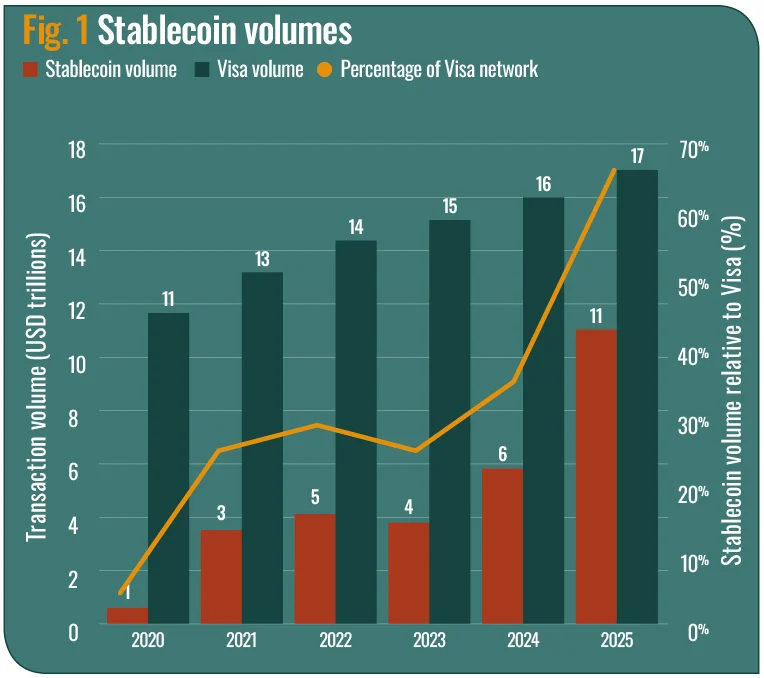
Stablecoins, with a market capitalization of roughly $320 billion, representing about 11.5% of total crypto market capitalization, bridge conventional finance and decentralized settlement. Offering greater price stability than volatile crypto assets, they function as a more predictable alternative. According to a 2025 IMF article by Adrian, Miccoli, and Sugimoto, the primary distinction lies in their centralized nature and backing by liquid financial assets like cash or government securities. Predominantly denominated in US dollars and often backed by U.S. Treasury bonds, these stablecoins effectively reinforce dollar hegemony rather than directly competing with it, thereby mitigating concerns of governments and financial institutions regarding loss of control over capital flows.
The use of stablecoins has steadily increased, fostering the concept of cryptocurrency as a routing layer where fiat currency is converted into crypto, transferred internationally, and then reconverted. This is particularly evident in remittance markets and dollar-scarce economies. In nations facing limited access to hard currency or unreliable banking systems, stablecoins are increasingly acting as synthetic digital dollars. In Argentina, businesses and households have utilized USDT to protect savings from peso devaluation. Similarly, in parts of Africa and Southeast Asia, freelancers and exporters are receiving payments in stablecoins to bypass correspondent banking delays and local currency volatility. Rather than supplanting the dollar system, crypto often extends its reach, providing access to dollar liquidity without direct engagement with the formal banking sector. This development stands in contrast to the original Bitcoin whitepaper’s vision of eliminating trusted third parties.

The global response to cryptocurrency has been varied. Initially dismissed by central banks as disruptive to capital controls, regulators have since acknowledged the underlying technology’s potential benefits. This has spurred experimentation, with numerous central banks now exploring Central Bank Digital Currencies (CBDCs). As of July 2022, nearly 100 CBDCs were in research or development stages, with two fully launched: Nigeria’s eNaira (October 2021) and the Bahamas’ Sand Dollar (October 2020), followed by Jamaica’s JAM-DEX in 2022. Currently, 41 CBDC projects are being piloted globally, including Russia’s Digital Ruble, Brazil’s Drex, China’s e-CNY, India’s Digital Rupee, and Europe’s Digital Euro. A primary driver for these initiatives, particularly in cases like the Sand Dollar, is financial inclusion for unbanked and underbanked populations.
Central banks have, in essence, been compelled to adapt. The advent of cryptocurrency has necessitated an upgrade of their traditional systems, prompting the development of sovereign digital alternatives to complement their decentralized counterparts. Stablecoins are also gaining institutional traction. An LSE Business Review article suggests that the rapid growth of dollar-backed stablecoins is reshaping monetary dynamics and expanding the dollar’s global reach. While reinforcing dollar hegemony, increased stablecoin activity outside the U.S. risks diminishing domestic central banks’ control over liquidity.
Global and central banks are also advancing tokenization projects from experimental to pilot phases. The Bank of England is collaborating with private banks to explore Distributed Ledger Technology (DLT) for faster, cheaper processes with fewer intermediaries, shorter settlement windows, and automated smart contracts. In the U.S., five banks are transitioning to an Ethereum-based tokenized deposit system. In Asia, the Hong Kong Monetary Authority (HKMA) is piloting real-value, cross-bank transfers of tokenized deposits with major banks, while in Singapore, Standard Chartered is conducting real-time global treasury operations on its blockchain.
The recent past has been characterized by a series of global shocks—health crises, geopolitical conflicts, and natural disasters—that have disrupted supply chains, inflated commodity prices, and triggered inflationary pressures. In this environment, Bitcoin has emerged not solely as a speculative asset but as a tool for financial freedom and a hedge against fiat devaluation. Its utility has become evident in nations grappling with hyperinflation and strict capital controls, such as Venezuela, where the number of Bitcoin users surged dramatically between 2014 and 2016. Similar trends are observed in Argentina, Turkey, and Nigeria, where dollar-backed digital tokens are increasingly used for everyday transactions.
The future trajectory of cryptocurrency appears more focused than its initial grand promises. The IMF acknowledges that tokenization and stablecoins are here to stay, though their ultimate adoption and the technology’s broader impact remain uncertain. The increasing fragmentation of global finance into distinct geopolitical blocs, coupled with volatile trade landscapes and a rise in global sanctions, further shapes this outlook.
Cryptocurrencies seem well-suited to a fragmenting world, finding utility within specific blocs where blockchain technology contributes to both financial and technological segmentation. The global financial order is shifting towards regionalization, driven by sanctions, export controls, tariffs, and technological decoupling, all of which incentivize the development of parallel systems for trade and settlement. While unlikely to form the bedrock of a new monetary order, digital assets are proving invaluable within these fractured systems. They function as adaptation tools, not potent enough to replace sovereign currencies but flexible enough to navigate political constraints.
In conclusion, cryptocurrency is not poised to replace the dollar or dominate global trade. However, it has carved out a significant niche within the financial system. The revolution envisioned by Bitcoin has not fully materialized, but in areas where traditional finance is weakest, slowest, or politically constrained, digital assets have quietly integrated themselves into the machinery of global commerce.