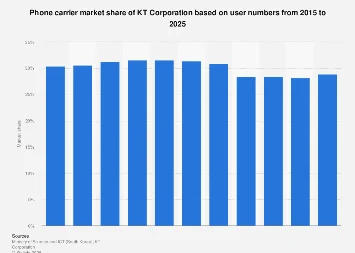
South Korea’s mobile telecommunications sector, a global leader in technological adoption and innovation, is characterized by a robust competitive environment. Within this landscape, KT Corporation has consistently maintained a significant market presence, vying for subscriber dominance against key rivals SK Telecom and LG U+ throughout the 2015-2025 period. While precise, publicly disclosed market share figures for KT Corporation in 2025 remain proprietary and often require specialized data access, industry analysis and historical trends indicate its sustained importance. The company’s strategic initiatives and subscriber base growth are crucial indicators of its position in this fiercely contested market.
The South Korean mobile market is a sophisticated ecosystem where network quality, service innovation, pricing, and customer experience are paramount. KT Corporation, as one of the "big three" carriers, operates a comprehensive network infrastructure, supporting a vast array of mobile services, from basic voice and data to advanced 5G capabilities and beyond. The company’s market share is not merely a reflection of subscriber numbers but also of its ability to capture and retain users in a market known for its high smartphone penetration and demanding consumer expectations. Historical data, even when not fully detailed, points to a competitive battle where shifts in market share are often incremental, driven by strategic product launches, aggressive marketing campaigns, and evolving consumer preferences.
Understanding KT Corporation’s market share necessitates acknowledging the broader dynamics of the South Korean telecommunications industry. The presence of Mobile Virtual Network Operators (MVNOs) significantly influences the market, offering more budget-friendly alternatives and fragmenting the subscriber base. These MVNOs lease network capacity from the major carriers, including KT Corporation, thereby contributing to their overall revenue streams and network utilization, even if not directly reflected in their primary brand market share. KT Corporation’s strategy often involves catering to a diverse range of customer segments, from premium users seeking cutting-edge services to value-conscious individuals who might opt for plans offered through affiliated MVNOs. This dual approach allows the company to maximize its reach and revenue potential across different market tiers.
The period from 2015 to 2025 has witnessed transformative technological shifts, most notably the widespread rollout and adoption of 5G technology. South Korea has been at the forefront of this revolution, and KT Corporation has been a key player in deploying and marketing its 5G services. The competitive advantage gained through superior 5G network performance and innovative service offerings, such as enhanced mobile gaming, augmented reality experiences, and industrial IoT solutions, has been instrumental in customer acquisition and retention. Analyzing market share trends within this context reveals how effectively each carrier has capitalized on the 5G wave. Early adopters of 5G technology and those with robust network coverage have likely seen a stabilization or even an increase in their subscriber base, particularly among technologically forward consumers and businesses.
Furthermore, the economic impact of KT Corporation’s market share extends beyond the telecommunications sector. A substantial subscriber base translates into significant revenue generation, which fuels investment in research and development, infrastructure upgrades, and job creation. The company’s financial health and market position directly influence its capacity to invest in future technologies, such as AI, quantum computing, and advanced network solutions, thereby shaping South Korea’s broader technological trajectory. A strong KT Corporation contributes to a robust national digital economy, fostering innovation and competitiveness on a global scale.
Global comparisons offer valuable perspective on KT Corporation’s standing. While South Korea’s mobile market is highly concentrated with a few dominant players, many other developed nations exhibit similar oligopolistic structures. However, the intensity of competition and the pace of technological adoption in South Korea are often considered benchmarks. Countries like Japan, the United States, and those in Western Europe also feature major carriers with significant market shares, but the subscriber churn rates and the speed at which new technologies are integrated can vary. KT Corporation’s ability to maintain a strong position in such a dynamic and demanding market underscores its operational efficiency and strategic acumen.
The evolution of mobile services has also broadened the scope of what constitutes a "mobile phone subscriber." Beyond traditional voice and data plans, the market now includes a vast array of connected devices, IoT solutions, and specialized enterprise services. KT Corporation, like its peers, has been diversifying its service portfolio to capture these emerging revenue streams. This includes expanding into areas like smart home solutions, cloud services, and digital media platforms. The success of these diversification efforts indirectly influences the company’s overall market standing by strengthening its ecosystem and increasing customer loyalty across a wider range of services.
Looking ahead, the competitive landscape is likely to remain intense. Factors such as the ongoing development of 6G technology, the increasing demand for data-intensive applications, and the evolving regulatory environment will continue to shape market dynamics. KT Corporation’s future market share will depend on its ability to anticipate and adapt to these changes, invest strategically in new technologies, and maintain its customer-centric approach. The company’s historical resilience and its commitment to innovation suggest that it will continue to be a formidable force in South Korea’s mobile communications arena for years to come. The intricate interplay of technological advancement, consumer behavior, and strategic competition will continue to define the fortunes of KT Corporation and its rivals in this critical sector.