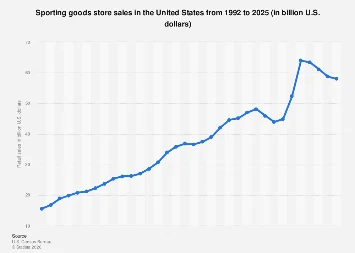
In 2025, the United States sporting goods retail sector experienced a contraction, with sales figures reflecting a notable decrease compared to preceding years. This downward trend, which began its discernible descent after 2021, signals a significant inflection point for brick-and-mortar establishments dedicated to athletic and outdoor equipment. While specific aggregate sales figures for the U.S. market in 2025 remain a subject of detailed analysis, the prevailing sentiment within the industry points towards a challenging economic environment for traditional sporting goods purveyors. This contraction occurs against a backdrop of robust and continuously expanding global markets for athletic apparel and footwear, underscoring a divergence in performance between different segments of the broader sports industry.
The global sportswear market, a colossal and perpetually growing entity, continues to defy economic headwinds, driven by an increasing consumer emphasis on health, wellness, and athleisure. Projections consistently indicate year-over-year growth, fueled by evolving fashion trends, technological innovations in fabric and design, and a widening global middle class with disposable income. Dominating this lucrative landscape are established giants such as Nike and Adidas, which, by a significant margin, command the largest market shares worldwide. Their extensive global reach, sophisticated supply chains, and potent brand recognition allow them to consistently outperform competitors. Beyond these titans, a dynamic ecosystem of other significant players actively shapes the market. Companies like Puma, the innovative lululemon, and the performance-focused Under Armour are also key contributors to the sector’s vitality, each carving out distinct niches and appealing to specific consumer demographics. Nike, in particular, not only stands as a preeminent force within the athletic apparel segment but also holds the distinguished title of the world’s leading apparel brand overall, a testament to its pervasive influence across consumer wardrobes globally. This dual leadership in athletic wear and broader apparel categories highlights a strategic diversification and brand ubiquity that few competitors can match.
Similarly, the athletic footwear market, a cornerstone of the sporting goods industry, continues to generate substantial revenue streams, not only globally but with a particularly strong performance within the United States. This segment is crucial for the overall health of the sports retail ecosystem, representing a significant portion of consumer spending on athletic gear. Nike’s dominance in this arena is once again starkly evident, with its footwear division alone generating more revenue than the combined footwear sales of its closest rivals, Adidas and Puma. This remarkable performance is a result of decades of strategic investment in product innovation, athlete endorsements, and effective marketing campaigns that have cemented its brand loyalty among consumers. The company’s ability to consistently deliver sought-after designs, coupled with its technological advancements in shoe construction, ensures its continued leadership in a highly competitive market.
The divergence in performance between U.S. sporting goods stores and the thriving global athletic apparel and footwear markets suggests a fundamental shift in consumer purchasing habits and retail strategies. While consumers are demonstrably willing to invest in branded athletic wear and footwear, their preference appears to be shifting away from traditional, specialized brick-and-mortar sporting goods retailers towards alternative channels. Online retail platforms, direct-to-consumer (DTC) sales models, and even large-scale department stores that offer curated selections of athletic wear are likely capturing a larger share of consumer spending. The convenience of e-commerce, coupled with the ability of online retailers to offer a wider selection and competitive pricing, presents a formidable challenge to legacy brick-and-mortar operations.
Furthermore, the rise of athleisure as a mainstream fashion trend has blurred the lines between performance athletic wear and everyday clothing. This trend has empowered consumers to purchase athletic apparel and footwear not solely for their intended sporting purpose but also for style and comfort in non-athletic settings. This broader appeal has undoubtedly contributed to the sustained growth of the global apparel and footwear markets, as consumers integrate these items into their daily wardrobes. Sporting goods stores, traditionally focused on specialized equipment and performance-oriented apparel, may find themselves needing to adapt their inventory and merchandising strategies to cater to this wider consumer base, incorporating more fashion-forward and versatile items.
Economic factors also play a significant role in this evolving retail landscape. Inflationary pressures and shifts in consumer discretionary spending can disproportionately impact sales of non-essential goods, including certain categories of sporting equipment. While essential athletic wear and footwear may remain resilient, spending on more niche or high-cost sporting goods could be more susceptible to economic downturns or periods of reduced consumer confidence. The U.S. sporting goods sector, therefore, faces the dual challenge of adapting to changing consumer preferences and navigating macroeconomic uncertainties.
The global comparison highlights the U.S. market’s unique challenges. While other regions may also be experiencing shifts in retail, the sheer scale and established infrastructure of the U.S. sporting goods retail sector make its contraction particularly noteworthy. Countries with rapidly developing economies and a burgeoning middle class often exhibit stronger growth in retail sectors as disposable incomes rise. In contrast, mature markets like the U.S. may see greater consolidation and a more pronounced impact from digital disruption.
Industry analysts suggest that for U.S. sporting goods retailers to reverse or at least mitigate the current downward trend, a multi-pronged strategy is imperative. This could involve a greater investment in their own e-commerce capabilities, offering a seamless omnichannel experience that integrates online and in-store purchasing. Enhancing the in-store experience to offer more than just products, such as expert advice, community events, or product customization services, could also draw consumers back to physical locations. Diversifying product offerings to include a wider range of athleisure wear and lifestyle-oriented apparel, mirroring the success of global apparel brands, is another avenue for growth. Furthermore, strategic partnerships with fitness studios, athletic clubs, or local sports leagues could foster community engagement and drive foot traffic. The future of U.S. sporting goods retail likely hinges on its ability to adapt to a dynamic consumer landscape, embracing digital transformation while redefining the value proposition of the physical retail space in an increasingly competitive global market.