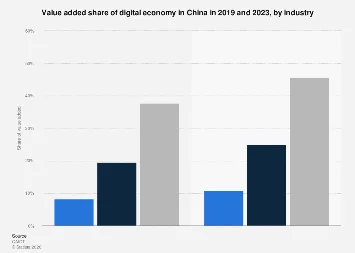
The accelerating integration of digital technologies across China’s economic landscape is reshaping industries at an unprecedented pace, with the tertiary sector emerging as a dominant force in this transformation. Between 2019 and 2023, the digital economy’s contribution to the value added in China’s service sector experienced a significant surge, indicating a profound shift in how goods and services are produced, delivered, and consumed. While specific percentage figures remain under proprietary access, the trend underscores a robust expansion driven by advancements in areas such as remote work infrastructure, sophisticated online education platforms, and immersive digital entertainment experiences. This digital penetration not only reflects evolving consumer behaviors but also signals a strategic imperative for businesses to adapt to a more interconnected and data-driven marketplace.
The primary industry, encompassing agriculture and resource extraction, has historically been less digitally intensive. However, the period between 2019 and 2023 likely witnessed an increased adoption of digital tools aimed at enhancing efficiency and sustainability. Precision agriculture, utilizing sensors, drones, and data analytics for crop management, alongside the digitization of supply chains for raw materials, represent key areas of growth. While the absolute contribution of the digital economy to this sector may remain lower compared to services, the rate of adoption and the potential for impact are substantial, particularly in optimizing resource allocation and mitigating environmental footprints. Emerging technologies such as the Internet of Things (IoT) for monitoring environmental conditions and blockchain for supply chain traceability are poised to play a crucial role in this modernization.
Similarly, China’s secondary industry, comprising manufacturing and construction, has also been a focal point of digital integration. The adoption of Industry 4.0 principles, including smart factories, automated production lines, and the use of artificial intelligence (AI) for quality control and predictive maintenance, has been gaining momentum. The value added by the digital economy within manufacturing is likely to have seen a notable increase, driven by the pursuit of enhanced productivity, reduced operational costs, and the ability to produce more customized goods. The "Made in China 2025" initiative, with its emphasis on high-tech manufacturing and smart production, has undoubtedly fueled this digital transformation. The integration of robotics, advanced analytics, and the Industrial Internet of Things (IIoT) are central to this evolution, aiming to elevate China’s manufacturing prowess on the global stage.
The tertiary industry, however, stands out as the vanguard of China’s digital economic progress. The pandemic acted as a powerful catalyst, accelerating trends that were already in motion. The widespread adoption of remote working solutions, necessitated by public health measures, has permanently altered workplace dynamics and spurred investment in cloud computing, collaboration tools, and cybersecurity. Online education platforms have democratized access to learning, offering a flexible and scalable alternative to traditional schooling, with significant implications for lifelong learning and skill development. The entertainment sector has witnessed a seismic shift towards digital delivery, with streaming services, online gaming, and virtual reality experiences becoming increasingly mainstream. This burgeoning digital ecosystem within the tertiary sector not only caters to evolving consumer demands but also generates new economic opportunities and employment.
Globally, China’s digital economy growth is a significant trend to monitor. Many developed economies have also experienced a surge in digital adoption, particularly in response to the pandemic. Countries like the United States, South Korea, and the nations of the European Union have invested heavily in digital infrastructure and innovation. However, China’s scale, its centralized approach to technological development, and its vast domestic market present a unique context. The sheer volume of internet users and the rapid proliferation of mobile payment systems have created fertile ground for digital services to flourish. Comparisons with other emerging economies often highlight China’s advanced state of digital integration, particularly in areas like e-commerce and digital payments, where it has leapfrogged many established markets.
The economic impact of this widespread digitalization is multifaceted. It contributes to increased productivity, drives innovation, and creates new avenues for economic growth. For businesses, it necessitates a strategic re-evaluation of operational models, customer engagement strategies, and talent acquisition. Companies that embrace digital transformation are better positioned to compete, adapt to market shifts, and achieve greater efficiency. Conversely, those that lag behind risk becoming obsolete. The digital economy also has profound implications for employment, leading to the creation of new job roles in areas such as data science, cybersecurity, and digital marketing, while potentially displacing traditional roles. Ensuring a just transition for the workforce and fostering digital literacy across all segments of society are therefore critical policy considerations.
Furthermore, the expansion of the digital economy raises important questions about data governance, privacy, and cybersecurity. As more economic activity moves online, the volume and sensitivity of data being generated and processed increase exponentially. Governments and businesses alike are grappling with the challenges of establishing robust regulatory frameworks to protect user data, prevent cyber threats, and ensure fair competition in the digital space. China’s approach to data regulation, characterized by a strong emphasis on national security and data localization, is a key aspect of its digital economic strategy.
Looking ahead, the trajectory of China’s digital economy is likely to be shaped by several key factors. Continued investment in advanced technologies such as artificial intelligence, 5G networks, and quantum computing will be crucial. The government’s ongoing focus on fostering indigenous innovation and reducing reliance on foreign technology will also play a significant role. Moreover, the interplay between policy, market forces, and consumer adoption will determine the pace and direction of digital transformation across all sectors. As China continues to navigate this digital evolution, its experiences and strategies will offer valuable insights for other nations seeking to harness the power of the digital economy for sustainable and inclusive growth. The ongoing digital ascension of China’s industries signifies not just a technological shift, but a fundamental reordering of its economic architecture, with far-reaching implications for global commerce and innovation.