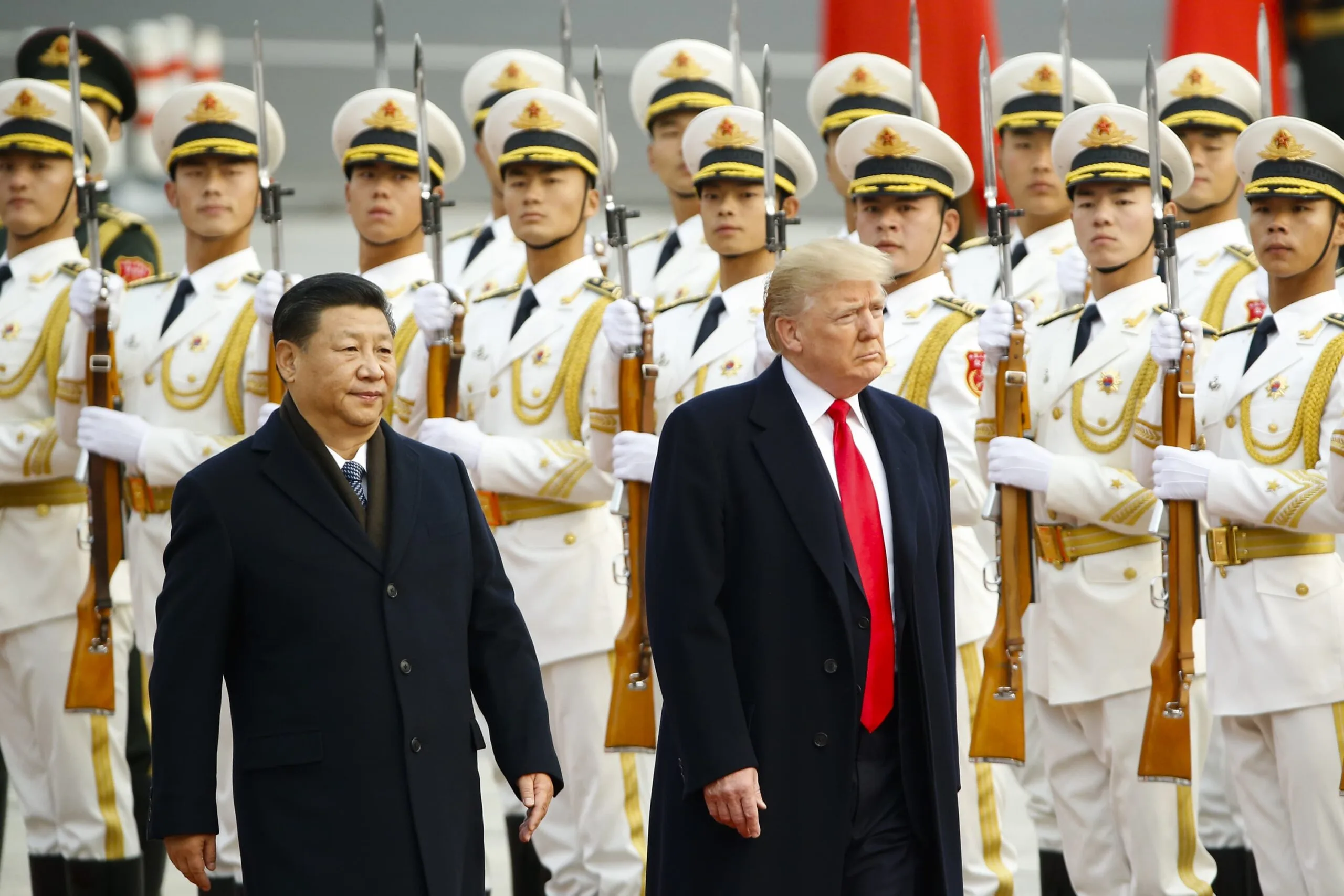
As President Donald Trump and President Xi Jinping prepare for their high-stakes summit in Beijing on May 14 and 15, the diplomatic gravity has shifted from the expected theater of trade wars to the urgent crisis of a widening conflict in the Middle East. While global markets had initially anticipated a primary focus on dismantling the 2025 tariff structures and easing the chokehold on rare earth exports, the specter of a full-scale war involving Iran has forced a pragmatic realignment of the bilateral agenda. This shift suggests that while a historic peace initiative could emerge from the talks, the resolution of long-standing economic grievances may be deferred to a later date, leaving global supply chains in a state of suspended animation.
The urgency of the Middle East situation was underscored earlier this week when Beijing hosted Iran’s foreign minister, marking the first such high-level engagement since hostilities intensified in late February. The diplomatic maneuver has positioned China as a potential mediator in a conflict that threatens the stability of the Strait of Hormuz—a vital artery through which approximately 20% of the world’s daily oil consumption passes. Treasury Secretary Scott Bessent has confirmed that the Iranian crisis will dominate the dialogue, a move that initially sent oil prices lower as traders gambled on the possibility of a "Grand Bargain" brokered by the world’s two largest economies. However, the volatility of the situation remains extreme; recent exchanges of fire in the Strait and reports of a Chinese-owned oil tanker being struck have injected a sense of "crisis management" into a summit that was originally envisioned as a "trade reset."
The decision to prioritize regional security over industrial policy has direct consequences for the American corporate delegation. In a departure from the 2017 summit, where nearly 30 CEOs accompanied President Trump and signed deals worth a staggering $250 billion, the 2026 iteration appears significantly more restrained. The White House has reportedly halved its proposed list of two dozen business leaders, reflecting a cautious approach to the optics of engagement. There is a palpable concern within the administration that a high-profile "CEO parade" in Beijing could be misconstrued as American industry becoming too entangled with the Chinese Communist Party, particularly as national security hawks in Washington continue to advocate for "de-risking" critical sectors.

Despite the trimmed guest list, the presence of heavyweights like Boeing CEO Kelly Ortberg and Citigroup CEO Jane Fraser highlights the enduring, if complicated, importance of the Chinese market. For Boeing, the stakes are existential. The aerospace giant is desperate to secure its first major Chinese order in nearly a decade, a period during which its European rival, Airbus, has aggressively expanded its market share in the Asia-Pacific region. Citigroup’s Fraser, representing a bank with a 124-year history in China, emphasized that multinational engagement remains a stabilizing force, even as political rhetoric turns hawkish. Her participation signals that while the U.S. government may be cautious, the financial sector views China not just as a manufacturing hub, but as a critical node for global capital flows and the expansion of Chinese firms into international markets.
The economic cost of this geopolitical pivot is most visible in the "forgotten" issues of the summit: tariffs and rare earths. China remains the world’s dominant supplier of rare earth elements, controlling roughly 60% of global mining and over 90% of processing and refining. These materials are the lifeblood of the modern economy, essential for everything from electric vehicle batteries and wind turbines to advanced missile guidance systems. Beijing’s recent tightening of export controls on these minerals was widely seen as a retaliatory strike against U.S. tech sanctions. By allowing the Iran crisis to take center stage, both leaders are effectively kicking the can down the road on a supply chain vulnerability that keeps Western manufacturers awake at night.
Similarly, the "April 2025 Tariffs"—a series of aggressive duties imposed by the Trump administration to which China was the first to retaliate—remain a significant drag on global growth. Economists note that these tariffs have contributed to "sticky" inflation in the United States and have disrupted the "just-in-time" logistics models that defined the pre-pandemic era. While Scott Kennedy of the Center for Strategic and International Studies (CSIS) suggests that minor wins, such as Chinese commitments to purchase U.S. soybeans and Boeing aircraft, are likely, the broader structural issues of market access and intellectual property protection are expected to remain unresolved.
The summit is also taking place against a backdrop of "pragmatic backpedaling." Both Washington and Beijing have shown signs of wanting to cool the temperature on tech sanctions and the "Pentagon blacklist" that has recently roiled bilateral relations. There is an emerging consensus that the rapid development of Artificial Intelligence (AI) presents a shared security threat that requires "guardrails" similar to those established during the nuclear arms race of the 20th century. This nascent cooperation on AI safety suggests that while the two nations are locked in a systemic rivalry, they recognize the need to manage that rivalry to prevent a catastrophic escalation.

For President Xi, the summit is an opportunity to project China as a responsible global power and a peer to the United States in conflict resolution. Having hosted a dozen world leaders already this year, including the British Prime Minister and South Korean leadership, Xi is eager to demonstrate that China is "open for business" despite the geopolitical headwinds. Michael Hart, president of the American Chamber of Commerce in China, noted that the mere image of Trump and Xi standing together could serve as a powerful internal signal within the Chinese bureaucracy. Since the uptick in U.S. military activity earlier this year, Chinese officials have been increasingly hesitant to engage with American business leaders; a successful summit could thaw this administrative freeze.
However, the path to a meaningful peace deal in the Middle East is fraught with domestic political risks for both leaders. For Trump, any perceived "softness" on Iran could alienate his base, while for Xi, the challenge lies in balancing China’s strategic partnership with Tehran against its need for a stable relationship with Washington. The "boards"—proposed trade and investment organizations designed to handle specific bilateral frictions—may offer a middle ground, providing a bureaucratic framework to manage disputes without requiring immediate, politically sensitive concessions.
Ultimately, the success of the May 14-15 summit will be measured by its ability to prevent a broader global conflagration. If Trump and Xi can engineer a de-escalation in the Strait of Hormuz, the meeting will likely be remembered as a diplomatic triumph that averted a global energy shock. Yet, for the industries waiting for clarity on tariffs and the tech sector desperate for a resolution to the rare earth impasse, the summit may offer more frustration than relief. The "great relief" described by analysts at the Chinese Academy of Social Sciences regarding a potential end to the Iran war is a sentiment shared by global markets, but it comes at the cost of addressing the fundamental economic imbalances that continue to define the 21st-century’s most important bilateral relationship.
As the world’s gaze fixes on Beijing, the reality of the "new normal" in U.S.-China relations is becoming clear: it is a relationship no longer defined solely by trade volumes or manufacturing output, but by the ability of two superpowers to act as the world’s ultimate "crisis managers." The transition from a trade-focused summit to a security-focused one is a stark reminder that in an interconnected world, the price of oil and the stability of shipping lanes can, at any moment, override the best-laid plans of corporate titans and trade negotiators alike. Whether this pivot leads to a lasting peace or merely a temporary pause in a larger economic confrontation remains the defining question for the global economy in 2026.