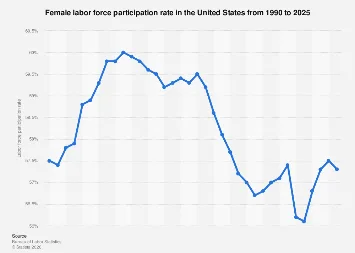
The United States is witnessing a stabilization in its female labor force participation rate, with projections for 2025 indicating a rate of 57.3%. This figure represents a notable recovery from the dip experienced in 2021, bringing the participation back to levels observed prior to the COVID-19 pandemic. While this resurgence signifies a positive trend, a deeper analysis of historical data and underlying economic factors reveals a more nuanced picture of women’s engagement in the American workforce.
From a peak of approximately 60% in the late 1990s and early 2000s, the female labor force participation rate in the U.S. saw a gradual decline before the pandemic. By 2019, it had settled around 57.4%. The onset of the pandemic in 2020 led to a significant disruption, with the rate dropping to 56.2% and further to 56.1% in 2021, a level not seen since the mid-1980s. This decline was attributed to a confluence of factors, including increased caregiving responsibilities, health concerns, and job losses concentrated in sectors with a high proportion of female workers, such as hospitality and retail.
The subsequent rebound to 56.8% in 2022 and 57.3% in 2023, with the projected 57.3% for 2025, suggests a degree of resilience. However, this rate remains below the pre-pandemic highs and considerably lower than the peak participation years. The civilian labor force, as defined by the U.S. Bureau of Labor Statistics (BLS), includes individuals aged 16 and older who are either employed or actively seeking employment, excluding those in the military or institutionalized settings. This broad definition underscores the significance of the participation rate as a key indicator of the nation’s economic health and the integration of women into its productive capacity.
Global Context and Comparative Trends
Examining the U.S. female labor force participation rate within a global context highlights both its relative standing and areas for potential improvement. Many developed nations have seen higher and, in some cases, more sustained levels of female labor force engagement. For instance, countries like Canada, Australia, and several European nations have often reported rates exceeding 60%, and in some cases, approaching 70%. These higher rates are often correlated with robust social infrastructure, including accessible and affordable childcare, generous parental leave policies, and a greater cultural emphasis on shared domestic responsibilities.
The persistent gap between the U.S. rate and those of some peer nations suggests that structural factors continue to play a significant role. The cost and availability of childcare remain a substantial barrier for many American women, impacting their ability to re-enter or remain in the workforce. Similarly, the U.S. federal policy landscape regarding paid family leave differs significantly from many other industrialized countries, where more comprehensive and mandated leave policies are in place. This can disproportionately affect women, who still tend to shoulder a larger share of caregiving duties for children and aging relatives.
Economic Implications and Future Outlook
The level of female labor force participation has profound economic implications. A higher participation rate generally correlates with increased economic output, a larger tax base, and greater consumer spending. Conversely, a stagnant or declining rate can limit economic growth potential and exacerbate existing income inequality. The recent stabilization, while positive, indicates that the U.S. may be operating below its full economic potential if a significant portion of its female population is not actively participating in the labor market.
Several factors are likely to influence the future trajectory of this rate. Technological advancements and the rise of remote work, accelerated by the pandemic, could offer greater flexibility for some women, potentially boosting participation. However, the uneven distribution of these opportunities and the potential for increased automation in certain sectors could also present new challenges.
Furthermore, demographic shifts, including an aging population and evolving family structures, will continue to shape labor force dynamics. As the baby boomer generation retires, the demand for labor may increase, potentially creating more opportunities. However, the ability of women to fill these roles will depend on the continued dismantling of structural barriers.
Policy interventions aimed at supporting working families, such as expanding access to affordable childcare, implementing comprehensive paid family and medical leave policies, and promoting pay equity, are frequently cited by economists as critical levers for increasing and sustaining female labor force participation. The effectiveness of such policies, coupled with societal shifts in gender roles and workplace norms, will be pivotal in determining whether the U.S. can move beyond its current participation rate and harness the full economic power of its female population.
The data from 2025, even with the caveat of being an 11-month average excluding October due to a federal government shutdown, provides a snapshot of the current economic environment. The return to pre-pandemic levels is a testament to the adaptability of women and the economy, yet it also serves as a reminder of the persistent challenges and the ongoing work required to achieve full and equitable labor force integration. The coming years will likely be shaped by a dynamic interplay of economic recovery, technological evolution, and policy developments, all of which will have a bearing on the participation of women in the American workforce.