In an era defined by accelerating geopolitical shifts, technological disruptions, climate volatility, and intricate supply chain dependencies, the ability of organizations to adeptly manage crises has transitioned from a desirable trait to an existential imperative. While every executive team hopes their enterprise is robust enough to weather unforeseen storms, the stark reality often emerges when an actual crisis strikes, exposing foundational vulnerabilities that can inflict catastrophic financial and reputational damage. The economic fallout from mishandled crises can be immense, impacting market capitalization, consumer trust, employee morale, and even national GDPs, underscoring the critical distinction between companies that merely survive and those that emerge stronger.
Consider the severe operational collapse experienced by Southwest Airlines during a brutal winter storm in December 2022. The airline, a domestic powerhouse, faced a complete system meltdown, resulting in the cancellation of over 17,000 flights and stranding an estimated two million passengers. The direct financial cost, exceeding $800 million in lost revenue and compensation, was compounded by immeasurable damage to its brand equity and a subsequent federal investigation. At the core of Southwest’s extensive difficulties was not merely adverse weather but a deeply entrenched issue of neglected, antiquated IT infrastructure. The failure of critical scheduling systems paralyzed operations, leading to a breakdown in internal communication channels and forcing frontline personnel into isolated, improvised responses without adequate support or information. This incident served as a stark illustration of how systemic deficiencies, rather than external catalysts alone, can amplify the severity of a crisis.
Contrast this with Microsoft’s response to a significant service outage in March 2021, which temporarily disrupted access for millions of users across its Teams, Outlook, and Microsoft 365 cloud platforms. Despite the widespread impact, Microsoft’s integrated crisis response mechanism activated almost instantaneously. The outage was contained, and essential services were largely restored within the same day, demonstrating exceptional operational agility. Crucially, the company followed up with a meticulous root-cause analysis, transparently communicating its findings to stakeholders. In the ensuing months, Microsoft substantially accelerated investments in system redundancy, failover capabilities, and incident transparency protocols, transforming a potentially devastating event into a catalyst for enhanced organizational resilience. This proactive approach allowed Microsoft not only to mitigate immediate harm but to leverage the crisis as a strategic opportunity to fortify its infrastructure and operational robustness.
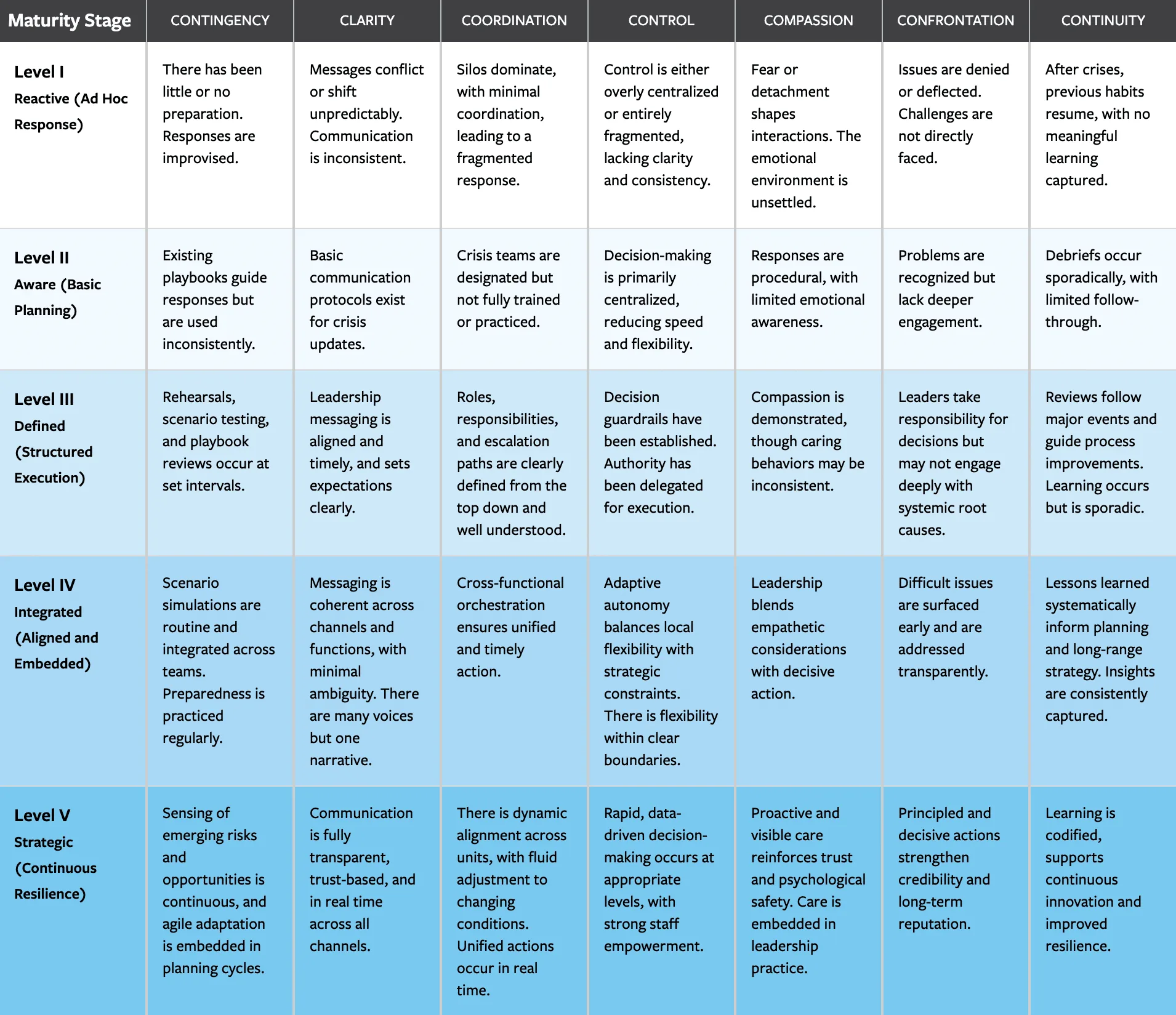
These divergent outcomes highlight a crucial question for contemporary leadership: Why do some organizations falter under pressure, while others respond with a calculated efficiency that minimizes disruption and even fosters long-term growth? Extensive research, drawing insights from high-level political, military, governmental, and corporate leaders who have navigated high-stakes disruptions, reveals that superior crisis management is not an inherent talent but a cultivated organizational capability. These leaders, across a spectrum of industries and public sectors, identified seven interconnected practice areas, termed the "7Cs," that are paramount for any entity aspiring to withstand and overcome significant adversities. Developing maturity across these dimensions empowers organizations to transform moments of peril into pathways for strategic evolution and enduring resilience.

The Seven Pillars of Crisis Resilience
1. Contingency Planning: Effective crisis management begins long before an event materializes. Mature contingency planning extends beyond static emergency manuals to embrace dynamic scenario analysis, stress-testing, and "war-gaming" potential disruptions. This involves simulating complex, multi-faceted crises – from cyberattacks on critical infrastructure to geopolitical supply chain shocks – to identify vulnerabilities, pre-allocate resources, and develop adaptive response frameworks. Organizations with high maturity in this area possess not just a plan, but a culture of continuous preparedness, regularly updating protocols based on emerging global risks and technological advancements. This proactive stance ensures that when a crisis hits, initial responses are not improvisational but are executed from a foundation of pre-thought and rehearsal.
2. Cross-Functional Coordination: Siloed operations are a primary impediment to effective crisis response. Superior organizations foster seamless, cross-functional coordination, breaking down departmental barriers to establish a unified command structure. This involves rapid, real-time information sharing across legal, communications, operations, IT, human resources, and executive leadership teams. Empowered, multidisciplinary teams are given clear roles and decision-making authority, enabling agile responses and preventing the fragmentation of effort witnessed in less prepared entities. The ability to quickly assemble and deploy diverse expertise ensures a holistic understanding of the crisis and a coordinated, coherent strategic response.
3. Transparent Communication: In a crisis, the information vacuum is quickly filled by speculation, rumor, and misinformation, often exacerbated by the speed of digital media. Mature crisis communicators prioritize radical transparency, providing timely, honest, and empathetic updates to all stakeholders – employees, customers, investors, regulators, and the public. This involves crafting clear, consistent messaging across all channels, acknowledging challenges, and outlining remedial actions. Beyond mere information dissemination, it encompasses active listening, engaging with feedback, and proactively managing narratives to protect reputation and maintain trust. A failure to communicate openly can erode credibility, amplify panic, and prolong the recovery process.
4. Compassion: A crisis invariably impacts people, whether employees, customers, or broader communities. Compassion in crisis management means prioritizing human well-being and demonstrating genuine empathy for those affected. This translates into tangible support systems for employees facing hardship, understanding and flexibility for customers experiencing disruptions, and ethical considerations for communities impacted by organizational actions. Beyond altruism, a compassionate approach is a strategic imperative, bolstering employee loyalty, strengthening customer relationships, and safeguarding long-term brand equity. Organizations that fail to show empathy risk alienating their most valuable assets – their people and their customer base.

5. Confrontation of Hard Truths: Effective crisis leaders possess the fortitude to confront uncomfortable realities, eschewing denial or blame in favor of data-driven decision-making. This capability involves an organizational culture that encourages critical self-assessment, welcomes dissenting opinions, and is prepared to admit mistakes publicly. Post-crisis, this translates into rigorous root-cause analyses and a commitment to implementing lessons learned, even if they expose internal shortcomings. By embracing accountability and fostering an environment where difficult truths can be spoken and acted upon, organizations can prevent recurring issues and embed resilience into their operational DNA.
6. Control: Amidst the inherent chaos of a crisis, maintaining a firm grip on operational processes and strategic direction is paramount. This capability involves establishing clear lines of authority, centralizing decision-making where necessary, and allocating resources judiciously to stabilize core functions. It means preventing "scope creep" where the crisis response becomes unwieldy, focusing instead on targeted interventions to contain the immediate threat. Maintaining control also extends to monitoring the financial implications, legal liabilities, and regulatory compliance throughout the crisis, ensuring that reactive measures do not inadvertently create new vulnerabilities or exacerbate existing ones.
7. Continuity: The ultimate goal of crisis management is not merely to survive, but to ensure business continuity and emerge stronger. This requires robust business continuity planning (BCP) that outlines how essential operations will be maintained or rapidly restored. Beyond immediate recovery, it encompasses a commitment to long-term organizational learning, embedding crisis insights into strategic planning, risk management frameworks, and employee training programs. Resilient organizations continuously evolve their systems, processes, and culture based on crisis experiences, transforming adversity into a catalyst for systemic improvements and sustainable growth. This iterative process ensures that each crisis encountered makes the organization more robust for the next.
In conclusion, the volatile global economic landscape demands a paradigm shift in how enterprises approach potential disruptions. The proliferation of complex, interconnected risks—from sophisticated cyber threats that cost the global economy trillions annually, to climate events causing billions in infrastructure damage, and geopolitical tensions reshaping trade routes—means that crises are no longer anomalies but an inherent part of the operational environment. Organizations that invest strategically in developing and maturing the 7Cs are not simply preparing for the worst; they are cultivating a competitive advantage. These capabilities enable faster recovery, mitigate financial losses, protect brand reputation, and foster a culture of adaptability that positions them for sustained success amidst uncertainty. For leaders, the imperative is clear: cultivating profound organizational resilience is no longer an option, but a foundational requirement for navigating the complexities of the modern global economy.