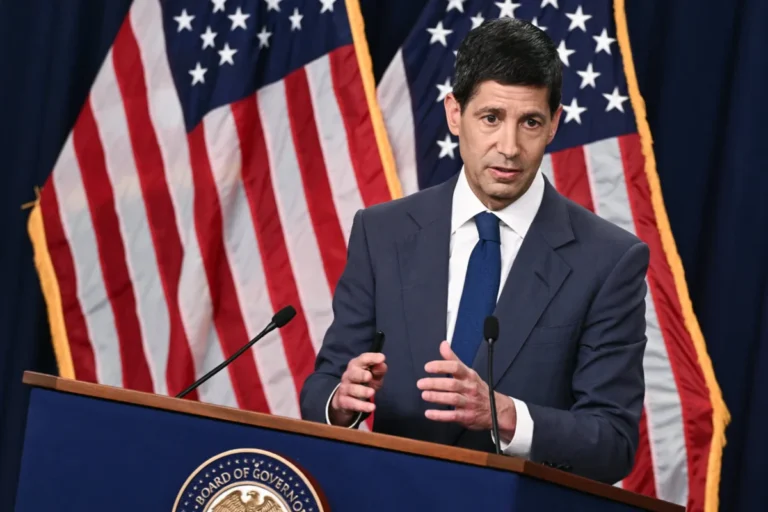
The release of the February employment data has sent a tremor through financial markets, revealing a contraction of 92,000 in nonfarm payrolls and igniting a fierce debate over the future trajectory of American monetary policy. This unexpected decline in labor demand has provided fresh ammunition for the Federal Reserve’s more dovish contingent, most notably Governor Stephen Miran, who argues that the central bank is now trailing the economic curve. In a series of public remarks following the data release, Miran articulated a vision of a Federal Reserve that must pivot away from its lingering obsession with inflation and toward a more aggressive defense of the American worker. His stance underscores a growing schism within the Federal Open Market Committee (FOMC) as the U.S. economy navigates a complex landscape defined by geopolitical instability, technical measurement anomalies, and a shifting political guard at the highest levels of economic governance.
The February jobs report represents a significant departure from the resilient hiring patterns that characterized much of the previous year. A loss of 92,000 jobs suggests that the restrictive monetary policy maintained by the Fed throughout 2024 and early 2025 is finally biting into the real economy with more force than many anticipated. While some analysts have looked for silver linings in labor force participation rates or wage growth, Miran’s assessment is far more stark. He contends that the current federal funds rate, which sits in a target range of 3.5% to 3.75%, is no longer merely cooling the economy but is actively stifling it. According to Miran, the primary risk to the U.S. economy has shifted from the "price stability" pillar of the Fed’s dual mandate to the "maximum employment" pillar. He suggests that the central bank’s current posture remains "modestly restrictive" at a time when the cooling labor market demands a "neutral" or even accommodative stance.
The concept of the "neutral rate"—often referred to by economists as R-star—lies at the heart of this policy disagreement. The neutral rate is the theoretical interest rate at which monetary policy is neither stimulative nor contractionary for the economy. Determining exactly where this level sits is more art than science, and it remains one of the most contentious topics in modern macroeconomics. In the Fed’s December projections, the consensus among officials placed the neutral rate at approximately 3.1%. This would imply that the Fed is only two quarter-point cuts away from reaching a steady state. Miran, however, offers a more aggressive estimate, suggesting that the neutral rate is likely a full percentage point lower than the current target range. By his calculus, the Fed would need to slash rates to roughly 2.5% to 2.75% just to stop leaning against economic growth.
Miran’s advocacy for lower rates is supported by his unconventional view of recent inflation data. While some of his colleagues remain wary of "sticky" inflation numbers that have hovered above the 2% target, Miran argues that these figures are essentially statistical noise. He points specifically to the way the Bureau of Labor Statistics and the Commerce Department account for certain service-sector costs. A prime example is the calculation of portfolio management fees. Because these fees are often structured as a percentage of assets under management, they tend to rise mechanically when the stock market performs well. In Miran’s view, a rising CPI or PCE print driven by a booming S&P 500 does not reflect an overheating economy or genuine inflationary pressure; rather, it is a quirk of accounting that should be ignored by policymakers. By stripping away these technical artifacts, Miran sees an inflation environment that is already well within the Fed’s comfort zone, leaving the central bank free to focus entirely on the deteriorating jobs picture.
The broader macroeconomic environment is further complicated by the recent surge in global energy prices, largely fueled by the escalation of conflict involving Iran. Traditionally, a spike in oil prices presents a "supply shock" that can lead to stagflation—a nightmare scenario of rising prices and falling growth. However, Miran dismisses the notion that the Fed should react to this volatility with higher rates. He categorizes the current energy spike as a "one-off shock" that impacts headline inflation but has little bearing on core inflation, which excludes volatile food and energy costs. Historically, core inflation has proven to be a much more reliable predictor of medium-term price trends. Miran’s perspective aligns with the school of thought that central banks should "look through" temporary energy price increases, as raising rates in response to a supply shock often exacerbates the economic pain for consumers without actually addressing the root cause of the price spike.

This ideological battle is taking place against a backdrop of significant institutional transition at the Federal Reserve. Miran, who was nominated by President Donald Trump to fill the unexpired term of Adriana Kugler, has emerged as a frequent and vocal dissenter on the FOMC. Since joining the committee in September, he has consistently pushed for more aggressive action. During the series of three quarter-point cuts in late 2025, Miran argued for half-percentage-point reductions. When the committee opted to pause in January, he was the lone voice calling for a continued descent. His role as a "dissenter-in-chief" highlights a level of division within the Fed not seen in over a decade. This internal friction is expected to intensify as the term of current Chair Jerome Powell nears its end in May. The nomination of Kevin Warsh to the Board of Governors—a move widely seen as a precursor to his elevation to the Chairmanship—suggests a looming shift in the Fed’s philosophical center of gravity.
The economic implications of a contracting labor market extend far beyond the walls of the Fed’s boardroom. For the American consumer, a loss of nearly 100,000 jobs in a single month signals a cooling of the "wealth effect" that has supported retail spending and housing demand. If the labor market continues to soften, the U.S. could see a pullback in personal consumption expenditures, which account for nearly 70% of the nation’s GDP. Furthermore, the manufacturing and construction sectors remain particularly sensitive to interest rate levels. High borrowing costs have already slowed capital investment and new housing starts; a failure by the Fed to adjust rates downward in the face of job losses could transform a "soft landing" into a more painful cyclical downturn.
Global markets are also watching the Fed’s next move with bated breath. As the world’s reserve currency, the U.S. dollar’s value is intrinsically linked to the Fed’s interest rate decisions. A more aggressive easing cycle by the Fed would likely lead to a depreciation of the dollar, providing some relief to emerging markets burdened with dollar-denominated debt. Conversely, if the Fed remains "higher for longer" while the labor market weakens, the resulting dollar strength could export deflationary pressures to the rest of the world, further complicating the global recovery. Comparisons with other major central banks, such as the European Central Bank and the Bank of England, show a global trend toward easing, though each institution is grappling with its own unique domestic labor dynamics and energy dependencies.
As the FOMC prepares for its upcoming meeting in mid-March, the pressure on Chair Jerome Powell to find a consensus is immense. The February jobs data has undeniably shifted the conversation. While the "hawks" on the committee may still point to the geopolitical risks in the Middle East and the potential for a rebound in headline inflation, the "doves" led by Miran now have a powerful data point to support their case for immediate action. The question facing the committee is no longer whether to cut, but how deep and how fast those cuts should be.
Ultimately, Governor Miran’s position represents a fundamental challenge to the cautious, incrementalist approach that has defined the Fed for much of the post-pandemic era. By arguing that the Fed should proactively move toward a neutral rate to forestall a labor market collapse, he is advocating for a more "forward-looking" policy that prioritizes growth and employment stability. Whether his colleagues will be swayed by the February payroll contraction remains to be seen, but the debate has clearly moved into a new, more urgent phase. With the leadership of the central bank in flux and the economic data flashing yellow, the coming months will determine whether the Fed can successfully recalibrate its policy before the cracks in the labor market widen into a chasm.