The conventional toolkit for supply chain management, historically calibrated for predictable disruptions like natural disasters, isolated supplier failures, or cyclical market shifts, is proving fundamentally inadequate against the escalating tide of geopolitical volatility. As nation-states increasingly weaponize trade, implement stringent sanctions, and engage in regional conflicts, global enterprises find themselves grappling with a new, multifaceted risk landscape that defies traditional mitigation strategies. This paradigm shift demands a systematic evolution in how companies perceive, monitor, and fortify their intricate global networks.
The current geopolitical climate is characterized by an unprecedented confluence of complexity and uncertainty. Decades of policies fostering global integration and efficiency, often leading to highly concentrated and lean supply chains, have inadvertently amplified vulnerabilities. Sudden shifts in U.S. trade policies, the imposition of export controls on critical technologies, or the outbreak of armed conflict can instantaneously invalidate long-held assumptions about market stability and operational security. For multinational corporations operating across vast, interconnected networks, the ripple effects of such events are notoriously difficult to predict, often leading to significant operational disruptions, soaring costs, and diminished profitability. The economic fallout from the Russia-Ukraine conflict, for instance, saw energy prices spike, commodity markets roil, and global inflation accelerate, underscoring the profound interconnectedness of geopolitical stability and economic well-being. Similarly, ongoing U.S.-China trade tensions and technology disputes have forced industries from semiconductors to renewable energy to re-evaluate their entire sourcing and manufacturing footprints, illustrating a deliberate move away from pure efficiency towards resilience and national security considerations.
At the core of adapting to this new reality lies the imperative for comprehensive, end-to-end visibility across the entire supply chain ecosystem. While achieving perfect transparency remains an aspirational goal, particularly across multi-tiered supplier networks, leading companies are aggressively pursuing advanced data analytics, digital twin technologies, and rigorous supplier auditing to gain deeper insights. This means meticulously understanding the dependencies, potential bottlenecks, and geopolitical exposures not just of primary suppliers but also their sub-tier partners and critical logistics channels. A recent study examining the strategies of 13 multinational corporations highlighted this shared commitment, noting that businesses prioritizing a holistic view of their procurement and distribution networks are better positioned to detect, assess, and respond to emerging threats. This foundational visibility is the bedrock upon which more robust geopolitical risk management frameworks are built.
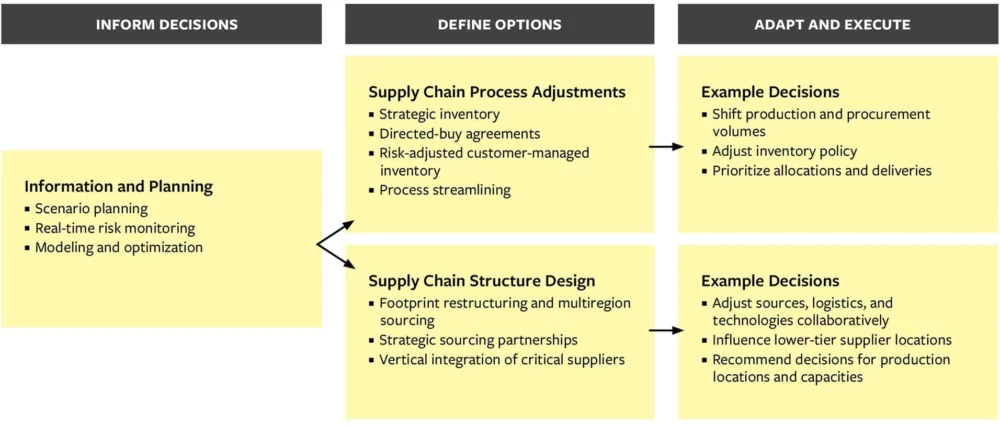
To navigate this constantly shifting terrain, a three-pronged strategic framework is emerging as a critical guide for executive teams. The first pillar focuses on understanding and continuous monitoring of geopolitical signals. This involves moving beyond superficial news monitoring to deep-dive scenario planning that incorporates a diverse range of potential future states, from escalating trade wars and regional protectionism to cyber warfare and critical infrastructure attacks. These scenarios must be dynamic, regularly updated with inputs from geopolitical intelligence firms, economic forecasts, diplomatic analyses, and even predictive AI models. Companies are increasingly investing in dedicated geopolitical intelligence units or subscribing to specialized services that provide early warning indicators and nuanced interpretations of global events. For example, understanding the political rhetoric surrounding critical minerals in Africa or shifts in maritime security in key shipping lanes can provide crucial lead time for strategic adjustments. This proactive intelligence gathering, coupled with robust risk mapping that identifies specific operational touchpoints vulnerable to identified scenarios, enables organizations to move from reactive crisis management to anticipatory strategic planning.

The second pillar emphasizes anticipating risks by proactively creating flexible options within the supply chain. This constitutes a significant departure from the "just-in-time" dogma that dominated supply chain optimization for decades. Instead, businesses are now embracing strategies such as multi-sourcing, geographical diversification, and the establishment of strategic buffer stocks for critical components. For instance, the semiconductor industry, severely impacted by geopolitical tensions and single-point failures, is seeing massive investments in new fabrication plants across multiple continents, driven by both corporate strategy and government incentives. Diversification extends beyond suppliers to manufacturing locations, logistics routes, and even technology platforms, reducing reliance on any single country, region, or vendor susceptible to political interference. Companies are also exploring "friend-shoring" or "near-shoring" initiatives, relocating production closer to end markets or to politically aligned nations, balancing the higher operational costs against enhanced security and reduced lead times. This strategic optionality is not merely about having backup plans but about embedding inherent resilience into the very design of the supply chain, ensuring that alternative pathways and resources are readily available before a crisis materializes.
Finally, the third pillar centers on developing the organizational agility to adapt quickly when disruptions inevitably occur. This requires more than just crisis management protocols; it demands a culture of rapid decision-making, empowered cross-functional teams, and dynamic operational reconfigurations. When faced with sudden sanctions, port closures, or export bans, companies must be able to pivot swiftly, reroute shipments, activate alternative manufacturing sites, and adjust procurement strategies in real-time. This adaptability is heavily supported by advanced digital platforms that provide real-time visibility into inventory levels, logistics movements, and production capacities across the entire network. Machine learning algorithms can help optimize new routes, identify alternative suppliers, and even predict potential new disruptions based on evolving geopolitical data. Furthermore, legal and compliance teams must possess an acute understanding of international trade law, sanctions regimes, and export controls, enabling them to navigate complex regulatory environments with speed and precision. Post-disruption, a continuous learning loop is essential, where lessons learned from each event feed back into the scenario planning and strategic preparedness phases, refining the framework for future challenges.
The economic implications of neglecting geopolitical supply chain risks are profound. Beyond direct operational costs and lost revenue, companies face reputational damage, erosion of market share, and long-term erosion of investor confidence. Conversely, those that successfully build resilience can transform it into a competitive advantage, attracting customers and partners who value stability and reliability. Governments are also playing an increasingly active role, implementing industrial policies, offering subsidies for strategic industries, and establishing national reserves of critical materials, further shaping the landscape for corporate supply chain decisions. The global move towards decarbonization, for instance, introduces new geopolitical considerations around the sourcing of rare earth metals and other critical minerals essential for renewable energy technologies, creating new flashpoints for competition and potential disruption.
In conclusion, the era of stable, purely efficiency-driven global supply chains is largely over. The persistent and unpredictable nature of geopolitical events necessitates a fundamental re-engineering of how businesses operate on a global scale. Investing in robust intelligence gathering, building strategic optionality, and fostering organizational agility are no longer optional extras but core competencies for survival and growth in a fragmented world. As global interconnectedness continues to evolve amidst shifting power dynamics and ideological divides, the ability to anticipate, withstand, and rapidly recover from geopolitical shocks will define the leaders of tomorrow’s international economy.