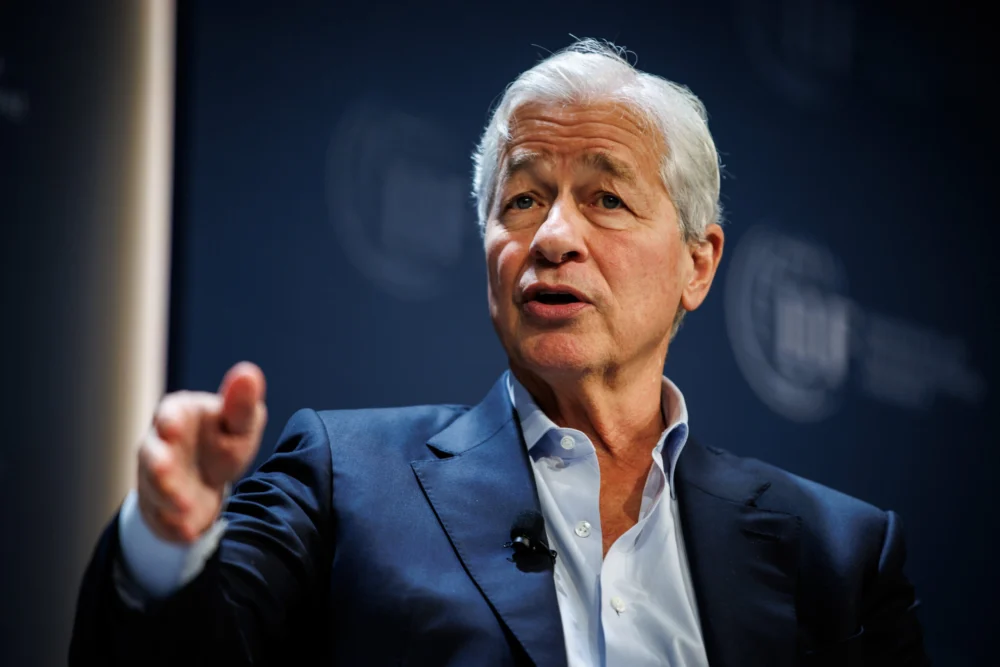
In the rarefied air of the World Economic Forum in Davos, Switzerland, where the global elite typically exchange pleasantries and vague commitments to sustainability, Jamie Dimon, the Chairman and CEO of JPMorgan Chase, delivered a sharp departure from the prevailing corporate reticence. As the leader of the world’s largest bank by market capitalization, Dimon’s words carry the weight of global capital markets, and his recent critique of President Donald Trump’s domestic immigration enforcement signals a potential fracture between the American business establishment and the White House’s most aggressive social policies. While Dimon has historically been a pragmatic voice on fiscal policy, his public condemnation of the methods employed by U.S. Immigration and Customs Enforcement (ICE) highlights a growing tension between the administration’s nationalist agenda and the labor needs of a $27 trillion economy.
The veteran banker’s comments were not a wholesale rejection of border security. In fact, Dimon began his remarks on Wednesday by acknowledging the administration’s success in fortifying the U.S.-Mexico border. Recent federal data suggests that illegal crossings fell to their lowest level in half a century between October 2024 and September 2025. This achievement, a cornerstone of the Trump administration’s second-term mandate, was one Dimon explicitly praised as a necessary step for national sovereignty. However, the CEO’s tone shifted dramatically when the conversation turned to internal enforcement and the optics of mass deportation.
Dimon’s criticism centered on the visceral reality of ICE operations that have become increasingly common in the interior of the United States. He alluded to reports and footage of aggressive raids, stating, "I don’t like what I’m seeing, with five grown men beating up little women." While he did not specify a single event, his remarks reflect a broader concern regarding the "internal anger" and the lack of distinction between violent criminals and the essential labor force that underpins critical sectors of the American economy. "We should calm down a little bit," Dimon urged, calling for a more measured and humane approach to a crisis that he views through both a moral and a macroeconomic lens.
From a purely economic standpoint, Dimon’s position is rooted in the demographic realities facing the United States. For years, in his annual letters to JPMorgan shareholders—widely read as a "state of the union" for global finance—Dimon has argued that a comprehensive immigration overhaul is one of the most effective levers for unlocking higher GDP growth. The U.S. labor market is currently navigating a complex period of transition; while unemployment remains low by historical standards, specific sectors are facing chronic shortages. Dimon noted that immigrants are the backbone of the American service and production sectors, stating, "We need these people. They work in our hospitals and hotels and restaurants and agriculture, and they’re good people. They should be treated that way."

The economic impact of a sudden contraction in the immigrant workforce could be severe. According to data from the American Immigration Council, undocumented workers contribute billions of dollars in federal, state, and local taxes annually. Furthermore, industries such as agriculture and construction, which rely heavily on immigrant labor, face immediate inflationary pressures when that labor pool is restricted. If mass deportations continue at the scale proposed by the current administration, economists warn of supply chain disruptions and a "labor shock" that could stall the post-pandemic recovery. Dimon’s intervention at Davos serves as a reminder that the "America First" policy must be balanced against the "America Productive" necessity.
The dialogue at Davos also touched upon the "climate of fear" currently pervading the American C-suite. Zanny Minton Beddoes, Editor-in-Chief of The Economist, challenged Dimon on why more business leaders haven’t spoken out against the administration’s more controversial tactics. Unlike the first Trump term, where CEOs frequently resigned from advisory boards in protest, the second term has seen a more cautious corporate world. Analysts suggest this is due to a fear of regulatory or legal retribution. The administration has shown a willingness to utilize the Department of Justice and other federal levers to challenge institutions—ranging from media conglomerates to law firms—that oppose its agenda.
Dimon, however, pushed back against the notion that he was being overly cautious. He argued that he has been consistent in his critiques of tariffs, foreign policy shifts regarding European allies, and immigration reform. "I’ve said it. What the hell else do you want me to say?" he retorted, signaling a frustration with the expectation that CEOs should act as the primary moral arbiters of the nation. Yet, by being one of the few to speak out, Dimon has effectively become the spokesperson for a business community that is privately terrified of the economic consequences of mass deportations but publicly silent.
The shift in U.S. immigration policy under the second Trump administration has been profound. Beyond border security, the administration has rescinded "sensitive location" guidance, which previously restricted ICE arrests at schools, hospitals, and places of worship. This policy shift has led to raids in communities that were once considered off-limits, creating the very imagery that Dimon found so distasteful. Additionally, the administration has moved to tighten access to asylum and has significantly increased funding for detention facilities, signaling a long-term commitment to a "zero-tolerance" internal enforcement strategy.
Dimon’s proposed alternative is a return to a merit-based system that prioritizes economic contribution while maintaining a path to legal status for those already integrated into the American fabric. He has long advocated for the protection of "Dreamers"—individuals brought to the U.S. as children—and has pushed for the expansion of H-1B visas for high-skilled workers. This dual approach—securing the border while facilitating legal, high-value immigration—is seen by many on Wall Street as the only sustainable path forward. The CEO specifically urged the President to use his newfound control of the border as political capital to pass meaningful reform for "hardworking people."

The global context of this debate cannot be ignored. As the U.S. adopts a more isolationist and restrictive stance, other developed nations are competing for the same talent. Countries like Canada, Australia, and members of the European Union have introduced more flexible visa regimes to combat their own aging demographics. If the U.S. becomes perceived as a hostile environment for immigrants—not just at the border, but within its cities—it risks losing its status as the world’s premier destination for global talent. Dimon’s concern about "five grown men" is not just about the morality of the act; it is about the "brand of America" and its ability to attract the human capital required to lead in the 21st century.
As the World Economic Forum concludes, Dimon’s remarks remain the most significant takeaway for those tracking the intersection of politics and finance. The JPMorgan CEO is betting that the administration will eventually recognize the economic ceiling created by a purely punitive immigration policy. Whether other CEOs will find the courage to join his chorus remains to be seen. For now, Dimon stands as a rare bridge between the boardroom and the front lines of a national crisis, arguing that a nation’s strength is measured not just by the height of its walls, but by the dignity it affords those who help build its future.
The coming months will likely see a heightening of this conflict as the administration’s deportation efforts ramp up. If the visual and social costs continue to mount, the "climate of fear" in the corporate world may eventually be eclipsed by the "climate of necessity." For Jamie Dimon, the message is clear: border security is a prerequisite, but the internal "anger" and aggressive enforcement currently on display are anathema to the American dream and, perhaps more importantly for Davos, the American economy. The challenge for the Trump administration will be to see if it can pivot from enforcement to evolution, or if it will continue on a path that its most prominent financial ally warns is fundamentally unsustainable.