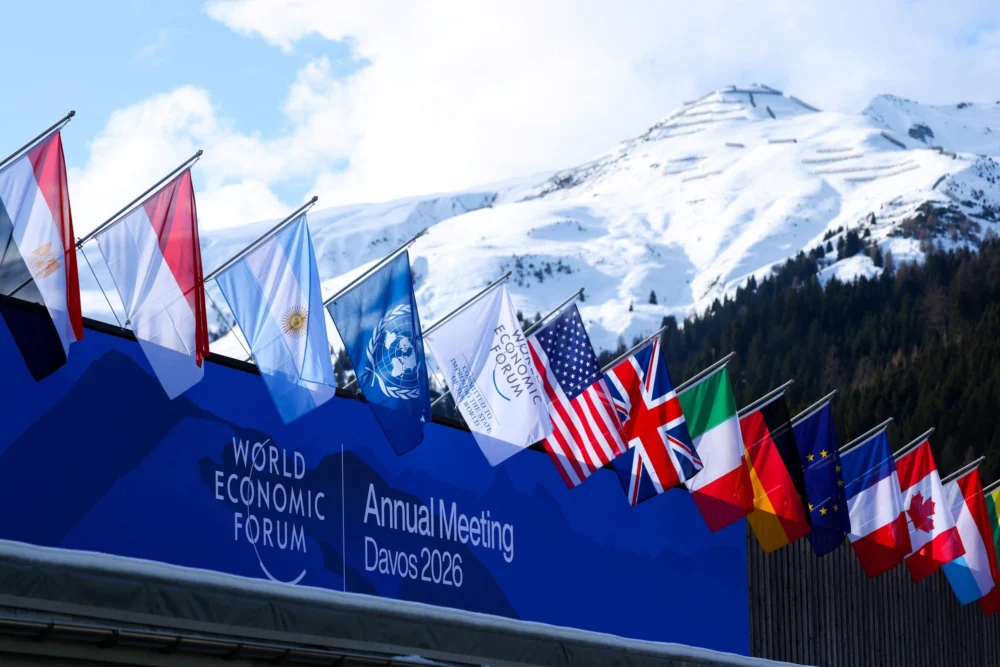
As the dust settles on the 56th annual meeting of the World Economic Forum in Davos, the traditional hierarchy of global influence appears to be undergoing a fundamental recalibration. While the snow-capped peaks of the Swiss Alps typically serve as a stage for the world’s most vocal proponents of the liberal international order, the 2026 summit was defined less by the high-decibel rhetoric of Western leaders and more by the quiet, methodical presence of Beijing. Despite a deliberate attempt to maintain a low profile, China emerged as the inescapable "elephant in the room," positioning itself as a bastion of predictability against a backdrop of increasing Western volatility and protectionist fervor.
The divergence in diplomatic styles was stark. While U.S. President Donald Trump dominated news cycles with unconventional claims regarding Greenland and pointed critiques of European allies, China’s delegation, led by Vice Premier He Lifeng, adhered to a script of cooperation and economic integration. This juxtaposition has led many analysts to view the current period as a "watershed moment" in international relations. The narrative is shifting from a global economy centered on Washington to a multipolar landscape defined by regional trade blocs and a resurgence of Eastern manufacturing dominance.
Beijing’s strategy at Davos was one of strategic patience. He Lifeng, a key architect of China’s economic policy, utilized his platform to promote domestic business opportunities and advocate for the equitable treatment of Chinese enterprises abroad. By framing U.S.-China trade discussions as a model for pragmatic cooperation—despite the underlying tensions—Beijing sought to present itself as the "adult in the room." This messaging resonates particularly well with middle-market powers and European nations that find themselves increasingly caught in the crossfire of transatlantic disputes.
The economic reality underpinning China’s diplomatic confidence is its unrivaled grip on global supply chains. Despite years of rhetoric regarding "de-risking" and "de-coupling," the data suggests that the world’s reliance on Chinese industry is deepening rather than diminishing. In the first three quarters of last year, China’s share of global container shipments climbed to a staggering 37%. This concentration of productive capacity creates a significant "manufacturing moat" that limits the leverage of Western nations. As global trade shifts, many observers note that so long as Beijing dominates the physical production of goods, the ability of other nations to impose unilateral economic will remains severely constrained.

The geopolitical vacuum created by fluctuating U.S. foreign policy has provided Beijing with a rare opening to repair and strengthen its ties with the European Union and other Western-aligned states. The recent controversy surrounding U.S. interests in Greenland, which sparked friction with Denmark and the broader EU, served as a catalyst for this shift. For many European policymakers, the erratic nature of current U.S. diplomacy reinforces the argument for "strategic autonomy"—a concept that frequently involves maintaining robust economic ties with China as a hedge against American protectionism.
This realignment is already visible in the diplomatic calendar. January 2026 saw a flurry of high-level visits to Beijing, marking a definitive end to the isolation of the pandemic era. President Xi Jinping hosted leaders from Ireland and South Korea, while Canadian Prime Minister Mark Carney engaged in a high-stakes visit that resulted in new strategic partnerships involving electric vehicles and agricultural exports. Even the United Kingdom, under Prime Minister Keir Starmer, is signaling a pragmatic pivot toward renewed engagement with the world’s second-largest economy. These interactions suggest that while political rhetoric in the West may remain hawkish, the economic gravity of the Chinese market continues to pull global leaders toward the East.
However, China’s path to global leadership is not without significant internal obstacles. The "state-dominated" nature of its economy faces a persistent challenge: sluggish domestic consumption. In December, retail sales growth slowed to a mere 0.9%, the most tepid pace since the height of the pandemic. While Beijing has prioritized boosting domestic demand and increasing disposable income, specific policy measures to achieve these goals remain elusive. The transition from an investment-led growth model to a consumption-led one is proving to be a slow and arduous process, complicated by a cooling property market and demographic headwinds.
Despite these domestic pressures, the international appetite for Chinese engagement remains high, particularly among non-American Western brands. Many companies are looking to diversify their international sales by expanding their footprint in China to offset potential losses from U.S. tariffs. Categories such as health supplements, pet care, and high-end sports equipment continue to see robust interest from Chinese consumers, who remain willing to spend on premium foreign goods even as the broader economy cools. This creates a paradoxical situation where Western businesses are deepening their ties with China even as their home governments move toward trade restrictions.
The friction between the U.S. and China remains the primary fault line in the global economy. Although a fragile one-year truce was reached in October, the structural issues—ranging from high tariffs to restricted access to advanced semiconductors—persist. The U.S. continues to view China’s technological ascent as a direct threat to its national security, while Beijing views American export controls as a containment strategy designed to thwart its rightful development. This "silicon curtain" is forcing third-party nations to choose between American technology and Chinese markets, a choice that many are increasingly reluctant to make.

The changing nature of global influence was perhaps best encapsulated by Larry Fink, CEO of BlackRock and a co-chair of this year’s Davos forum. Fink suggested that the World Economic Forum itself might need to evolve, moving away from its traditional Alpine home to cities like Jakarta, Dublin, or Buenos Aires. This decentralization reflects a broader recognition that the "mountain" of Western institutional power must eventually come down to earth to meet the rising influence of the Global South and the East.
China has already anticipated this shift, hosting its own "Summer Davos" in Dalian, an event that has increasingly tilted away from Western-centric agendas toward a more inclusive, regional focus. This alternative forum serves as a laboratory for a new world order—one where the rules of trade and diplomacy are not dictated solely by the G7, but are negotiated across a broader spectrum of emerging economies.
Even within the U.S. delegation, there were flashes of a more nuanced approach. In his high-profile address, President Trump softened his tone toward President Xi, describing him as a "highly respected" leader and acknowledging the "amazing" things China has achieved. This rhetorical flexibility suggests that while the U.S. may pursue aggressive tariff policies, it also recognizes the necessity of maintaining a working relationship with Beijing to prevent a total collapse of global stability.
Ultimately, the 2026 Davos meeting may be remembered as the moment the "unipolar moment" officially gave way to a fragmented, yet interconnected, reality. China’s strategy of remaining the "stabilizing force" in a sea of Western political volatility is gaining traction. By focusing on consistent messaging, manufacturing dominance, and targeted diplomacy, Beijing is positioning itself not just as a participant in the global order, but as a primary architect of its future. The world is witnessing a structural shift where the centers of power are no longer confined to traditional Western capitals, and China, through its strategic silence and economic weight, is ensuring it remains the pivot point of this new era.