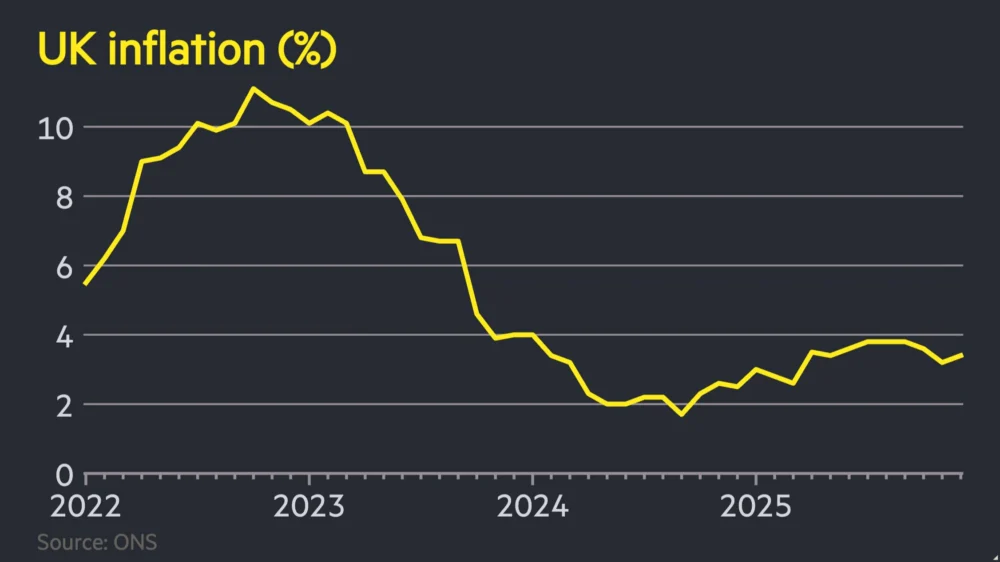
The British economy faced a sobering reality check as the latest data from the Office for National Statistics (ONS) revealed an unexpected acceleration in consumer prices, with the headline inflation rate climbing to 3.4% in December. This uptick, which defied consensus forecasts from City economists and the Bank of England’s own projections, marks a significant disruption in the disinflationary trend that had characterized much of the previous quarter. The surprise increase has sent ripples through financial markets, tempering expectations for an early pivot toward interest rate cuts and reigniting a fierce debate over the "stickiness" of price pressures within the United Kingdom’s unique economic landscape.
The transition from November to December saw a confluence of factors drive the Consumer Prices Index (CPI) higher. Chief among these was a sharp increase in tobacco duties, following the Chancellor’s Autumn Statement, which added immediate upward pressure to the non-discretionary spending category. However, beneath the volatile components of food and energy, policymakers are increasingly concerned by the resilience of services inflation. This metric, which serves as a proxy for domestic price pressure and wage-push dynamics, remains stubbornly elevated. For the Bank of England (BoE), the services sector is the ultimate barometer of whether inflation is truly being tamed or merely temporarily suppressed by falling global commodity prices.
The December figures represent a pivotal moment for the Monetary Policy Committee (MPC). For months, Governor Andrew Bailey and his colleagues have maintained a "higher-for-longer" rhetoric, cautioning that the final mile of the journey to the 2% inflation target would be the most arduous. This latest data validates that caution. While inflation has retreated significantly from its double-digit peaks in 2022, the move to 3.4% suggests that the UK remains an outlier among its G7 peers. In comparison, while the United States and the Eurozone have also experienced bumps in their disinflationary paths, the UK’s labor market tightness and its historical sensitivity to energy price shocks continue to provide a more volatile backdrop for monetary policy.
Market reactions to the announcement were swift and reflected a recalibration of risk. Gilt yields, which track expectations for future interest rates, edged higher as traders moved to price out the probability of a rate cut in the first half of the year. Sterling saw a modest appreciation against both the Dollar and the Euro, a typical response to the prospect of sustained high interest rates, yet the currency’s gains were capped by underlying fears regarding the UK’s growth prospects. The central bank now finds itself in a precarious "stagflationary" bind: it must keep rates high enough to choke off persistent inflation, yet every month that the base rate remains at 5.25%, the risk of a technical recession deepens.
The structural drivers of this inflation surprise are multifaceted. Beyond the immediate impact of tobacco and alcohol taxes, the UK continues to grapple with the long-term consequences of a shrinking workforce and the post-Brexit reconfiguration of trade routes. Labor shortages in key sectors—ranging from hospitality to high-tech manufacturing—have forced employers to offer higher nominal wages to retain staff. While wage growth has begun to cool from its record highs, it still outpaces the productivity gains necessary to keep inflation in check. This "wage-price" feedback loop remains the primary nightmare for the MPC, as it threatens to embed inflation expectations into the psyche of both businesses and consumers.
Furthermore, the external environment has become increasingly unpredictable. Disruptions to shipping in the Red Sea have raised the specter of renewed supply chain costs, threatening to reverse the progress made in lowering goods inflation. For a nation that imports a significant portion of its food and energy, these geopolitical tremors act as a constant headwind. The December rise to 3.4% may be a harbinger of more volatility to come if freight insurance premiums and fuel surcharges begin to filter through to the high street in the coming months.
The impact of this inflationary resilience is perhaps most acutely felt by British households, many of whom are currently navigating the "mortgage cliff." As hundreds of thousands of homeowners transition from low-fixed-rate deals to current market rates, the erosion of disposable income is profound. The hope that the Bank of England would provide relief via a spring rate cut has been dampened by the December data. For the average consumer, the "cost of living crisis" is not a historical event but a continuing reality, as the prices of essential services—insurance, telecommunications, and household maintenance—continue to rise at rates well above the headline average.
From a fiscal perspective, the inflation surprise poses a challenge for the government as it prepares for an upcoming general election. Prime Minister Rishi Sunak had previously made halving inflation one of his five key pledges. While the rate is substantially lower than it was when the pledge was made, the move back up to 3.4% complicates the narrative of economic stability. It also limits the Chancellor’s "fiscal headroom." With inflation-linked debt interest payments remaining high, the government’s ability to implement significant tax cuts in the spring budget may be constrained if the Bank of England is forced to keep monetary conditions tight to counteract fiscal loosening.
Economists at major investment banks have begun to adjust their 2024 outlooks in light of the ONS report. Some analysts suggest that the UK is experiencing a "second wave" of inflation, driven by the delayed pass-through of previous costs and the synchronization of annual price hikes across the service industry. Others argue that the December rise is a statistical "blip" caused by the timing of government tax changes and that the broader trend remains downward. However, the consensus is shifting toward the view that the BoE will require several more months of cooling data before it feels confident enough to signal a change in direction.
The global context provides a stark contrast. In the United States, the Federal Reserve has signaled that it is at the peak of its tightening cycle, with discussions shifting toward the timing of the first cut. Similarly, the European Central Bank is monitoring a faster-than-expected decline in price pressures across the Continent. The UK’s divergence from these trends underscores the specific vulnerabilities of its economy, including a heavy reliance on natural gas and a particularly acute labor supply shock. This "British exceptionalism" in inflation metrics is likely to keep the Pound under scrutiny and maintain pressure on the BoE to avoid a premature easing that could lead to a policy error.
Looking ahead, the first quarter of the new year will be critical. The MPC will be looking for a decisive slowdown in private sector wage settlements and a moderation in the "core" inflation rate, which excludes volatile food and energy prices. If these metrics do not show improvement, the prospect of interest rates remaining at 5.25% through the summer becomes increasingly likely. The central bank’s task is akin to a high-wire act: balancing the need to restore price stability with the imperative to avoid a deep economic contraction.
Ultimately, the rise in UK inflation to 3.4% in December serves as a reminder that the post-pandemic economic recovery is far from linear. The road to 2% is paved with structural hurdles that cannot be cleared by monetary policy alone. As the nation moves deeper into an election year, the intersection of sticky inflation, stagnant growth, and high borrowing costs will remain the central theme of the British economic narrative. For now, the "pivot" to lower rates remains a distant prospect, as the Bank of England waits for more definitive evidence that the inflationary fire has truly been extinguished.