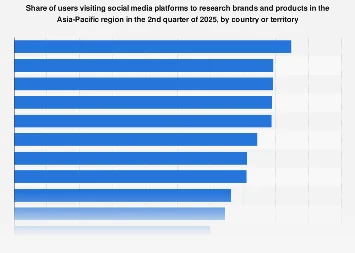
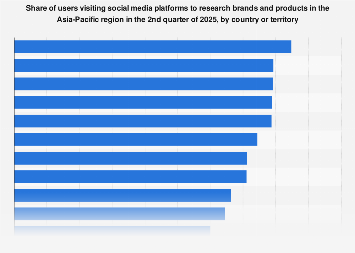
In the rapidly evolving digital landscape of the Asia-Pacific (APAC) region, social media platforms are no longer just avenues for connection and entertainment; they have cemented their position as primary hubs for consumer brand research. By the second quarter of 2025, a significant majority of internet users across numerous APAC territories are projected to leverage these platforms to inform their purchasing decisions, a trend that underscores a profound shift in how consumers discover and evaluate products and services. This burgeoning reliance on social media for pre-purchase intelligence highlights the imperative for brands to cultivate a robust and authentic online presence to capture the attention and trust of this increasingly digitally-native consumer base.
Data compiled for the period of April through June 2025 reveals a varied but uniformly high engagement with social media for brand research purposes across the diverse economic and cultural tapestry of the APAC region. While specific figures vary from country to country, the overarching trend points towards a dominant role for platforms like Facebook, Instagram, TikTok, and others in shaping consumer journeys. This phenomenon is not merely a reflection of increased internet penetration but a testament to the evolving functionality and perceived trustworthiness of social media as an information source. Consumers are increasingly turning to peer reviews, influencer endorsements, and brand-generated content shared on these platforms, seeking authentic insights and social proof before committing to a purchase.
At the upper echelons of this trend, Vietnam is anticipated to lead the charge, with a substantial percentage of its internet users actively engaging in brand research on social media. This high adoption rate suggests a consumer population that is highly receptive to digital marketing and peer recommendations, potentially driven by a youthful demographic eager to explore new products and trends. The vibrant digital ecosystem in Vietnam, characterized by a burgeoning e-commerce sector and high mobile usage, provides fertile ground for social media to become an indispensable tool for consumer decision-making. Brands operating in or targeting Vietnam must prioritize strategies that leverage user-generated content, influencer collaborations, and interactive brand experiences to resonate with this proactive consumer segment.
In stark contrast, Japan, a market known for its mature and discerning consumer base, exhibits a comparatively lower, yet still significant, proportion of users turning to social media for brand research. This divergence can be attributed to several factors, including Japan’s historically strong reliance on traditional retail channels, established product review sites, and a cultural inclination towards in-depth, often offline, product evaluation. While social media’s influence is undoubtedly growing in Japan, it may function more as a supplementary research tool rather than the primary one, with consumers likely cross-referencing information from social channels with more traditional sources. Nevertheless, even a smaller percentage in a market as large as Japan represents a substantial audience, indicating that brands cannot afford to overlook the digital sphere.
The underlying drivers of this widespread social media adoption for brand research are multifaceted. Firstly, the proliferation of smartphones and affordable mobile data plans has democratized internet access across the APAC region, bringing billions of consumers online. Secondly, social media platforms have evolved beyond simple social networking, integrating sophisticated e-commerce features, live shopping capabilities, and advanced search functionalities that make product discovery and research seamless. Thirdly, the rise of social commerce, where consumers can purchase products directly within social media applications, further blurs the lines between research and transaction, incentivizing users to spend more time exploring brands on these platforms.
From an economic perspective, this shift has profound implications for businesses. Brands that fail to establish a compelling presence on social media risk becoming invisible to a significant portion of their target audience. This necessitates a strategic allocation of marketing budgets towards digital channels, with a focus on creating engaging, informative, and authentic content. The ability to foster community, respond to customer inquiries in real-time, and manage online reputation becomes paramount. Furthermore, the data generated by social media interactions offers invaluable insights into consumer preferences, market trends, and competitive landscapes, enabling businesses to refine their product development, marketing strategies, and customer service efforts.
The varying levels of social media engagement for brand research across APAC also present opportunities for nuanced market strategies. For instance, in emerging markets with rapidly growing digital populations, a strong social media push can be instrumental in establishing brand awareness and market share from the ground up. Conversely, in more developed markets, a sophisticated approach that integrates social media with other marketing channels, emphasizing authenticity and value-driven content, might be more effective. Understanding the specific digital behavior and cultural context of each market is crucial for optimizing campaign performance and return on investment.
Beyond direct consumer engagement, the influence of social media extends to shaping brand perception and building loyalty. Positive reviews, shared experiences, and engaging content can create a sense of trust and connection that transcends transactional relationships. Conversely, negative feedback or poorly managed online crises can spread rapidly, significantly impacting a brand’s reputation and sales. Therefore, proactive social media management, including sentiment analysis and crisis communication protocols, is no longer an option but a necessity for businesses operating in the APAC region.
The projected data for Q2 2025 also signals a growing importance of influencer marketing within the APAC region. Consumers often trust recommendations from individuals they follow and admire, making influencers powerful conduits for brand messaging. Brands are increasingly partnering with micro and macro-influencers to reach niche audiences and build credibility. This trend is particularly pronounced in fashion, beauty, travel, and technology sectors, where visual content and personal endorsements play a significant role in purchase decisions.
Looking ahead, the trajectory of social media’s role in brand research is likely to continue its upward climb. As platforms introduce more advanced AI-driven personalization, augmented reality shopping experiences, and immersive content formats, the appeal and utility of social media for consumers will only deepen. Businesses that embrace this evolving digital paradigm, investing in authentic engagement, data-driven insights, and agile marketing strategies, will be best positioned to thrive in the dynamic and increasingly interconnected Asia-Pacific marketplace. The era of passive product discovery is giving way to an active, social-driven consumer journey, and the brands that understand and adapt to this fundamental shift will undoubtedly lead the way.