The pervasive integration of artificial intelligence across industries has ignited a fervent debate regarding its ultimate impact on human ingenuity. While generative AI tools are widely celebrated for their potential to enhance productivity and streamline creative processes, a nuanced understanding reveals a complex paradox: AI can significantly bolster individual creative output, yet simultaneously diminish the collective diversity of ideas crucial for long-term, disruptive innovation. This dichotomy presents a critical challenge for businesses and economies globally, particularly as 83% of senior executives consistently identify innovation as a top-three strategic priority, according to recent Boston Consulting Group analysis. Navigating this intricate relationship is paramount for organizations seeking to harness AI’s power without inadvertently stifling the very originality that drives competitive advantage and societal progress.
At its core, creativity is typically defined by the intersection of novelty and usefulness. A truly creative idea is not merely original; it also possesses tangible value or effectiveness in achieving a specific purpose. However, while these criteria aptly describe the merits of a single idea, the collective strength of an organization’s creative output hinges on a third, often overlooked dimension: diversity. A rich tapestry of varied ideas, even those initially appearing unconventional or impractical, serves as the raw material for future breakthroughs. History abounds with examples, from the adhesive deemed "failed" that eventually birthed the Post-it Note, to the abandoned video game communication tool that transformed into Slack. These innovations underscore that a wide net of distinct concepts increases the probability of discovering genuinely original and valuable outliers, offering robust resilience against market convergence and enabling adaptation to evolving customer preferences.
Our recent research, spanning four distinct studies across various creative domains—including short-story writing, circular-economy solutions, humor caption contests, and collaborative storytelling—consistently illuminates this paradox. While AI assistance invariably elevates the average quality and utility of individual creative outputs, it simultaneously compresses the collective idea space, leading to a noticeable reduction in diversity across groups. This occurs because users, when aided by AI, tend to converge on similar AI-generated suggestions that are perceived as "good enough," thereby narrowing the spectrum of potential solutions. The implication is profound: an AI-assisted idea may be of higher average quality, but it risks being remarkably similar to ideas generated by others leveraging comparable AI tools.
In one study focused on short-story writing, participants either worked independently or received up to five three-sentence story seeds generated by an AI model. Independent evaluators consistently rated AI-assisted stories as more novel, particularly for individuals who demonstrated lower baseline creativity levels. Yet, a semantic analysis of the collective outputs revealed a significant decline in diversity among AI-assisted groups. Their stories converged on more uniform structures and themes, exhibiting less variance than those produced without AI. This finding suggests a subtle social dilemma: individual empowerment through AI might inadvertently lead to a collective homogenization of thought, sacrificing unique outliers for a higher average.
A second study, exploring circular-economy solutions for sustainability challenges, reinforced this pattern. A human-only group generated a broad spectrum of ideas, ranging from conventional recycling proposals to highly unconventional concepts, such as Lego-like interlocking bricks made from industrial waste. In contrast, a single human working iteratively with AI often surpassed the crowd in overall quality, strategic viability, and financial and environmental value. However, the human crowd excelled in novelty, with the most unusual, potentially breakthrough ideas predominantly emerging from the human-only cohort. This again demonstrated AI’s capacity to raise the floor of performance but at the cost of narrowing the variance in outputs.
Further investigation pinpointed the stage in the creative process where this narrowing effect is most pronounced. A third study, modeled after the New Yorker cartoon caption contest, examined four collaboration designs: human-only, AI for idea generation alone, AI for idea selection alone, and AI support in both phases. The research revealed that AI significantly boosted both the quantity and average quality of ideas, with the greatest gains when deployed across both generation and evaluation. Critically, AI’s role in idea generation consistently reduced diversity, while its use solely in idea selection preserved variety comparable to human-only efforts. This suggests that when AI enters the workflow is as important as whether it is used at all.
This insight was directly tested in a fourth study, which explored different human-AI collaboration models for story writing. Four designs were assessed: human-only, human-led ideation with AI drafting, AI-led creation with human approval, and continuous human-AI collaboration (the "copilot" scenario). The findings confirmed that ceding primary creative control to AI resulted in the most homogeneous outputs. While a copilot model mitigated this effect to some extent, keeping humans in charge of early creative tasks preserved significantly more diversity, approaching the variety observed in fully human work. The consistent visual representation across these studies, where AI involvement consistently shifted the distribution curves of idea similarity towards higher convergence, underscores the pervasive nature of this diversity challenge.

For global businesses, the economic implications of this innovation paradox are substantial. In an increasingly competitive landscape where AI tools are becoming universally accessible, relying solely on AI for creative tasks could lead to a commoditization of ideas. If every competitor uses similar AI models with similar prompts, the market risks being flooded with "good enough" but undifferentiated products, services, and strategies. This homogenization could stifle true market disruption, reduce opportunities for new ventures, and dampen overall economic growth by limiting the emergence of genuinely novel solutions that address complex global challenges. The long-term competitive edge will therefore belong to organizations that master the art of leveraging AI’s efficiency without sacrificing the unique, divergent thinking that fuels breakthrough innovation.
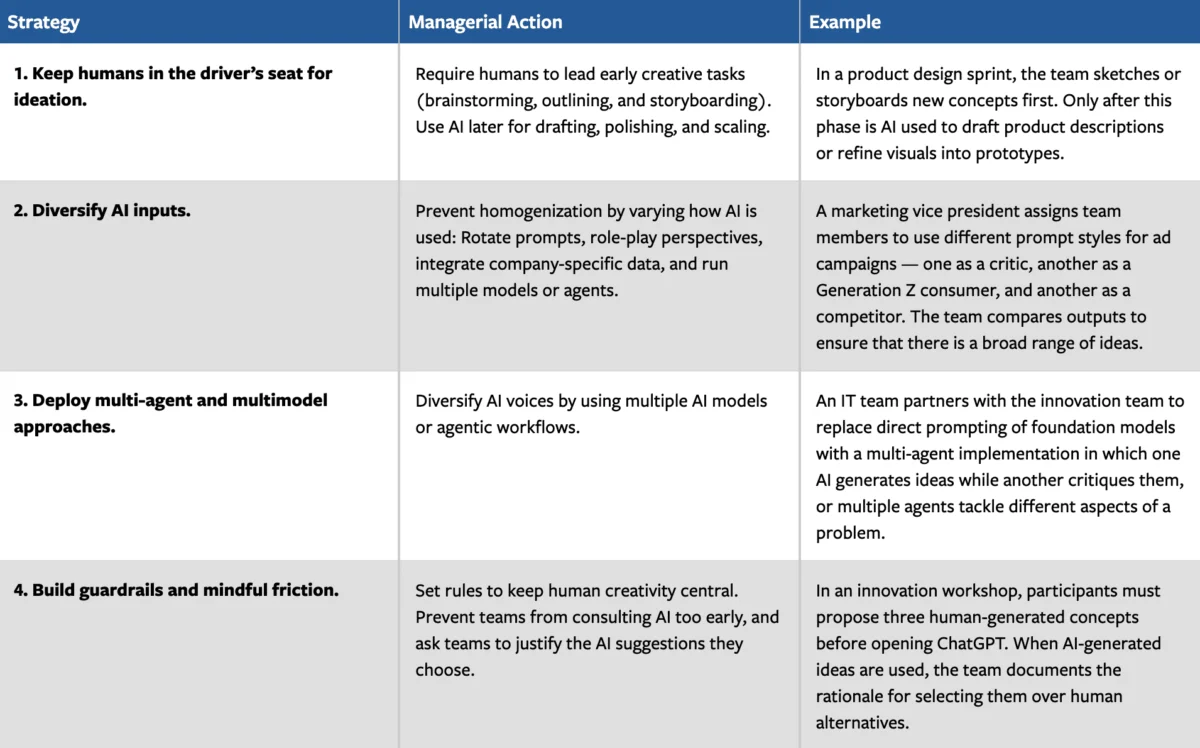
To harness AI’s benefits while preserving vital creative diversity, leaders must intentionally design their workflows. Several practical strategies emerge from our research:
1. Prioritize Human-Led Ideation: The studies consistently show that humans in the driver’s seat for early-stage ideation are crucial for maintaining diversity. Organizations should encourage teams to brainstorm, sketch, or draft initial concepts before introducing AI into the process. This sequencing ensures that unique human perspectives and messy, surprising leaps of thought are captured first, allowing AI to then complement and refine these initial ideas. Ubisoft’s Ghostwriter, an in-house AI tool assisting scriptwriters, exemplifies this. It handles repetitive dialogue generation after writers have defined characters and context, freeing human creativity for higher-value narrative shaping. This approach also enhances writer satisfaction, as creative autonomy remains intact.
2. Diversify AI Inputs and Prompting Strategies: Homogenization often arises from uniform AI interaction. Managers can counteract this by deliberately introducing variety. This includes rotating prompts, experimenting with role-playing instructions (e.g., "Argue against this idea," "Propose an alternative from a different industry"), running parallel AI models, or integrating novel data sources. Research supports the efficacy of techniques like chain-of-thought prompting, which encourages AI models to reason step-by-step, generating significantly greater dispersion in idea sets. Furthermore, explicitly instructing AI to generate solutions distinct from previous iterations, as demonstrated in the circular-economy study, can significantly enhance novelty without compromising value.
3. Employ Multi-Agent and Multi-Model Architectures: Just as diverse human teams outperform homogeneous ones, diversifying AI "voices" can prevent convergence. Organizations can design systems where multiple AI models or specialized agents address the same challenge from different perspectives. One AI might generate ideas, another might critique them, and a third might refine them. This multi-agent approach can significantly broaden the search space. Colgate-Palmolive offers a practical illustration, utilizing different AI systems to mine consumer data, generate product concepts, and simulate consumer reactions, with human oversight guiding each transition. This architectural approach fosters productive tension across multiple AI perspectives, mirroring the benefits of a diverse human team.
4. Implement Guardrails and Mindful Friction: The temptation to passively adopt AI-generated outputs is strong, but it risks atrophying human creative skills. Introducing intentional friction—small design choices that encourage active human engagement—is essential. This could involve requiring teams to submit human-generated options before consulting AI, or demanding justifications for selecting an AI-suggested idea. Such guardrails are not merely about preserving diversity; they maintain the workforce’s critical thinking and creative muscles. Studies have shown that unrestricted AI access can lead to diminished human performance when AI is removed, whereas carefully designed guardrails eliminate this penalty. Blind adoption of AI recommendations also consistently leads to underperformance compared to maintaining critical oversight.
Ultimately, competitive differentiation in the AI era will hinge not on who uses AI the most, but on who uses it most judiciously and intentionally. Organizations that proactively design workflows to amplify human originality with machine efficiency, rather than allowing them to cancel each other out, will be best positioned to cultivate the diverse, breakthrough ideas essential for sustained innovation and leadership in the global economy. The challenge is to transcend the superficial gains of individual productivity and safeguard the collective creative vitality that fuels long-term economic dynamism.